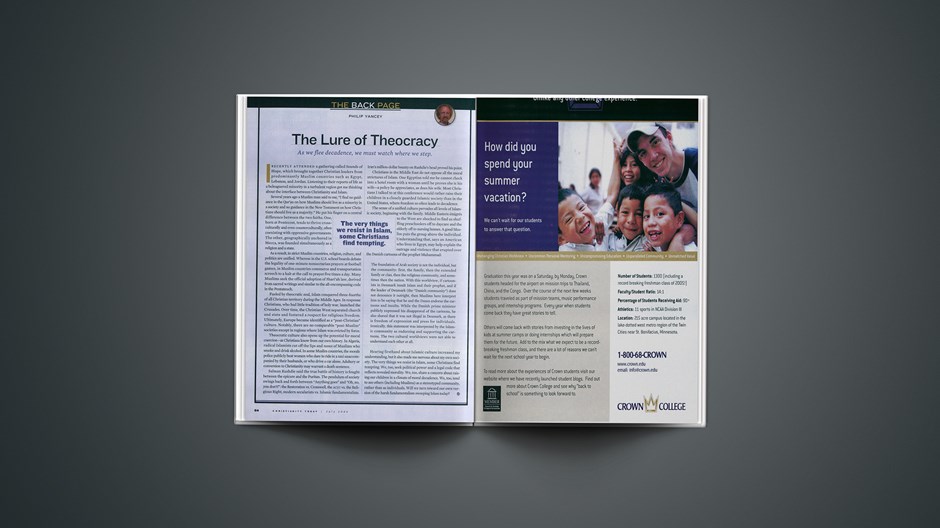
I recently attended a gathering called Sounds of Hope, which brought together Christian leaders from predominantly Muslim countries such as Egypt, Lebanon, and Jordan. Listening to their reports of life as a beleaguered minority in a turbulent region got me thinking about the interface between Christianity and Islam.
Several years ago a Muslim man said to me, "I find no guidance in the Qur'an on how Muslims should live as a minority in a society and no guidance in the New Testament on how Christians should live as a majority." He put his finger on a central difference between the two faiths. One, born at Pentecost, tends to thrive cross-culturally and even counterculturally, often coexisting with oppressive governments. The other, geographically anchored in Mecca, was founded simultaneously as a religion and a state.
As a result, in strict Muslim countries, religion, culture, and politics are unified. Whereas in the U.S. school boards debate the legality of one-minute nonsectarian prayers at football games, in Muslim countries commerce and transportation screech to a halt at the call to prayer five times a day. Many Muslims seek the official adoption of Shari'ah law, derived from sacred writings and similar to the all-encompassing code in the Pentateuch.
Fueled by theocratic zeal, Islam conquered three-fourths of all Christian territory during the Middle Ages. In response Christians, who had little tradition of holy war, launched the Crusades. Over time, the Christian West separated church and state and fostered a respect for religious freedom. Ultimately, Europe became identified as a "post-Christian" culture. Notably, there are no comparable "post-Muslim" societies except in regions where Islam was evicted by force.
Theocratic culture also opens up the potential for moral coercion—as Christians know from our own history. In Algeria, radical Islamists cut off the lips and noses of Muslims who smoke and drink alcohol. In some Muslim countries, the morals police publicly beat women who dare to ride in a taxi unaccompanied by their husbands, or who drive a car alone. Adultery or conversion to Christianity may warrant a death sentence.
Salman Rushdie said the true battle of history is fought between the epicure and the Puritan. The pendulum of society swings back and forth between "Anything goes" and "Oh, no, you don't!": the Restoration vs. Cromwell, the ACLU vs. the Religious Right, modern secularists vs. Islamic fundamentalists. Iran's million-dollar bounty on Rushdie's head proved his point.
Christians in the Middle East do not oppose all the moral strictures of Islam. One Egyptian told me he cannot check into a hotel room with a woman until he proves she is his wife—a policy he appreciates, as does his wife. Most Christians I talked to at this conference would rather raise their children in a closely guarded Islamic society than in the United States, where freedom so often leads to decadence.
The sense of a unified culture pervades all levels of Islamic society, beginning with the family. Middle Eastern émigrés to the West are shocked to find us shuffling preschoolers off to daycare and the elderly off to nursing homes. A good Muslim puts the group above the individual. Understanding that, says an American who lives in Egypt, may help explain the outrage and violence that erupted over the Danish cartoons of the prophet Muhammad:
The foundation of Arab society is not the individual, but the community: first, the family, then the extended family or clan, then the religious community, and sometimes then the nation. With this worldview, if cartoonists in Denmark insult Islam and their prophet, and if the leader of Denmark (the "Danish community") does not denounce it outright, then Muslims here interpret him to be saying that he and the Danes endorse the cartoons and insults. While the Danish prime minister publicly expressed his disapproval of the cartoons, he also shared that it was not illegal in Denmark, as there is freedom of expression and press for individuals. Ironically, this statement was interpreted by the Islamic community as endorsing and supporting the cartoons. The two cultural worldviews were not able to understand each other at all.
Hearing firsthand about Islamic culture increased my understanding, but it also made me nervous about my own society. The very things we resist in Islam, some Christians find tempting. We, too, seek political power and a legal code that reflects revealed morality. We, too, share a concern about raising our children in a climate of moral decadence. We, too, tend to see others (including Muslims) as a stereotyped community, rather than as individuals. Will we turn toward our own version of the harsh fundamentalism sweeping Islam today?
Philip Yancey is editor at large of Christianity Today and cochair of the editorial board for Books and Culture. Yancey's most recent book is What Good Is God?: In Search of a Faith That Matters. His other books include Prayer (2006), Rumors of Another World (2003), Reaching for the Invisible God (2000), The Bible Jesus Read (1999), What's So Amazing About Grace? (1998), The Jesus I Never Knew (1995), Where is God When It Hurts (1990), and many others. His Christianity Today column ran from 1985 to 2009.















 While we pray for peace, we need moral clarity about this war.
 As my doubts about his teachings grew, so did a secret fascination with Jesus.
 The Grammy-winning artist was found dead at her home in Nashville at age 47.






