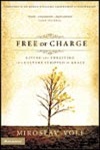
Miroslav Volf, the leading Protestant theologian of his generation, has written a book that might serve as a model for how to do "public theology"—a book that can be read with profit by any thoughtful Christian. Free of Charge: Giving and Forgiving in a Culture Stripped of Grace is a sustained examination of the scandalous truth at the heart of the gospel: "God's forgiveness is indiscriminate." We've become dulled to this truth, Volf observes. We need to recover it again and again.
Don't linger over the reference to a "culture stripped of grace" in the subtitle. That's one of the book's very few concessions to a marketing department's idea of relevance. Volf refers at the outset to "a larger pattern of what we may call the gracelessness that is slowly spreading like a disease through many of our cultures," but the specific example he gives—a rude American cop—will strike many readers as underwhelming, and he makes no effort to mount a historical argument. What he's interested in is a perennial human condition—and the way in which God's graciousness allows us to enter a very different "culture," a community of love.
Exploring the implications of God's great gift with a subtle dialectical intelligence and a winsome voice—the stories from his life that give the book a powerful personal dimension will stay with readers a long time—Volf is in constant conversation with Martin Luther. Indeed, Free of Charge could be described as a return to the wellsprings of the Reformation.
My copy of the book is a thicket of Post-it notes marking passages to return to: "Naked need is the occasion for God's giving, not a need adorned with the clean, elegant robes of respectability and good works." "There are no unforgivable sins." "There are no unforgivable people."
Nothing new there, though the book's emphasis on the communal setting of giving and forgiving (or the absence thereof) will be fresh to many readers, as it was to me. (To the fellow in the back row who is poised to ask, "What about the sin against the Holy Spirit?" Volf has an answer: "That is the sin of closing oneself off to the One through whom God forgives all people and all sins." In other words, it is a willful posture that makes forgiveness impossible, not because God is unwilling to forgive, but because the sinner has deliberately shut the door.)
Volf isn't setting out for novelty. Rather, he wants to lead us to the simple but profoundly unsettling question with which he concludes: "Why do we"—and here "we" are Christians who are supposed to know better—"refuse the God-given bridge that would transport us from selfishness to self-giving, from vengeance to forgiveness? That's a mystery that should make us tremble—tremble before the God who gives to the ungrateful and who forgives the ungodly."
No wonder Free of Charge was chosen by the archbishop of Canterbury as the 2006 Lent book of the Anglican Communion. This book should be used widely in small groups and Sunday school classes. In one respect, however, Volf's study seems oddly incomplete.
We can't think about God's forgiveness without also thinking about God's judgment. When Volf refers to God as a judge, it is typically in a context in which he is showing how we often alternate between two woefully inadequate images of God: on the one hand as an "implacable judge," and on the other hand as a divine Santa Claus or a besotted grandparent, infinitely indulgent.
Well, we know God isn't an implacable judge—there would be no forgiveness if he were. But we also know—since he tells us so—that he is still a judge, as, indeed, Volf's conclusion reminds us. And so we want to understand, insofar as we can grasp such a mystery, how God's forgiveness and his judgment play out in concert. Despite a hint here and there, Volf doesn't take up this question.
That's unfortunate. But perhaps there will be another book from Volf that will explore this theme with the depth and insight he has brought here.
Love Your Heavenly Enemy | How are we going to live eternally with those we can't stand now? By Miroslav Volf (Oct. 23, 2000)
After the Grave in the Air | True reconciliation comes not by ignoring justice nor by putting justice first, but by unconditional embrace. By Miroslav Volf (Sept. 21, 2001)
Have something to add about this? See something we missed? Share your feedback here.
Our digital archives are a work in progress. Let us know if corrections need to be made.















 While we pray for peace, we need moral clarity about this war.
 A Christian reconciliation group in Israel and Palestine warned that war would come. Now the war threatens their relevance.العربيةFrançais
 But experts say it can offer opportunities for leaders and congregations to grow.






