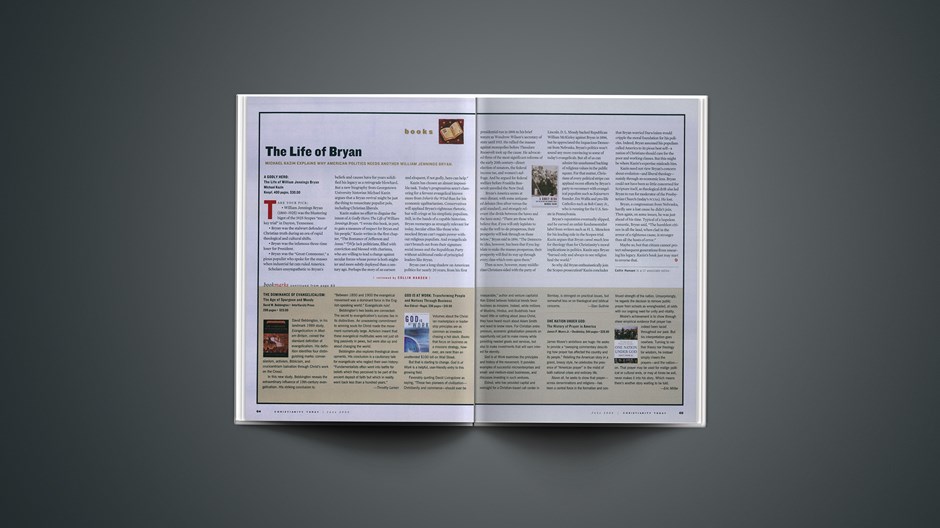
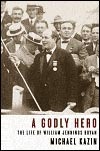
Scholars unsympathetic to Bryan's beliefs and causes have for years solidified his legacy as a retrograde blowhard. But a new biography from Georgetown University historian Michael Kazin argues that a Bryan revival might be just the thing to resuscitate populist pols, including Christian liberals.
Kazin makes no effort to disguise the intent of A Godly Hero: The Life of William Jennings Bryan. "I wrote this book, in part, to gain a measure of respect for Bryan and his people," Kazin writes in the first chapter, "The Romance of Jefferson and Jesus." "[W]e lack politicians, filled with conviction and blessed with charisma, who are willing to lead a charge against secular forces whose power is both mightier and more subtly deployed than a century ago. Perhaps the story of an earnest and eloquent, if not godly, hero can help."
Kazin has chosen an almost impossible task. Today's progressives aren't clamoring for a fervent evangelical known more from Inherit the Wind than for his economic egalitarianism. Conservatives will applaud Bryan's righteous rhetoric, but will cringe at his simplistic populism. Still, in the hands of a capable historian, Bryan reemerges as strangely relevant for today. Secular elites like those who mocked Bryan can't regain power without religious populists. And evangelicals can't branch out from their signature social issues and the Republican Party without additional ranks of principled leaders like Bryan.
Bryan cast a long shadow on American politics for nearly 20 years, from his first presidential run in 1896 to his brief tenure as Woodrow Wilson's secretary of state until 1915. He rallied the masses against monopolies before Theodore Roosevelt took up the cause. He advocated three of the most significant reforms of the early 20th century—direct election of senators, the federal income tax, and women's suffrage. And he argued for federal welfare before Franklin Roosevelt unveiled the New Deal.
Bryan's America seems at once distant, with some antiquated debates (free silver versus the gold standard), and strangely relevant (the divide between the haves and the have-nots). "There are those who believe that, if you will only legislate to make the well-to-do prosperous, their prosperity will leak through on those below," Bryan said in 1896. "The Democratic idea, however, has been that if you legislate to make the masses prosperous, their prosperity will find its way up through every class which rests upon them."
Then as now, however, many middle-class Christians sided with the party of Lincoln. D. L. Moody backed Republican William McKinley against Bryan in 1896, but he appreciated the loquacious Democrat from Nebraska. Bryan's politics won't sound any more convincing to some of today's evangelicals. But all of us can admire his unashamed backing of religious values in the public square. For that matter, Christians of every political stripe can applaud recent efforts by Bryan's party to reconnect with evangelical populists such as Sojourners founder Jim Wallis and pro-life Catholics such as Bob Casey Jr., who is running for the U.S. Senate in Pennsylvania.
Bryan's reputation eventually slipped, and he earned an unfair fundamentalist label from writers such as H. L. Mencken for his leading role in the Scopes trial. Kazin argues that Bryan cared much less for theology than for Christianity's moral implications in politics. Kazin says Bryan "burned only and always to see religion heal the world."
So why did Bryan enthusiastically join the Scopes prosecution? Kazin concludes that Bryan worried Darwinism would cripple the moral foundation for his policies. Indeed, Bryan assumed his populism called America to its pious best self—a nation of Christians should care for the poor and working classes. But this might be where Kazin's expertise misleads him.
Kazin need not view Bryan's concern about evolution—and liberal theology—mainly through an economic lens. Bryan could not have been so little concerned for Scripture itself, as theological drift also led Bryan to run for moderator of the Presbyterian Church (today's PCUSA). He lost.
Bryan, a congressman from Nebraska, hardly saw a lost cause he didn't join. Then again, on some issues, he was just ahead of his time. Typical of a hopeless romantic, Bryan said, "The humblest citizen in all the land, when clad in the armor of a righteous cause, is stronger than all the hosts of error."
Maybe so, but that citizen cannot protect subsequent generations from smearing his legacy. Kazin's book just may start to reverse that.
















 While we pray for peace, we need moral clarity about this war.
 As my doubts about his teachings grew, so did a secret fascination with Jesus.
 Helping marine biodiversity flourish is a means of participating in God’s work, says an Indonesian theologian.






