Liev Schreiber, Julia Stiles, Seamus Davey-Fitzpatrick
Theatre Release
June 06, 2006 by 20th Century Fox
In the last few years, we've seen two prequels to The Exorcist and a remake of The Amityville Horror, so it was probably only a matter of time before someone got around to reviving that other popular 1970s supernatural horror movie, The Omen. The producers of this film had an especially timely marketing hook: a release date (6/6/06) that lends itself to ad campaigns with a mark-of-the-Beast theme.
In other ways, though, the remake of The Omen cannot help but seem as dated as the movie on which it is based. This is partly because the new film is extremely faithful to the original. Composer Marco Beltrami does not just emulate the style of Jerry Goldsmith's Oscar-winning score for the original movie, he even re-uses some of its themes. And screenwriter David Seltzer does not adapt his earlier script so much as dust it off and tweak a few time-sensitive details; for example, where the first film speculated that "the Common Market" was the fulfillment of a prophecy about the Roman Empire—a key piece in the end-times puzzles of Hal Lindsey and others at that time—the new film refers to "the European Union" instead.
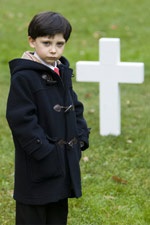
Seamus Davey-Fitzpatrick as Damien, a boy who tends to get a bit, er, cross at times
However, most of the other biblical interpretations remain as they were, and they just don't sound as imminent or, well, ominous as they once did. Take, for example, the poem that is recited several times in both films, which refers to the return of Jews to Zion. The modern state of Israel was only 28 years old when the original film came out, and at that time, it was alarmingly common for evangelicals to speculate that the Rapture or the Second Coming might happen before the nation's 40th birthday. (As one who grew up in the evangelical subculture at that time, I vividly remember thinking I might never see adulthood because of this.) So the first Omen came out at a time of great eschatological urgency. Today, however, the Israeli state is more than twice as old as it was back then, life goes on like it always has, and if anyone has proposed a new date for the end of the world, it would not seem to enjoy the widespread consensus, even on a speculative level, that the old date had.
The remake does try to create a sense of imminent dread, though. In one of the few significant changes to the script, the new Omen begins with a sequence set at the Vatican, in which an astronomer spots a suspicious sign in the heavens, and a cardinal argues before the Pope that various recent news items are fulfillments of a passage in Revelation (which this film quotes about as accurately as Pulp Fiction quoted Ezekiel). The destruction of the World Trade Center, the loss of the Columbia space shuttle, the Southeast Asian tsunami, the prisoner abuse at Abu Ghraib, and so on—all these things herald the imminent arrival of the Antichrist.
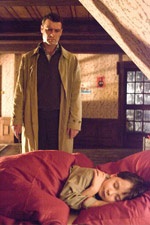
Robert Thorn (Liev Schreiber) checks on his son Damien, who is beginning to have some 'behavior issues'
The film then settles into its familiar narrative. Robert Thorn (Liev Schreiber), an American diplomat stationed in Rome, arrives at a hospital to discover that the child borne by his wife Katherine (Julia Stiles) is dead. However, Katherine does not yet know of the death of their child, but a shady hospital priest has a plan: He offers a different baby, whose mother had just died in childbirth. Robert wonders if he should just tell his wife the truth about their dead child, but the priest says, "God will forgive this little deception."
Five years later, Robert is the American ambassador to Great Britain and his son, Damien (Seamus Davey-Fitzpatrick), has grown up to become a dark-haired boy with piercingly blue eyes. Everything seems to be going well—but then the nanny commits suicide by hanging herself at Damien's fifth-birthday party, in front of all his guests, after dedicating her act of self-destruction to the boy. Yikes.
Creepier things begin to happen. Animals react violently to Damien's presence at the zoo. Damien reacts violently when his parents try to take him to a church for a wedding. A priest, Father Brennan (Pete Postlethwaite), shows up at the embassy claiming to know deep dark secrets about Robert's son. A photographer, Keith Jennings (David Thewlis), notices strange blemishes in the photos he takes—marks which seem to predict the deaths of the people he has photographed. And in the midst of it all, Katherine begins to fear that she is losing her own mind.
On one level, The Omen is a story about a family, and a married couple in particular, crumbling under psychological stress. The film works partly because it taps into every parent's fear that the babies they dote on will grow up to become children who don't like them; it works because it presents a worst-case scenario of what can happen when children get older and develop their own separate identities, including friendships and interior lives that are not what their parents would wish for them. One of the film's subtler details—it's in the background of only one or two shots—is the sketchy drawing Damien posts on his bedroom wall, depicting his nanny's suicide. And what parent wouldn't be a little worried about a thing like that?
Article continues below
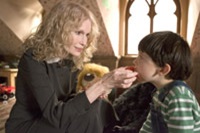
Damien's nanny, Mrs. Baylock (Mia Farrow), knows and protects the boy's dark secret
Director John Moore, whose last film (Flight of the Phoenix) was also a remake, does not stray far from his source, though he does make a few slight changes. A famous decapitation scene, which the original film dragged out with slow motion and repetitive editing, is handled fairly quickly here. On the other hand, a scene of someone being impaled by a falling spike is amplified here, as the spike falls through a stained-glass window and sends the broken shards down into the body of its victim. Also, some of the film's bigger scares come from the brief nightmares that plague Katherine and Robert—nightmares that were not in the original film.
Moore also retains some of the original film's errors. In one scene, Jennings says the town of Megiddo is south of Jerusalem, and that its name comes from the word "Armageddon." He's wrong on both points: Megiddo is northwest of Jerusalem, in the Valley of Jezreel, and the word "Armaggedon" is actually derived from "Har Megiddo," meaning "the hill of Megiddo." In addition, the film blurs the line between what we might call a sacramental worldview and a magical worldview. Father Brennan tells Robert to accept Jesus as his savior and to take communion—not so much for his own salvation, but because it will give him the power he needs to defeat the Antichrist. Later, a monk named Bugenhagen (Michael Gambon) gives Robert seven knives, which he says are the only way the Antichrist can be killed; he even says the knives must be used in a specific way, and in a specific order, and it is unclear whether the person who uses them would need to have any faith.
Such details are, of course, just the usual horror-movie hooey. And the new film is, if anything, slightly campier in this regard than the original. When Damien first sees the dog that hypnotized his nanny into committing suicide, he waves to it—and in reply, the dog drips one big fat drop of drool. And then there is the casting of Mia Farrow as Mrs. Baylock, the Satanic nanny who takes over. Farrow knows a thing or two about demonic children, having starred in Rosemary's Baby almost 40 years ago, and her adoption of foreign children in real life is very much a part of her public persona—so we are definitely meant to laugh when Mrs. Baylock says at her job interview, "Caring for children has been the joy of my life." The times may not be as apocalyptic as they once were, but this is still an Omen for the age of irony.
Article continues below
Talk About It
Discussion starters
What do you believe about the end times? Do you think the Bible predicts a single Antichrist, or is the Antichrist to be understood symbolically, like the other figures and creatures described in Revelation
If the Antichrist were alive today, would there be any point in trying to stop him? Should anyone try to stop him? What about the possibility that his presence would mean that the Second Coming of Christ is just around the corner? Would it be possible or even desirable to postpone the end, e.g. the way Nineveh's destruction was postponed
Do end-times theories of this sort—especially when they are connected to grim news reports—make you feel more fatalistic and resigned to the evil in the world, or do they make you want to do something about the evil in the world
Father Brennan says the only way to defeat the Devil is to take communion—to eat Jesus' flesh and drink his blood. Do you agree or disagree? Do you think he is proved right in the end? Do you think Robert Thorn would have had a better chance of defeating Damien if he had been a practicing Christian
How does this film portray the church? Note how the church seems to be prepared for the end times in a way that the other characters are not—the other characters get all their information from the Bible, or from monks, etc.—but also note how some of the clergy Robert meets turn out to have been complicit in the Satanic conspiracy. Does this film make you more inclined, or less inclined, to turn to the church for help?
The Family Corner
For parents to consider
The Omen is rated R for disturbing violent content (including a suicide by hanging, an impaling, a beheading, an immolation, a fatal injection, and several attacks by dogs), graphic images and some language (including a few four-letter words). One character also expresses her intention to have an abortion.
No, no, this has nothing to do with the child of Brad Pitt and Angelina Jolie. It's just another recycled big screen horror flick. Horror movies are so hot right now, Hollywood just can't stop cranking out remakes along with the originals. And, sure enough, just in time for its 30-year anniversary, here's a whole new version of The Omen, starring Mia Farrow, Julia Stiles, Pete Postlethwaite, and Liev Schreiber.
Article continues below
The "son of Satan" plotline has opened the door for 20th Century Fox to vigorously market this new Omen to Christian audiences, just as Sony did with The Da Vinci Code. This week, I received a pamphlet in the mail that was filled with Bible verses that relate, in some way, to The Omen. And this "tract" also pointed out that the movie opens on 06.06.06. I was not spooked.
Neither are many of the Christian press critics who have seen the film.
David DiCerto (Catholic News Service) says it's "skillfully crafted and well-acted," and that it differs from The Da Vinci Code in that it "does not attack core Christian beliefs, though its horror-film treatment of religion is obviously sensationalized." Overall, he finds it "a fairly decent, if occasionally lurid, thriller."
"It's still creepy after all these years," writes Steve Beard (Thunderstruck), who offers excerpts from interviews with the cast and director. "While some will speak with condescending tones about the superiority of the original version with Gregory Peck and Lee Remick, the performances of Liev Schreiber, Julia Stiles, Mia Farrow, and David Thewlis were engaging and spooky. While the very premise of the film … will strike some as heretical or preposterous, it will definitely make for interesting conversation about the end of the world as we know it."
Bob Smithouser (Plugged In) writes, "Here and there, The Omen version 6-6-06 improves on the atmosphere of the original. European locales. Creepy art decoration. Ominous ties to current events. But beyond that, this almost literal retelling of David Seltzer's story (with much of the dialogue recycled verbatim) will join Gus Van Sant's Psycho on the ash heap of pointless horror remakes."
from Film Forum, 06/22/06
An uncredited reviewer (Relevant) writes, "The story is scattered, treating whichever character can induce the most fear for the moment as the protagonist. This leads to little and mechanical development on the part of the story's true protagonist, the diplomat/boy's father. When his moment to become the hero arrives, it's empty and stiff. And don't forget the massive plot holes in terms of location and events."
After lobbying from fellow Southern Baptists and Christians affected by the war, the House speaker moves a package forward.
Harvest Prude
The Omen
1 of 3
Seamus Davey-Fitzpatrick as Damien, a boy who tends to get a bit, er, cross at timesRobert Thorn (Liev Schreiber) checks on his son Damien, who is beginning to have some 'behavior issues'Damien's nanny, Mrs. Baylock (Mia Farrow), knows and protects the boy's dark secret













 While we pray for peace, we need moral clarity about this war.
 A Christian reconciliation group in Israel and Palestine warned that war would come. Now the war threatens their relevance.españolالعربيةFrançais
 After lobbying from fellow Southern Baptists and Christians affected by the war, the House speaker moves a package forward.