The search for the "common good" can be traced back for millennia. The idea of a "counterculture," at least by that name, goes back only to 1968. So this year's question for the Christian Vision Project—How can followers of Christ be a counterculture for the common good?—juxtaposes the ancient and the new. That same juxtaposition makes Frederica Mathewes-Green a perennially compelling voice. A veteran of the original counterculture who traveled through Hinduism before coming to faith in Christ, Mathewes-Green eventually found her spiritual home in Eastern Orthodoxy, the church in which her husband is now a pastor. In her prolific writing and speaking, she traverses the ground between movies and icons, consumer culture and spiritual disciplines. A longtime contributor to Christianity Today, she is a columnist for Beliefnet and a movie reviewer for National Review Online. Her most recent book is First Fruits of Prayer (Paraclete). Here she calls us away from preoccupation with the shifting winds of "the culture" toward a more central, and lasting, mission.
If you hang around with Christians, you find that the same topic keeps coming up in conversation: their worries about "the culture." Christians talk about sex and violence in popular entertainment. They talk about bias in news reporting. They talk about how their views are ignored or misrepresented. "The culture" appears to be an aggressive challenger to "the church," and Christians keep worrying what to do about it. You soon get the impression that Church Inc. and Culture Amalgamated are like two corporations confronting each other at a negotiating table. Over there sits Culture—huge, complex, and self-absorbed. It's powerful, dangerous, unpredictable, and turbulent. Church is smaller, anxious; it studies Culture, trying to figure out a way to weasel in.
But there are flaws in this picture. For one thing, neither party is as monolithic as it seems. There are many devout believers among the ranks of journalists and entertainers, and there are even more culture-consumers among the ranks of devout believers. Indeed, it's almost impossible to avoid absorbing this culture; if you sealed the windows, it would leak in under the door. I once heard a retreat leader say she'd attempted a "media fast," but found the gaudy world met her on every side. "I may be free in many ways," she said, "But I am not free to not know what Madonna is doing."
Furthermore, the church is not a corporation; rather, it is incorporate, or better, incarnate, carried in the vulnerable bodies of fallible individuals who love and follow Jesus Christ. The culture is even less of an organization. It is more like a photomosaic composed of tiny faces, faces of the millions of people—or billions, rather, thanks to the worldwide toxic leak of American entertainment—who are caught up in its path.
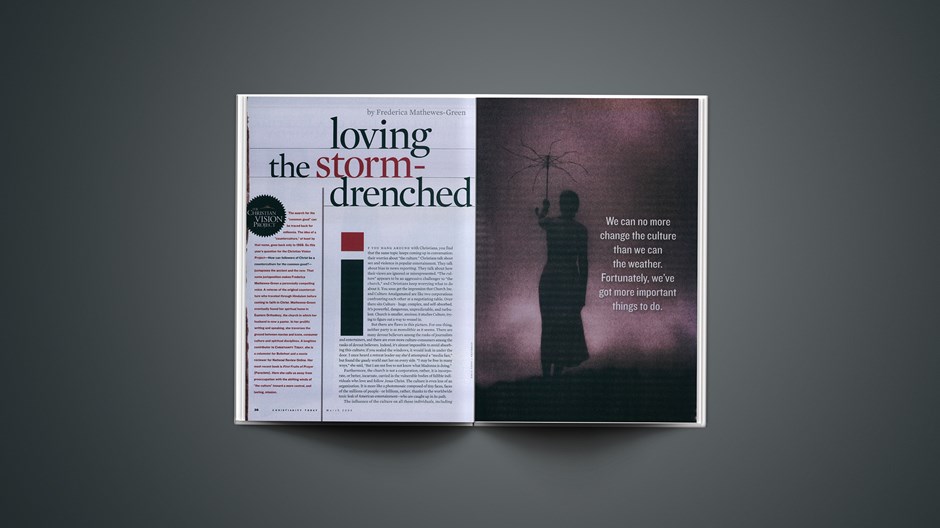
The influence of the culture on all those individuals, including Christians, is less like that of a formal institution and more like the weather. We can observe that, under current conditions, it's cloudy with a chance of cynicism. Crudity is up, nudity is holding steady, and there is a 60 percent chance that any recent movie will include a shot of a man urinating. Large fluffy clouds of sentimental spirituality are increasing on the horizon, but we have yet to see whether they will blow toward or away from Christian truth. Stay tuned for further developments.
As Mark Twain famously remarked, everyone talks about the weather, but no one does anything about it. I think much of our frustration is due to trying to steer the weather, rather than trying to reach individuals caught up in the storm.
It's possible to influence weather within limits, to seed clouds for rain, for example. And it is right for us to consider what we can do to provide quality fiction, films, and music, and to prepare young Christians to work in those fields. We can do some things to help improve ongoing conditions. But it is futile to think that we will one day take over the culture and steer it. It's too ungainly. It is composed of hundreds of competing sources. No one controls it.
What's more, it is already changing—constantly, ceaselessly, seamlessly—changing whether we want it to or not, in ways we can't predict, much less control. If you take the cultural temperature at any given moment, you will find that some of the bad things are starting to fade, and improvement is beginning to appear; simultaneously, some good things are starting to fall out of place, and a new bad thing is emerging.
Not only can we not control this process, we can't even perceive it until changes are so far developed as to be entrenched. Chasing the culture is a way to guarantee that you will always be a step behind the times.
Waiting for Fun to Hurt
One of my favorite classic films is It Happened One Night (1934), starring Clark Gable and Claudette Colbert. This comedy won five Academy Awards and deserved them; it has some of the most original characters and clever writing you'll find in any American film. The underlying premise is that a couple will not have sex before marriage, and this romantic tension drives the plot.
Article continues below
Yet that does not guarantee uniform "positive values." Everyone in the movie smokes, including the heroine (while wearing her wedding gown). It's not even safe smoking: We see the hero light up in a haystack. What's more, the hero regularly directs physical threats at the heroine; he says, for example, "She needs someone to take a sock at her once a day, whether she's got it coming to her or not." While the cultural barometer in recent decades has been falling on sexual morality, indicators for smoking and violence against women have indisputably improved.
But the most striking element is the attitude toward drunkenness. The first time we see Gable's character he is roaring drunk, and this is assumed to be hilarious. His drunkenness is encouraged and subsidized by other characters. In the post-Prohibition decades, being drunk (as opposed to merely drinking) was seen as rebellious, cool, and fashionable, and people who objected were depicted as prudes and squares. That fad eventually passed, when the damage done by alcoholism could no longer be romanticized away.
Now, in the post-sexual-revolution decades, being promiscuous is seen as rebellious, cool, and fashionable, and people who object are depicted as prudes and squares. That fad will eventually pass, too, when the damage done by abortion, divorce, and sexually transmitted diseases can no longer be romanticized away.
We cannot instigate this change by appealing to morality, but simple common sense has a stubborn tendency to re-emerge. By the '70s it was becoming apparent that alcoholism dealt too much disease, divorce, and family disintegration to be all that funny. This change was not achieved by the Woman's Christian Temperance Union (WCTU) finally coming up with the bulls-eye slogan that would "change hearts and minds." Instead, people just came to their senses.
But note that when the WCTU is mentioned today, it's still seen as a bastion of prudes and squares. They were not vindicated, even though they turned out to be right. And it may be the same with us. We may always be seen as prudes and squares. Despite this, sexual common sense is likely to re-emerge. (It happened once before: Films of the 1920s through 1950s reflect an acceptance of male adultery that would be horrifying today. We presume that these old movies will showcase "old-fashioned values," and they do; we just don't realize what those values were.) So sometimes cultures shift for the better. When so-called fun hurts enough, people stop doing it.
Article continues below
The Pounding Storm
The culture, then, is like the weather. We may be able to influence it in modest ways, seeding the clouds, but it is a recipe for frustration to expect that we can direct it. Nor should we expect positive change without some simultaneous downturn in a different corner. Nor should we expect that any change will be permanent. The culture will always be shifting, and it will always be with us.
God has not called us to change the weather. Our primary task as believers, and our best hope for lasting success, is to care for individuals caught up in the pounding storm. They are trying to make sense of their lives with inadequate resources, confused and misled by the Evil One and unable to tell their left hand from their right (Jonah 4:11). They are not a united force; they are not even in solidarity with each other, apart from the unhappy solidarity of being molded by the same junk-food entertainment. They are sheep without a shepherd, harassed and helpless (Matt. 9:36). Only from a spot of grounded safety can anyone discern what to approve and what to reject in the common culture.
But we must regretfully acknowledge that we, too, are shaped by the weather in ways we do not realize. Most worryingly, it has induced us to think that the public square is real life. We are preoccupied with that external world, when our Lord's warnings have much more to do with our intimate personal lives, down to the level of our thoughts.
So, when Christians gather, there's less talk about humility, patience, and the struggle against sin. Instead, there's near-obsessive emphasis on the need for a silver-bullet media product that will magically open the nation to faith in Jesus Christ. Usually, the product they crave is a movie. Now, I'm delighted that Christians are working in Hollywood; we should be salt and light in every community that exists, and so powerful a medium clearly merits our powerful stories. But it's telling that the media extravaganza so eagerly awaited is not a novel or a song, something an individual might undertake, but a movie: something that will require enormous physical and professional resources, millions of dollars, and, basically, work done by somebody else.
This focus on an external, public sign is contrary to the embodied mission of the church. Christ planned to attract people to himself through the transformed lives of his people. It's understandable that we feel chafed by what media giants say about us and the things we care about, and that we crave the chance to tell our own side of the story. It's as if the world's ballpark is ringed with billboards, and we rankle because we should have a billboard too. But if someone should actually see our billboard, and be intrigued, and walk in the door of a church, he would find that he had joined a community that was just creating another billboard.
Article continues below
A Common Enemy
One excellent way to see how much our culture's passing weather patterns have influenced us is to read old books. If you receive all your information from contemporary writers, Christian or secular, you will never perceive whole concepts that people in other generations could see. (For example, earlier generations of Christians perceived a power in sexual purity that eludes us completely; we can only fall back on "don'ts.") Every Christian should always have at his bedside at least one book that is at least 50 years old—the older the better.
Sure, you can make yourself read the contemporary magazines and authors you disagree with, but even they share the same underlying assumptions. It's as if we see our "culture war" opponents standing on the cold peak of an iceberg. From our corresponding peak, all we can discern between us is an expanse of dark water. But underneath that water, the two peaks are joined in a single mass. The common assumptions we share are invisible to us, but they will be perceived, and questioned, by our grandchildren.
C.S. Lewis has a wonderful passage on this phenomenon in his introduction to Athanasius's On the Incarnation: "Every age has its own outlook. It is specially good at seeing certain truths and specially liable to make certain mistakes. We all, therefore, need the books that will correct the characteristic mistakes of our own period. And that means the old books."
The "old books" can help us discern the prevailing assumptions of our cultural moment, not only concerning the content of our discussions, but also their style. We expect that combatants will be casual, rather than formal. We expect that their arguments will be illustrated by popular culture, rather than the classics or history. Conservatives and liberals agree that it is admirable to be rebellious and challenge authority, and both sides are at pains to present the other side as authority.
More serious, however, is a tone of voice we adopt from the culture: sarcastic, smart-alecky, jabbing, and self-righteous. We feel the sting of such treatment and give it right back; we feel anger or even wounded hatred toward those on the "other side." But God does not hate them; he loves them so much he sent his Son to die for them. We are told to pray for those who persecute us and to love our enemies. The weight of antagonistic and mocking big-media machinery is the closest thing we've got for practicing that difficult spiritual discipline. If we really love these enemies, we will want the best for them, the very best thing we have, which is the knowledge and love of God.
Article continues below
Smart-alecky speech doesn't even work. It may win applause, but it does not win hearts. It hardens the person who feels targeted, because he feels mocked and misrepresented. It increases bad feeling and anger. No one changed his mind on an issue because he was humiliated into it. In fact, we are misguided even to think of our opponents in the "culture wars" as enemies in the first place. They are not our enemies, but hostages of the Enemy. We have a common Enemy who seeks to destroy us both, by locking them in confusion and by luring us to self-righteous pomposity.
Culture is not a monolithic power we must defeat. It is the battering weather conditions that people, harassed and helpless, endure. We are sent out into the storm like a St. Bernard with a keg around our neck, to comfort, reach, and rescue those who are thirsting, most of all, for Jesus Christ.
How the Kingdom Comes | The church becomes countercultural by sinking its roots ever deeper into God's heavenly gifts. By Michael S. Horton (Christianity Today, Jan. 13, 2006)
Sleep Therapy | In search of a counterculture for the common good. By Lauren F. Winner (Books & Culture)
Better Than a Cigar | Introducing the Christian Vision Project. By David Neff (Jan. 13, 2006)

















 While we pray for peace, we need moral clarity about this war.
 As my doubts about his teachings grew, so did a secret fascination with Jesus.
 The Grammy-winning artist was found dead at her home in Nashville at age 47.






