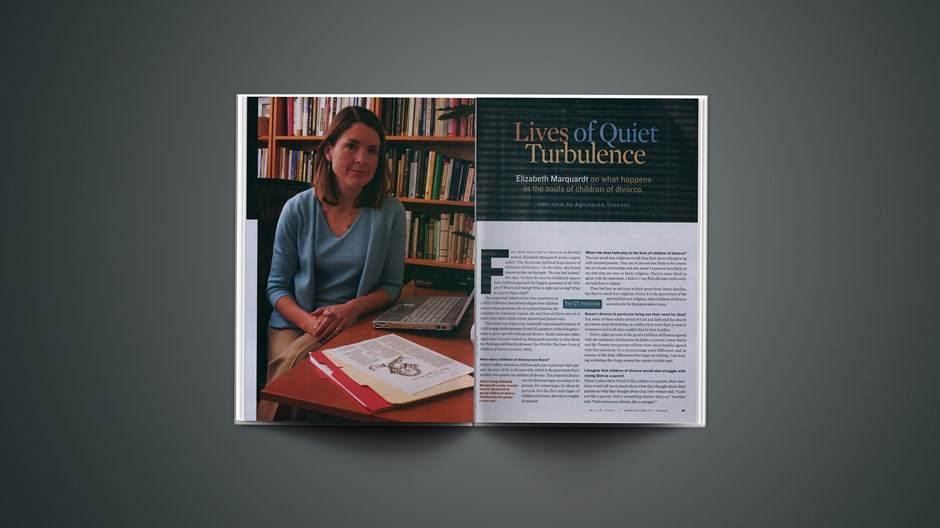
For her master's thesis in divinity school, Elizabeth Marquardt wrote a paper called "The Moral and Spiritual Experiences of Children of Divorce." At the time, she found almost no data on the topic. "No one had looked," she says, "at how divorce in childhood shapes how children approach the biggest questions of all: Who am I? Where do I belong? What is right and wrong? What is true? Is there a God?"
She suspected, based on her own experience as a child of divorce, that divorce shapes how children answer these questions. So, in a project based at the Institute for American Values, she and Norval Glenn set out to learn more about adults whose parents had parted ways.
The result was a four-year, nationally representative survey of 1,500 young adults between 18 and 35, members of the first generation to grow up with widespread divorce. Senior associate editor Agnieszka Tennant looked up Marquardt recently to chat about her findings published in Between Two Worlds: The Inner Lives of Children of Divorce (Crown, 2005).
How many children of divorce are there?
About a million American children each year experience their parents' divorce. Of 18- to 35-year-olds, which is the generation that I studied, one-quarter are children of divorce. The projected divorce rate for first marriages nowadays is 43 percent. For remarriages, it's about 60 percent. For the first marriages of children of divorce, the rate is roughly 60 percent.
What role does faith play in the lives of children of divorce?
They are much less religious overall than their peers who grew up with married parents. They are 14 percent less likely to be a member of a house of worship and also about 14 percent less likely to say that they are very or fairly religious. They're more likely to agree with the statement, I believe I can find ultimate truths without help from a religion.
They feel just as spiritual as their peers from intact families, but they're much less religious. If Gen X is the generation of the spiritual but not religious, then children of divorce account a lot for that generation's turn.
Doesn't divorce in particular bring out their need for God?
Yes, some of these adults turned to God and faith and the church as a home away from home, as a father they never had, in search of answers and truth they couldn't find in their families.
Thirty-eight percent of the grown children of divorce agreed with the statement, God became the father or parent I never had in real life. Twenty-two percent of those from intact families agreed with this statement. It's a 16 percentage point difference, and, in surveys of this kind, differences that large are striking. I am leading workshops for clergy around the country on this topic.
I imagine that children of divorce would also struggle with seeing God as a parent.
When I asked them if God is like a father or a parent, their reactions would tell me as much about what they thought about their parents as what they thought about God. One woman said, "God's not like a parent. God is something smarter than us." Another said, "God seems more distant, like a manager."
When they do seek God, what faith traditions do people from broken homes tend to favor?
Children of divorce are much more likely to be evangelicals than those from intact families.
Forty-two percent of all grown children of divorce identify as evangelical or born again, compared to 37 percent of those who grew up with married parents. So in America, more divorce is making more evangelicals.
Why is that?
The way that evangelical theology emphasizes the central saving role of the personal relationship with Jesus Christ and God as your Father resonates with some children of divorce. They say, My earthly parents were not there for me-or, My earthly father failed me, but in God I found that loving father figure I never had.
Also, evangelical churches do a somewhat better job of acknowledging divorce as a problem. Our mainline Protestant churches don't want to offend divorced and single parents in their congregations, so they don't reach out to the children as a consequence.
In general, most churches aren't doing a good job at reaching out to children of divorce. Of those grown children of divorce who were active in a church at the time of their parents' divorce, two-thirds said that no one from the clergy or congregation reached out to them at that time. It's really amazing. Only one-quarter said that someone did reach out to them.
How does divorce affect how the children of divorce read the Bible?
Let's take, for instance, the parable of the Prodigal Son. The children of divorce don't focus on the end of the story, when the child comes home and is welcomed by a loving parent. They focus on the beginning of the story, when someone leaves the family home. For them, it's not the child who leaves the home; it's the parent.
Their lives look more like the parable of the Prodigal Parent.
They think about the initial departure of their father or mother, which caused the divorce, or about the many comings and goings that occurred in their families throughout their childhoods because both of their parents worked. They lived separately. They dated. They remarried.
Article continues below
Young adults from divorced families were seven times more likely to strongly agree with the statement, I was alone a lot as a child. They say things like, I was the one who was at home trying to keep the house together, trying to keep a family unit together. One young woman told me, "When I hear the parable about the Prodigal Son, I always think maybe one of these days my dad will decide to come back, too."
How sad.
Then you realize that the parable is supposed to illustrate God's love and compassion and presence-the ever-present, steady, everlasting presence. But children of divorce see themselves in the role of the father waiting for the child to come home; that's the role of God in the story. They have to be their own protector. They have to be the one waiting in the doorway for someone else to come home. It's a scary and anxiety-producing place for a child.
We've all heard people pity some marriages by saying things like, They're just staying together for the kids. But your research suggests that staying together for the sake of the kids can be a noble and Christian thing, not a pitiable concession.
The idea of a "good" divorce is ripe for challenge. The children of so-called good divorces fare worse in many ways than those from unhappy marriages, so long as the parents' marriage was low-conflict. And what most people don't realize is that two-thirds of divorces today end low-conflict marriages.
How do the children of "good" divorces fare worse than those from unhappy, low-conflict marriages?
They're far more likely to get divorced themselves one day compared to those who grow up in unhappy, low-conflict marriages. They are far more likely to say they were alone a lot as children, to say they missed their fathers, to say they had to protect their mothers. They had more responsibility to care for younger siblings than those from intact families.
Some people might be surprised to hear that, because a prevailing attitude among some in recent years is, as one academic put it, "A good divorce or a good marriage-it matters not." Many experts have said, wrongly, that both situations are fine for kids.
What do such optimists mean by good divorce?
If you divorce your spouse, but you minimize your conflict with your spouse afterwards, and you both stay involved in the child's life, then they say the divorce will have relatively little impact on your child.
Article continues below
There are children's books written that portray divorce as an adventure. There's one about how fun it is to stay with your dad in the city and ride on the subway and go to a museum, and then visit your mom in the country and ride a horse. It distorts and silences the children's loss and moral confusion.
I find this happy talk about divorce to be incredibly callous-this idea that children are resilient, as if that justifies what we do to them. Do we say: Well, most children probably can carry a 40-pound sandbag. Some might get injured, but most can probably manage it?
Even if children are resilient, this does nothing to change the burden they must overcome. My research shows that for children of divorce, conflict between the parents' worlds is always alive in their inner lives-even when the parents do not fight. Any kind of divorce, amicable or not, radically restructures children's childhoods and requires them to take on an entirely new job.
What is the nature of this new job?
The job that was formerly the job of the parents-to make sense of the parents' different sets of values and beliefs and ways of living. It's a hard job for all of us who are married. When you get divorced, the job doesn't go away. It's just not the adults' job anymore; now it becomes the job of the child.
What does this restructuring of childhood do to children?
In our study, only one-fifth of the grown children of divorce said their parents had a lot of conflict after the divorce, but two-thirds said their parents seemed like polar opposites after the divorce. Nearly half said they had to be a different person with each of their parents. They were much more likely to say that they had to keep secrets after the divorce. All these percentages are two to three times higher than for people from intact families.
Children of divorce feel like divided selves. They say: I had to be a different person with each of my parents. I had a whole different life with each one. There's only a certain set of memories I talk to my dad about and only a certain set I talk to my mom about.
You've interviewed a lot of outwardly successful adult children of divorce who appear to be fine. Are they?
The successful grown children of divorce hear stories and studies about damaged children of divorce, and they cringe and say, That's not me. I'm not damaged. I didn't get pregnant when I was 14, and I didn't get arrested.
But I've had so many of them say to me, when they talk about their childhoods, "Well, I wasn't abused, but … " Then they stop. They didn't have a language to express what they went through. So what I tried to do in this book is offer a new vocabulary: We had to grow up traveling between two worlds. We had to be early moral forgers. We were little adults. Spiritually, we were child-sized old souls.
Article continues below
What do you mean by child-sized old souls?
So many grown children of divorce told me stories about not going to church anymore after the divorce. Others would talk about seeking out a church in their neighborhood by themselves in their teen years, of being alone at church.
One woman recalled sitting in the back of church while kids with their parents sat up front. This passing comment was a powerful image revealing the truth that children of divorce were often relegated, even if only figuratively, to the back of the church.
What light do your findings shed on your understanding of marriage?
Marriage is a complex institution that secures mothers and fathers for the children that their sex acts create. It is flawed, but it's the most pro-child social institution that virtually all civilizations have come up with so far. It's a rich and fairly radical idea that different people should come together and do something really hard, like stay together for a lifetime despite everything in the culture that's encouraging them to go it alone.
How many divorces are unnecessary?
We have this misperception that when people get divorced, it's because they're at each other's throats. Solid research has found that about one-third of divorces end high-conflict marriages. Children on average do better when a high-conflict, abusive, and violent marriage ends.
But most marriages that are ending in divorce are low-conflict and look a lot like the ones that are staying together. Research shows that married couples generally fight about the same five things: money, sex, in-laws, religion, and time. Some choose to get divorced over it; some don't. If, after divorce, you could find new strength within yourself to get past your issues and cooperate with your ex, then you could do it before he or she is your ex.
What do you say to spouses in low-conflict marriages who grow apart?
It is troubling to live in a marriage when you're not sure if you love each other; that hurts. But the kids are largely unaware of these things. If you're living with your children and taking care of them, if you're not fighting much, that's what your children care about. Your preschooler doesn't care if you're having great sex with your husband. But she will be concerned when suddenly she wakes up every day and Daddy's not there like he used to be.
Article continues below
Did you ask your respondents about the commandment to honor fathers and mothers?
Those with married parents generally said something like this: The older I get, the more I realize what my parents did for me. Honoring my parents means, as they get older, I'll take care of them.
People from divorced families had a very different reaction. The command immediately caused them to question what their parents did for them. If Dad abandoned the family and Mom heroically raised them on her own in trying circumstances, they said, I honor my mom. Given everything she did for me, how could I not? But they got stuck on the issue of how to honor their father.
Some said, I just can't honor my parents. They weren't there for me, father or mother. Often people who said that were either kind of stuck in their faith journey or were not interested.
What about those with an active faith?
They said that the commandment called them to stay in relationship with their parents, when they might otherwise have abandoned it. It was both hopeful and sad. It was a sign of how weak their family relationships had become, but also how powerful a faith journey can be in helping you find a sense of wholeness even amidst these broken family relationships.
















 While we pray for peace, we need moral clarity about this war.
 A Christian reconciliation group in Israel and Palestine warned that war would come. Now the war threatens their relevance.العربيةFrançais
 The founder of Concerned Women for America was credited by President Ronald Reagan with “changing the face of American politics.”






