His speaking style is disarmingly low-key, almost professorial, but only the rarest professors make every word count the way Tim Keller does. For 16 years, he has been preaching at Redeemer Presbyterian Church in Manhattan, distilling biblical teaching into arrestingly simple phrases that convey the radical surprise and gracious truth of Christian faith. One such typically piquant phrase is the source of the Christian Vision Project's big question for 2006: How can followers of Christ be a counterculture for the common good? Keller's vision of a church keenly committed to the welfare of its city attracts 4,000 worshipers each week to Redeemer's four rented locations, sends them out into many forms of charitable service through the church's ministry Hope for New York, and fuels a church-planting effort that embraces Baptists and Pentecostals as well as Presbyterians, immigrant neighborhoods as well as Manhattan. Fifty years from now, if evangelical Christians are widely known for their love of cities, their commitment to mercy and justice, and their love of their neighbors, Tim Keller will be remembered as a pioneer of the new urban Christians.
In the winter of 2006, two movies mirrored the fractured and confusing relationship between Christians and culture. The Chronicles of Narnia: The Lion, The Witch and The Wardrobe struck fear in many secular hearts. Some journalists saw it as an ominous sign of growing right-wing power that a company like Disney would make a movie that had such profound evangelical appeal (and, arguably, content). And why did Disney pull the plug on the gay-friendly TV reality series Welcome to the Neighborhood? Isn't this, the pundits asked, what happens when you let Christians influence culture?
At the same time, The End of the Spear, the account of five evangelical missionaries martyred in Ecuador, upset some Christians when it was discovered that an active gay man was playing Nate Saint, the lead role in the movie. Conservative cultural commentators were divided. Some, like Eugene Veith of World magazine, urged Christians to see the movie and judge it on its artistic merits, not on the morals of its actors off screen. Others urged a boycott. Major questions about Christianity and culture were raised on hundreds of websites. What makes a movie "Christian"? Do all the actors have to be Christians? If not, which kinds of sinners are allowed, and which are not? Is spiritual compromise inevitable when Christians try to enter mainstream cultural production?
The relationship of Christians to culture is the singular current crisis point for the church. Evangelicals are deeply divided over how to interact with a social order that is growing increasingly post-Christian. Some advise a reemphasis on tradition and on "letting the church be the church," rejecting any direct attempt to influence society as a whole. Others are hostile to culture, but hopeful that they can change it through aggressive action, often of a political sort. Still others believe that "you change culture one heart at a time." Finally, many are attracted to the new culture and want to reengineer the church to modify its adversarial relationship with culture. Many in the "one heart at a time" party play down doctrine and stress experience, while some in the reengineering group are changing distinctives of evangelical doctrine in the name of cultural engagement. That is fueling much theological controversy, but even people who agree on the need for change disagree over what to do to our doctrine to reach the culture.
None of the strategies listed above should be abandoned. We need Christian tradition, Christians in politics, and effective evangelism. And the church has always contextualized itself into its surrounding culture. There are harmful excesses in every approach, however. I think that is because many have turned their specialty into a single magic bullet that will solve the whole problem. I doubt such a magic bullet exists, but just bundling them all together is not sufficient either.
Instead, we need a new and different strategy.
City Within a City
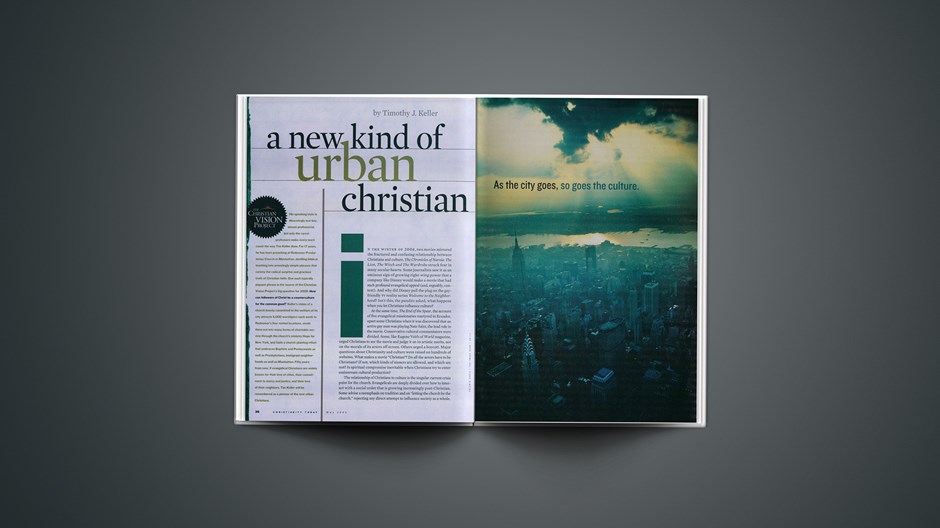
My first strategic point is simple: More Christians should live long-term in cities. Historians point out that by A.D. 300, the urban populations of the Roman Empire were largely Christian, while the countryside was pagan. (Indeed, the word pagan originally meant someone from the countryside—its use as a synonym for a non-Christian dates from this era.) The same was true during the first millennium A.D. in Europe—the cities were Christian, but the broad population across the countryside was pagan. The lesson from both eras is that when cities are Christian, even if the majority of the population is pagan, society is headed on a Christian trajectory. Why? As the city goes, so goes the culture. Cultural trends tend to be generated in the city and flow outward to the rest of society.
People who live in large urban cultural centers, occupying jobs in the arts, business, academia, publishing, the helping professions, and the media, tend to have a disproportionate impact on how things are done in our culture. Having lived and ministered in New York City for 17 years, I am continually astonished at how the people I live with and know affect what everyone else in the country sees on the screen, in print, in art, and in business.
Article continues below
I am not talking about the "elite-elites"—the rich and famous—but about the "grassroots-elites." It is not so much the top executives that make MTV what it is, but the scores of young, hip creatives just out of college who take jobs at all levels of the organization. The people who live in cities in the greatest numbers tend to see their values expressed in the culture.
Do I mean that all Christians must live in cities? No. We need Christians and churches everywhere there are people! But I have taken up the call of the late James Montgomery Boice, an urban pastor (at Philadelphia's Tenth Presbyterian Church) who knew that evangelical Christians have been particularly unwilling to live in cities. In his book Two Cities: Two Loves, he argued that evangelicals should live in cities in at least the same percentage as the general population. If we do not, we should not expect much influence in society.
Once in cities, Christians should be a dynamic counterculture. It is not enough for Christians to simply live as individuals in the city. They must live as a particular kind of community. Jesus told his disciples that they were "a city on a hill" that showed God's glory to the world (Matt. 5:14-16). Christians are called to be an alternate city within every earthly city, an alternate human culture within every human culture, to show how sex, money, and power can be used in nondestructive ways.
Regarding sex, the alternate city avoids secular society's idolization of sex and traditional society's fear of it. It is a community that so loves and cares for its members that chastity makes sense. It teaches its members to conform their bodily beings to the shape of the gospel—abstinence outside of marriage and fidelity within. Regarding money, the Christian counterculture encourages a radically generous commitment of time, money, relationships, and living space to social justice and the needs of the poor, the immigrant, and the economically and physically weak. Regarding power, Christian community is visibly committed to power-sharing and relationship-building between races and classes that are alienated outside of the body of Christ. The practical evidence of this will be churches that are increasingly multiethnic, both in the congregations at large and in their leadership.
Article continues below
It will not be enough for Christians to form a culture that runs counter to the values of the broader culture. Christians should be a community radically committed to the good of the city as a whole. We must move out to sacrificially serve the good of the whole human community, especially the poor. Revelation 21-22 makes it clear that the ultimate purpose of redemption is not to escape the material world, but to renew it. God's purpose is not only saving individuals, but also inaugurating a new world based on justice, peace, and love, not power, strife, and selfishness.
So Christians work for the peace, security, justice, and prosperity of their city and their neighbors, loving them in word and in deed, whether they believe what we do or not. In Jeremiah 29:7, Israel's exiles were called not just to live in the city, but also to love it and work for its shalom—its economic, social, and spiritual flourishing. The citizens of God's city are the best possible citizens of their earthly cities.
This is the only kind of cultural engagement that will not corrupt us and conform us to the world's pattern of life. If Christians go to urban centers simply to acquire power, they will never achieve cultural influence and change that is deep, lasting, and embraced by the broader society. We must live in the city to serve all the peoples in it, not just our own tribe. We must lose our power to find our (true) power. Christianity will not be attractive enough to win influence except through sacrificial service to all people, regardless of their beliefs.
This strategy (if we must call it that) will work. In every culture, some Christian conduct will be offensive and attacked, but some will be moving and attractive to outsiders. "Though they accuse you … they may see your good deeds and glorify God" (1 Peter 2:12, see also Matt. 5:16). In the Middle East, a Christian sexual ethic makes sense, but not "turn the other cheek." In secular New York City, the Christian teaching on forgiveness and reconciliation is welcome, but our sexual ethics seem horribly regressive. Every non-Christian culture has enough common grace to recognize some of the work of God in the world and to be attracted to it, even while Christianity in other ways will offend the prevailing culture.
Article continues below
So we must neither just denounce the culture nor adopt it. We must sacrificially serve the common good, expecting to be constantly misunderstood and sometimes attacked. We must walk in the steps of the one who laid down his life for his opponents.
The Worldview of Work
There is another important component to being a Christian counterculture for the common good. Christians should be a people who integrate their faith with their work. Culture is a set of shared practices, attitudes, values, and beliefs, which are rooted in common understandings of the "big questions"—where life comes from, what life means, who we are, and what is important enough to spend our time doing it in the years allotted to us. No one can live or do their work without some answers to such questions, and every set of answers shapes culture.
Most fields of work today are dominated by a very different set of answers from those of Christianity. But when many Christians enter a vocational field, they either seal off their faith and work like everyone else around them, or they spout Bible verses to their coworkers. We do not know very well how to persuade people of Christianity's answers by showing them the faith-based, worldview roots of everyone's work. We do not know how to equip our people to think out the implications of the gospel for art, business, government, journalism, entertainment, and scholarship. Developing humane, creative, and excellent business environments out of our understanding of the gospel can be part of this work. The embodiment of joy, hope, and truth in the arts is also part of this work. If Christians live in major cultural centers in great numbers, doing their work in an excellent but distinctive manner, that alone will produce a different kind of culture than the one in which we live now.
Jewish society sought spiritual power, while Greek society valued wisdom (1 Cor. 1:22-25). Each culture was dominated by a hope that Paul's preaching revealed to be an idol. Yet only in Christ, the true "wisdom of God" for Greeks and the true "power of God" for Jews, could their cultural storylines find a happy ending. The church envisioned in this article attracts people to Christianity by showing how Christ resolves our society's cultural problems and fulfills its cultural hopes. "For the foolishness of God is wiser than man's wisdom, and the weakness of God is stronger than man's strength."
Previous Christianity Today articles from the Christian Vision Project include:
The Conservative Humanist | Those who are pro-life and pro-family should have no problem being pro-human. (April 21, 2006)
Loving the Storm-Drenched | We can no more change the culture than we can the weather. Fortunately, we've got more important things to do. By Frederica Mathewes-Green (March 3, 2006)
How the Kingdom Comes | The church becomes countercultural by sinking its roots ever deeper into God's heavenly gifts. By Michael S. Horton (Jan. 13, 2006)
Inside CT Better Than a Cigar | Introducing the Christian Vision Project. By David Neff (Jan. 13, 2006)



















 While we pray for peace, we need moral clarity about this war.
 As my doubts about his teachings grew, so did a secret fascination with Jesus.
 We must always be people of the Word, but we’ll have to reimagine deep engagement with Scripture.






