"We pray that a Chinese Martin Luther King will arise from the church in China," say Christian leaders of the new Human Rights Protection Movement (HRPM).
These lawyers, pastors, journalists, and human rights leaders across China are trying out the strategies of the historic American civil rights movement, using litigation, media publicity, and nonviolent protests.
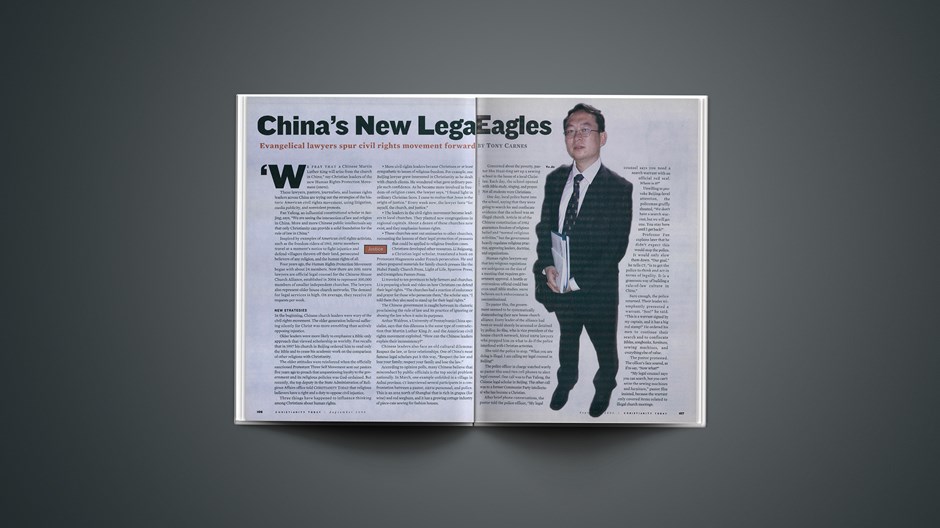
Fan Yafeng, an influential constitutional scholar in Beijing, says, "We are seeing the intersection of law and religion in China. More and more Chinese public intellectuals say that only Christianity can provide a solid foundation for the rule of law in China."
Inspired by examples of American civil rights activists, such as the freedom riders of 1961, HRPM members travel at a moment's notice to fight injustice and defend villagers thrown off their land, persecuted believers of any religion, and the human rights of all.
Four years ago, the Human Rights Protection Movement began with about 24 members. Now there are 300. HRPM lawyers are official legal counsel for the Chinese House Church Alliance, established in 2004 to represent 300,000 members of smaller independent churches. The lawyers also represent older house church networks. The demand for legal services is high. On average, they receive 30 requests per week.
New Strategies
In the beginning, Chinese church leaders were wary of the civil rights movement. The older generation believed suffering silently for Christ was more ennobling than actively opposing injustice.
Older leaders were more likely to emphasize a Bible-only approach that viewed scholarship as worldly. Fan recalls that in 1997 his church in Beijing ordered him to read only the Bible and to cease his academic work on the comparison of other religions with Christianity.
The older attitudes were reinforced when the officially sanctioned Protestant Three Self Movement sent out pastors five years ago to preach that unquestioning loyalty to the government and its religious policies was God-ordained. But recently, the top deputy in the State Administration of Religious Affairs office told Christianity Today that religious believers have a right and a duty to oppose civil injustice.
Three things have happened to influence thinking among Christians about human rights.
• More civil rights leaders became Christians or at least sympathetic to issues of religious freedom. For example, one Beijing lawyer grew interested in Christianity as he dealt with church clients. He wondered what gave ordinary people such confidence. As he became more involved in freedom-of-religion cases, the lawyer says, "I found light in ordinary Christian faces. I came to realize that Jesus is the origin of justice." Every week now, the lawyer fasts "for myself, the church, and justice."
• The leaders in the civil rights movement became leaders in local churches. They planted new congregations in regional capitals. About a dozen of these churches now exist, and they emphasize human rights.
• These churches sent out emissaries to other churches, recounting the lessons of their legal protection of peasants that could be applied to religious freedom cases.
Christians developed other resources. Li Baiguang, a Christian legal scholar, translated a book on Protestant Huguenots under French persecution. He and others prepared materials for family church presses like the Hubei Family Church Press, Light of Life, Sparrow Press, and Gwangzhou Pastors Press.
Li traveled to ten provinces to help farmers and churches. Li is preparing a book and video on how Christians can defend their legal rights. "The churches had a reaction of endurance and prayer for those who persecute them," the scholar says. "I told them they also need to stand up for their legal rights."
The Chinese government is caught between its rhetoric proclaiming the rule of law and its practice of ignoring or abusing the law when it suits its purposes.
Arthur Waldron, a University of Pennsylvania China specialist, says that this dilemma is the same type of contradiction that Martin Luther King Jr. and the American civil rights movement exploited. "How can the Chinese leaders explain their inconsistency?"
Chinese leaders also face an old cultural dilemma: Respect the law, or favor relationships. One of China's most famous legal scholars put it this way, "Respect the law and lose your family; respect your family and lose the law."
According to opinion polls, many Chinese believe that misconduct by public officials is the top social problem nationally. In March, one example unfolded in a village in Anhui province. CT interviewed several participants in a confrontation between a pastor, HRPM personnel, and police. This is an area north of Shanghai that is rich in grapes (for wine) and red sorghum, and it has a growing cottage industry of piece-rate sewing for fashion houses.
Concerned about the poverty, pastor Shu Huai-ting set up a sewing school in the home of a local Christian. Each day, the school opened with Bible study, singing, and prayer. Not all students were Christians.
Article continues below
One day, local police burst into the school, saying that they were going to search for and confiscate evidence that the school was an illegal church. Article 36 of the Chinese constitution of 1982 guarantees freedom of religious belief and "normal religious activities," but the government heavily regulates religious practice, approving leaders, doctrine, and organizations.
Human rights lawyers say that key religious regulations are ambiguous on the size of a meeting that requires government approval. A hostile or overzealous official could ban even small Bible studies. HRPM believes such enforcement is unconstitutional.
To pastor Shu, the government seemed to be systematically dismembering their new house church alliance. Every leader of the alliance had been or would shortly be arrested or detained by police. So Shu, who is vice president of the house church network, hired HRPM lawyers who prepped him on what to do if the police interfered with Christian activities.
Shu told the police to stop. "What you are doing is illegal. I am calling my legal counsel in Beijing!"
The police officer in charge watched warily as pastor Shu used two cell phones to alert legal counsel. One call was to Fan Yafeng, the Chinese legal scholar in Beijing. The other call was to a former Communist Party intellectual who has become a Christian.
After brief phone conversations, the pastor told the police officer, "My legal counsel says you need a search warrant with an official red seal. Where is it?"
Unwilling to provoke Beijing-level attention, the policeman gruffly shouted, "We don't have a search warrant, but we will get one. You stay here until I get back!"
Professor Fan explains later that he didn't expect this would stop the police. It would only slow them down. "Our goal," he tells CT, "is to get the police to think and act in terms of legality. It is a grassroots way of building a rule-of-law culture in China."
Sure enough, the police returned. Their leader triumphantly presented a warrant. "See!" he said. "This is a warrant signed by my captain, and it has a big red stamp!" He ordered his men to continue their search and to confiscate Bibles, songbooks, furniture, sewing machines, and everything else of value.
Article continues below
The pastor protested. The officer's face soured, as if to say, "Now what?"
"My legal counsel says you can search, but you can't seize the sewing machines and furniture," pastor Shu insisted, because the warrant only covered items related to illegal church meetings.
The police officer rebutted, "We are not seizing anything. We are just moving things!"
The reply was worthy of a Laurel and Hardy comedy. But Fan claims that it showed the police felt that they had to at least show the appearance of legality. Weeks later, the pastor was arrested again. This time, the police had all the right papers with red stamps. The pastor only spent a short time in jail.
Good Citizens
For Chinese Christian writer Yu Jie of the HRPM, the experience of pastor Shu is "a hopeful step." Yu, who is one of China's most well-known advocates of democracy, argues that Christians need to learn to be good citizens. They need to prod the government as it takes small steps toward democracy and the rule of law. (See "A More Practical Approach.")
"We cannot rely on the people in power to just hand religious freedom down to us," Yu says.
Yu belongs to Beijing Family Church. His church is not registered with the government, but it is not underground. "We use the designation 'family church.' It is a more neutral term than 'underground church.' We believe you should be above ground and have an active role in society."
The writer is a thorn in the side of the government. His 1998 book Fire and Ice, which sold more than 1 million copies, tartly criticized government corruption. When Yu was arrested in 2003 for drafting a freedom-of-religion statement, 20 million people registered their support for him online.
More Christians in China are beginning to realize that while reform is possible, it happens slowly. One lawyer, who became a Christian last year, tells CT, "Before I believed in God, I wanted to subvert the government [in] one day. After I believed in God, I came to believe that reform is gradual."
Typically, Chinese receive education about the American civil rights movement. King's "I Have a Dream" speech is used in schools, and it inspired China's slogan for the 2008 Olympics, "One World, One Dream."
Martin Luther King Jr. has become a standard for the government to respect. It puts them in a difficult spot when they want to silence incipient Martin Luther Kings in China.
Article continues below
Party leaders are struggling with whether the law serves the Communist Party or whether the party is under the law. The unresolved tension has generated immense social stress. The number of unresolved legal disputes sent to Beijing rose to 30 million in 2005, up from only 20,000 between 1979 and 1982.
Recently, a play about King's civil rights leadership opened in Beijing. The government gave permission to American Caitrin McKiernan to put on the play, which featured gospel singers and was performed on Sundays at the National Theater. Producer McKiernan wondered how Chinese audiences would respond. She found that audiences knew King and related his moral courage to their own situation. According to The New York Times, at a discussion of the civil rights movement at a Beijing university, one student named Paul said, "The significance of Martin Luther King for me is that we have to have the courage to stand up for our legitimate benefits."
Currently, HRPM is preparing dozens of cases to protect villagers from corrupt officials and businessmen and to uphold Chinese citizens' human rights.
China watcher Waldron observes that Chinese Christian human rights activists are a huge challenge for the government. "Li Baiguang and others like him are feared in China. They are citing chapter and verse of laws that are flouted [by the Chinese government]." One Chinese pastor supportive of the civil rights strategy says that "Martin Luther King's phrase sums up the Chinese view: 'I have a dream.' "
Tony Carnes is a senior writer for Christianity Today.















 While we pray for peace, we need moral clarity about this war.
 We’ve got little information on Jesus’ appearance and personality. But that’s the way God designed it.españolFrançais
 The Grammy-winning artist was found dead at her home in Nashville at age 47.






