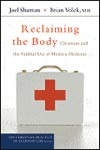
All Christians believe that God matters. Yet the way many Christians use our health care system implies that God doesn't matter. Joel Shuman and Dr. Brian Volck say in Reclaiming the Body: Christians and the Faithful Use of Modern Medicine that Christians navigate the world of doctors, drugs, and hospitals much like non-Christians. They give greater-than-deserved power to what the authors describe as the "mysteriously animated social force" of medicine. Reclaiming the Body is a well-researched and skillfully crafted argument calling Christians to understand and utilize medicine "as if God mattered."
by Joel Shuman and Brian Volck
Brazos Press
192 pp.; $19.99
Shuman and Volck begin by outlining the sociopolitical groundwork that underlies many of our American assumptions about health and medicine. The book debunks the myth that Christianity and modern medicine are pursuing identical goals. Modern medicine, the authors argue, emphasizes the autonomy of the individual and holds up the supreme end of bodily perfection. These goals are not only unattainable, but more importantly, are inconsistent with the Christian faith. The book points out the dangers of society's worship of and allegiance to medicine for its perceived ability to defeat or forestall death. While our Christian beliefs should protect us from this deification of medicine, the authors remind us that we often fall into the same trap.
As a remedy, Shuman and Volck emphasize the practical nature of living in Christian community. They assert that a vital component of a Christian approach to medicine is to proactively engage in "the smelly acts of bodily care." Most readers will see the title and assume that the body we are to reclaim is our physical body, when in fact we are encouraged to reclaim the body of Christ, the church, and its role as it applies to modern medicine.
The fact that most of us think of the body in terms of skin and bone and not the community of faith only proves the authors' point: that health and medicine, like everything else, must be viewed in light of our larger connection to the body of Christ. The book calls the church to become a more "liturgically gathered and dispersed community" so that we might routinely remind ourselves "what 'normal' really looks like." This is the essential first step, the authors argue, toward a Christian life that will show the world it is abnormal, opening the door for Christians to display an approach to medicine that more accurately reflects the character of God.
By their own admission, Shuman and Volck have not produced a work that offers a "five-year plan for the re-Christianizing of medicine." Indeed, they propose that a Christian takeover of the American Medical Association might actually make things worse. Nor do they offer practical steps to take when visiting the doctor or making choices about health care. Rather, Christians are given something deeper: a new lens that enables us to view medicine in a way consistent with what we say we believe.
The authors spend several chapters casting this lens over certain modern phenomena, such as our obsession with body image, the often dysfunctional ways in which modern society treats its children, and the unjust distribution of health resources both within our country and around the world. But we are not given a list of steps to combat these evils. Instead, through personal stories, literary examples, and Scriptural references, we are inspired to find our own ideas that will transform the specific ways in which we each utilize our unique set of health care resources as they apply to these issues and others.
Reclaiming the Body is not a quick read, and it shouldn't be. Shuman and Volck spend the necessary time to expand their argument for using medicine "as if God mattered." The authors cite numerous biblical references and other illustrations in support of their vision, from St. Augustine to Karl Barth, Hamlet and Harry Potter. This book will speak to Christians who are looking for a new way to think about their physical health and what role medicine should play in their lives. It will inspire medical professionals and health care workers to find God in their daily experience and to put God back into places where it seemed God had been permanently removed. It has the potential to completely transform a congregation's ministry to the sick and dying.
Reclaiming the Body presents a compelling vision for Christians as they negotiate the world of health care. It is not a condemnation of modern medicine. Nor does it simply describe how to consecrate our trips to the doctor. Rather, it is a call to transformed Christian living, one that emphasizes the importance of viewing medicine through the lens of the larger community of the body of Christ. Christians who adopt this countercultural approach will not only put medicine in the proper place in their own lives, but will display to the world the glory of Christ through the simple, daily acts of caring for the sick and visiting the doctor.
Article continues below
David Fisher is a family physician and geriatrician and member of the Christian Medical and Dental Association.












 While we pray for peace, we need moral clarity about this war.
 We’ve got little information on Jesus’ appearance and personality. But that’s the way God designed it.españolFrançais
 After lobbying from fellow Southern Baptists and Christians affected by the war, the House speaker moves a package forward.





