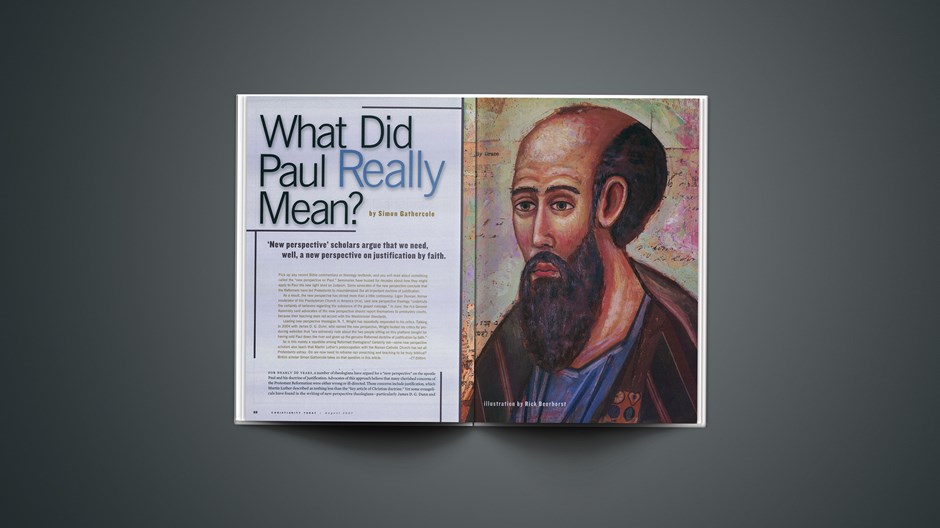
Pick up any recent Bible commentary or theology textbook, and you will read about something called the "new perspective on Paul." Seminaries have buzzed for decades about how they might apply to Paul the new light shed on Judaism. Some advocates of the new perspective conclude that the Reformers have led Protestants to misunderstand the all-important doctrine of justification.
As a result, the new perspective has stirred more than a little controversy. Ligon Duncan, former moderator of the Presbyterian Church in America (PCA), said new perspective theology "undercuts the certainty of believers regarding the substance of the gospel message." In June, the PCA General Assembly said advocates of the new perspective should report themselves to presbytery courts, because their teaching does not accord with the Westminster Standards.
Leading new perspective theologian N. T. Wright has repeatedly responded to his critics. Talking in 2004 with James D. G. Dunn, who named the new perspective, Wright faulted his critics for producing websites that "are extremely rude about the two people sitting on this platform tonight for having sold Paul down the river and given up the genuine Reformed doctrine of justification by faith."
So is this merely a squabble among Reformed theologians? Certainly not—some new perspective scholars also teach that Martin Luther's preoccupation with the Roman Catholic Church has led all Protestants astray. Do we now need to reframe our preaching and teaching to be truly biblical? British scholar Simon Gathercole takes on that question in this article.—CT Editors
***
For nearly 30 years, a number of theologians have argued for a "new perspective" on the apostle Paul and his doctrine of justification. Advocates of this approach believe that many cherished concerns of the Protestant Reformation were either wrong or ill-directed. Those concerns include justification, which Martin Luther described as nothing less than the "key article of Christian doctrine." Yet some evangelicals have found in the writing of new perspective theologians—particularly James D. G. Dunn and N. T. Wright—a key to unlocking Paul's original intent. So what's all the fuss about?
What's So New About Paul?
One point that needs to be clear at the outset is that the new perspective on Paul is not really what it might sound like. For one thing, no secret society meets to promote this new school of thought. Advocates do not even offer a united front: Scholars generally associated with the new perspective argue with each other just as much as traditionalists do. The new perspective is, rather, a convenient umbrella for a current trend in Pauline scholarship with quite a limited agenda.
This leads to a second point. The new perspective does not propose to reevaluate all of Paul's thought. It says nothing new, for example, about the person of Christ, the Holy Spirit, or the Christian life. It is focused narrowly on what Paul says about justification, and even more specifically on what Paul opposes when he talks about justification by faith. In particular, the new perspective investigates the problem Paul has with "works" or "works of the law."
The difference between old and new perspectives can be summed up briefly. In the old perspective, works of the law are human acts of righteousness performed in order to gain credit before God. In the new perspective, works of the law are elements of Jewish law that accentuate Jewish privilege and mark out Israel from other nations.
Two vital ingredients go into the new perspective. The first is actually more a new perspective on Judaism than on Paul. It reacts against the traditional idea that Jews in Paul's day believed they could accumulate merit before God by their deeds. In place of seeing Paul's contemporaries as legalistic, the new perspective says the concern in early Judaism was to maintain the identity of the Jewish nation, especially through observing the Sabbath, circumcising their newborns, and eating kosher. These boundary markers or badges of identity for the Jewish nation distinguished them as belonging to God's covenant people.
Second, this understanding of first-century Judaism is then applied to Paul. According to the new perspective, Paul is only focusing on these aspects of Jewish life (Sabbath, circumcision, food laws) when he mentions "works of the law." His problem isn't legalistic self-righteousness in general. Rather, for Jews these works of the law highlighted God's election of the Jewish nation, excluding Gentiles. Called by God to reach the Gentiles, Paul recognizes that Jews wrongly restricted God's covenant to themselves.
Paul extends these insights to church relations. Just as Jews wrongly restricted God's covenant, so also Jewish Christians wrongly insisted that Gentile Christians needed to observe the law to be full-fledged disciples. This led to the challenge that Paul issued to Peter at Antioch (Gal. 2:11-14). How could Peter withdraw from table fellowship with the Gentiles there? Surely such an action was inconsistent with the truth of the gospel.
Article continues below
These two points are the product of a flurry of literature in the late 1970s and early 1980s. The new perspective on Judaism was argued for largely by E. P. Sanders in his Paul and Palestinian Judaism (1977). Sanders was particularly concerned about anti-Jewish tendencies in the old perspective and its portrayal of Judaism as inferior to Christianity. Sanders's aim was to present a cleaned-up picture of early Judaism, untainted by Christian prejudice. He argued that both pre-Christian Judaism and its successor, rabbinic Judaism, had just as strong an emphasis on grace as Pauline Christianity did. Election was central to Judaism, as was God's redemption of his people from Egypt. Observing the law merely kept Jews in the covenant established by God.
Scholars received Sanders's work as a major contribution to Jewish studies. But it fell rather flat when applied to Pauline scholarship. So N. T. Wright and James D. G. Dunn, along with Sanders, attempted to integrate this new view of Judaism more successfully with a new view of Paul. They focused on "exclusivism," the sense of national righteousness maintained by practices such as Sabbath-observance, circumcision, and keeping kosher. Paul, the new perspective argued, dedicated himself to warning against exclusivist national righteousness. God was bringing people from all nations to believe in the Messiah.
Happy Beginning, Sad Ending
Almost all scholars, new and old, agree that Paul answers the problem of "works of the law" with "faith." But if the new perspective has shifted how we understand works of the law, then the meaning of faith—or at least the emphasis of it—needs to shift as well. In the old perspective, faith means trust in God's mercy alone, not in human acts of righteousness. In the new perspective, faith is a badge, or identity marker, which can be shared by all, Jew and Gentile.
The new perspective does not necessarily deny the traditional meaning of faith, but rather finds its focus elsewhere. Faith remains central to Paul's doctrine of justification, because it means that Gentiles do not need to become Israelites when they become Christians. According to the new perspective, Paul accentuates this point in the early chapters of his letter to the Romans.
Article continues below
Galatians makes the same point in a different setting. Here, Paul finds the problem inside the church. Galatians 2 breaks the rules of good storytelling with a happy beginning and a sad ending. Initially, Peter and Paul agree at their meeting in Jerusalem about law-observance not being necessary for Gentiles (Gal. 2:1-10). Later, in Antioch, Peter rebuilds the barrier between Jews and Greeks. Nervous about his reputation as a traditional Jew, he withdraws from table fellowship with the Gentiles (2:11-14). Paul considers this move a disaster. So he castigates Peter and reminds him how faith and faith alone—not works of the law—mark people out as belonging to God's covenant (2:15-16). Faith means that Jew and Gentile must eat together.
Following this pattern, justification by faith and not by works of the law focuses on God's acceptance not only of Jews but also of Gentiles. Some have argued that Paul makes this point most clearly in Romans 3:28-30: "For we maintain that a man is justified by faith apart from observing the law [literally, "apart from works of the law"]. Is God the God of Jews only? Is he not the God of Gentiles too? Yes, of Gentiles too, since there is only one God, who will justify the circumcised by faith and the uncircumcised through that same faith." Advocates of the new perspective tend to read this passage as a statement about God welcoming Gentiles, who then need not observe Jewish practices, such as Sabbath-keeping, circumcision, and a kosher diet. This interpretation would then be confirmed by what follows: a focus again on the fact that God is not the God merely of a single nation, but of Jew and Gentile alike (verses 29-30).
The New Perspective Assessed
The new perspective cannot merely be written off as a disaster from start to finish, as some critics would have us believe. One of the most important benefits of the new perspective on Paul is that it accentuates the worldwide focus of God's dealings in Christ. Paul uses justification to highlight how all Christians, Jewish and Gentile, come to God on the same basis—that of faith.
The new perspective also elevates our historical awareness of Paul's situation. There are certainly important ways in which Paul's debate with his Jewish contemporaries anticipates later controversies—between Augustine and Pelagius, for instance, and to a lesser extent between Luther and his opponents. But we must not read Paul merely with our favorite debate from church history in mind. E. P. Sanders rightly detects in much of the traditional Protestant description of Judaism an anxiety about Roman Catholic works-righteousness crouching at the door. This leads us to Sanders's concern with portraying Judaism in a fair and unprejudiced light. This is also an important contribution: There can be no place in the church for cheap caricatures of Judaism. Sanders has encouraged scholars to look seriously at Jewish sources around the time of Paul to understand what they really say.
Article continues below
Nevertheless, other scholars have shown that Sanders himself presents a one-sided view in his reaction against the one-sided traditional view of Judaism. So the close examination of these sources is still an important area of scholarly research. We also need to be careful in how we talk about Judaism from the pulpit and in our conversations about Scripture. Christians must avoid cheap caricatures as well as a politically correct anxiety about saying that Jews need to hear the gospel.
Similarly, when pastors preach on the Gospels and Acts, they must distinguish between criticism delivered by Jesus and Paul against their contemporaries, on the one hand, and their high regard for the law of Moses on the other. Some Jews in the first century clearly did interpret the law in a way that imposed strictures foreign to the Torah. But we must not criticize the law itself, as if it were a body of petty rules and regulations. To do so would be to criticize God himself. His law is "holy, righteous, and good" (Rom. 7:12).
Six Tendencies
On the other side, there are a few points at which the new perspective is, in my judgment, at fault.
1. We need to go back to E. P. Sanders and his insistence that Judaism in Paul's day did not think in terms of salvation as something earned or gained by obedience to the law. Now it is certainly the case that Protestant scholarship had previously exaggerated this fact, but it is not wrong either. Documents from around the time of Paul state that some Jews believed obedience to the law was rewarded on the final day with salvation: "The one who does righteousness stores up life for himself with the Lord" (Psalms of Solomon, c. 50 B.C.). "Miracles, however, will appear at their own time to those who are saved by their works" (2 Baruch, c. A.D. 100). There are a number of examples like this. Paul's understanding of justification makes sense, then, as a criticism of law observance as the means to eternal life (see Rom. 3:20). Many of Paul's contemporaries seem to have believed that obedience was possible without a radical inbreaking of God.
Article continues below
For Paul on the other hand, salvation was impossible without the earth-shattering events of the Cross, Resurrection, and Pentecost. I mentioned previously that for Sanders, observance of the law was merely how people stayed in the covenant that God had already established. But obedience for Paul was no mere formality. It took mighty acts of God to make it possible.
2. Does Paul think primarily of circumcision, Sabbath observance, and food laws when he uses the phrase "works of the law"? My own view, and that of a number of other scholars, is that Paul focuses on observance of the law as a whole. Works of the law simply means doing the law—the law in its entirety. So the issue at stake with works of the law is not so much Jewish identity as the ability of Israelites as human beings to obey the entire law. We shall return to this point later.
3. Criticism of "individualistic" readings of Paul can throw the baby out with the bathwater. Some new perspective scholars want to guard against individualistic understandings of justification. Seeing faith to be transcultural, available to both Jew and Gentile, these scholars shift the emphasis from personal conversion toward the larger canvas of God's dealings in salvation history. But we cannot escape the dimensions of conversion and personal faith in Paul. These are vitally important: The church is not a lump of humanity, but an assembly of individuals. Faith according to Paul is exercised by individuals (e.g. Rom. 4:5; 12:3; Gal. 2:20), and is also a feature of churches (e.g. Rom. 1:8; Col. 1:4). Individual and corporate faith are not at odds with one another.
4. A further tendency of the new perspective is to confuse the content of justification with its applications. It is true to say that justification by faith is about including Gentiles into the people of God. But it is essential to see that the core meaning of justification by faith is about how believers, despite their sin, can be reckoned as righteous before God. Then we can speak of the scope of justification, which is for all who believe, from every tongue, tribe, and nation. Unfortunately, in some hands, the emphasis on inclusion as a primary component of justification can have two further effects.
5. Seeing justification as primarily addressing how Gentiles can be incorporated into the people of God can lead to a downplaying of sin. This approach to justification can lose sight of Paul's vital concern for how sinners can be made righteous. One leading New Testament scholar has described his view of justification as God building an extra room in his house for Gentiles. But this view neglects the fact that Israelites as well as Gentiles are sinners and need to be justified.
Article continues below
6. Since the emphasis in some discussions of justification is on inclusion, tolerance, and ecumenism, there can be a tendency to downplay the importance of doctrinal clarity. One recent commentary on Romans emphasizes mutual acceptance as the key to the book. It is revealing that the commentator then regards Romans 16:17-20 as a later interpolation, because the passage emphasizes teaching doctrine and staying away from heretics. Paul insists, however, that unity and doctrine are not mutually exclusive. True unity comes not at the expense of doctrine, but precisely around the central truths of the gospel.
Once again, it needs to be remembered that the new perspective does not put forward a single, united front. As a result, these criticisms will not all apply to one person at the same time. They are, however, tendencies to keep an eye out for when studying the new perspective.
Hard Hearts Need Justification
It's not enough, though, to interact with scholarship about Paul. We also need to understand what the Bible teaches about justification.
"God is the justifier!" (Rom. 8:33). The triune God, out of his great love, sent his Son to die as a substitute. On this basis, he justifies believers (Rom. 5:1-11). But what happens in the event of justification? The word itself has been interpreted in a number of different ways, so it's helpful to turn to biblical passages that define it. The apostle Paul derives his definition from the Old Testament—specifically, Genesis 15:6: "What does the Scripture say? 'Abraham believed God, and it was credited to him as righteousness'" (Rom. 4:3, quoting Gen. 15:6).
In the Old Testament, "righteousness" is the status that an Israelite received when he or she fully observed the requirements of the law: "And if we are careful to obey all this law before the Lord our God, as he has commanded us, that will be our righteousness" (Deut. 6:25). The tragedy of the covenant, however, is that despite God's glorious provision of redemption and of his Torah, the Israelites often behaved just like Gentiles. Stiff-necked and hard-hearted, they rebelled against God. They never attained the status of righteousness, which they would have possessed had they lived up to the ideal in Deuteronomy.
Article continues below
But this status of righteousness is precisely what is granted to those who have faith in Christ. Although these former idolaters traded in the glory of God and disobediently suppressed the truth, God now declares them righteous—declares them to have fulfilled everything in his presence that he has commanded. This "in his presence" (or "before the Lord our God" in Deut. 6:25) is important. Justification, in which righteousness is reckoned to us, is both a legal declaration of our status and a statement about our relationship with God. People who are sinners are declared by God to have done all that he has commanded.
This justification, made possible through the cross of Christ, means we don't need to be anxious before God. There is nothing that can come between the justified person and the everlasting blessing of life with God on the other side of Judgment Day. The phrase from Romans 8:33, "God is the justifier," is Paul's answer to the question of whether it is possible for anyone to bring a charge against God's elect. Of course not! Paul is almost certainly alluding here to Isaiah's great testimony about the Lord:
He who vindicates me is near.
Who then will bring charges against me?
Let us face each other!
Who is my accuser?
Let him confront me!
It is the Sovereign Lord who helps me.
Who is he that will condemn me?
They will all wear out like a garment;
the moths will eat them up
(Isa. 50:8-9).
Justification by Faith
Faith is another term that Paul helpfully defines. (Paul isn't always as difficult to understand as he is cracked up to be!) He returns to the Genesis narrative and Abraham's response to God's promise, offering this clear description of faith: "Against all hope, Abraham in hope believed and so became the father of many nations, just as it had been said to him, 'So shall your offspring be.' Without weakening in his faith, he faced the fact that his body was as good as dead—since he was about a hundred years old—and that Sarah's womb was also dead. Yet he did not waver through unbelief regarding the promise of God, but was strengthened in his faith and gave glory to God, being fully persuaded that God had power to do what he had promised. This is why 'it was credited to him as righteousness'" (Rom. 4:18-22).
Article continues below
We can see from this passage three particularly important aspects of faith (or believing—they are forms of the same word in Greek).
1. Abraham recognized the futility of his own future without God and God's help. God promised that Abraham's descendants would be as numerous as the stars, yet humanly speaking this was impossible: Abraham "faced the fact that his body was as good as dead," and when he did trust God, it was "against all hope." So trusting God is not something we simply add on to our life. Christian faith requires a complete reorientation of our whole attitude.
2. But faith is not merely an attitude—it is also the response to God's specific promises. In Abraham's case, his faith answers the divine word, "So shall your offspring be." Faith is not content-less humility that places our hope in a higher power. No, in faith we answer the divine word and its specific verbal content. God speaks, and we believe in him in response to his word. God made particular promises to Abraham, and in Romans 4, Paul goes on to say that God promises justification to those who trust in him as the one who raised Jesus from the dead (Rom. 4:23-25; see also Rom. 10:9).
3. Faith focuses not only on what God has said but also on his character. Abraham trusted that "God had power to do what he had promised." Biblical faith mirrors God, the object of that faith. In everyday life, we generally have different kinds of faith in different people, according to the nature of the relationship. We have a certain kind of faith in a spouse, another kind in a doctor, and a different sort in relation to a pastor or a friend. By telling us who God is, the Bible defines what kind of faith we must place in him: He is the God who justifies the ungodly (Rom. 4:5), who creates out of nothing (4:17), and who raised Jesus from the dead (4:24). Utterly all-powerful, he wields that power to bring righteousness where there was none, creation where there was none, and life where there was none. That's the God we believe in.
Not by Works of the Law
So what is wrong with works of the law? They are associated with the flesh, Paul answers. (The NASB helpfully preserves the old-fashioned sounding flesh, for a more literal translation of the key passages.) "Works of the law" means obedience to the law done outside of Christ, without the new-creating power of the Holy Spirit. In this condition, it is clearly impossible to observe the law, "because by the works of the law no flesh will be justified in his sight; for through the law comes the knowledge of sin" (Rom. 3:20, NASB). Paul has seen this borne out in Israel's history. Even this nation "entrusted with the very oracles of God" (Rom. 3:2), given a law that was "holy, righteous, and good" (Rom. 7:12), could not please God.
Article continues below
The flesh is powerless to obey. "For what the law could not do, weak as it was through the flesh, God did" (Rom. 8:3, NASB). Trying to obey the law through the flesh is like trying to climb a sheer rock face with no foothold or handhold, without equipment. It can't be done.
In fact, the problem runs deeper than the flesh's weakness. The flesh even wars with God: "Because the mind set on the flesh is hostile toward God; for it does not subject itself to the law of God, for it is not even able to do so" (Rom. 8:7, NASB). Do revolutionaries follow the law? No—they seek to overthrow it. We sometimes present sin as people's failure in varying degrees to reach God's standards. But Romans 8:7 shows that we do not even start to please God. The problem with works of the law, according to Paul, is that stiff-necked human beings, left to their own devices, cannot get anywhere near pleasing God.
Paul makes it clear to the Romans that God reckons righteousness purely by grace. He stresses that God is the sole operator in salvation. There is no place for the program offered by the law, that "if we are careful to obey all this law before the Lord our God, as he has commanded us, that will be our righteousness" (Deut. 6:25). As we have seen, it is not that we have accomplished some successful law-observance that needs to be topped off by God to make a full quota. No, we have not left the starting blocks as far as righteousness is concerned. God acts so that it is obvious to all that he alone does the whole saving work. "And if by grace, then it is no longer by works; if it were, grace would no longer be grace" (Rom. 11:6).
At its core, the doctrine of justification says that sinners can be miraculously reckoned righteous before God. This happens for all who believe and has nothing to do with observance of the law, which for sinners is impossible. With this foundation in place, we can move on to see how Paul uses the doctrine of justification by faith. The new perspective rightly observes that Paul uses justification to argue that Gentile Christians need not take on the yoke of the law (Galatians) and that Jewish Christians and Gentile Christians should live together in harmony (Romans 14-15). While we must not neglect these demands, we should not allow the tail to wag the dog.
Article continues below
Simon Gathercole is senior lecturer in New Testament at the University of Aberdeen. He was recently appointed a lecturer at the University of Cambridge, starting in October.
A recent Christianity Today editorial outlined why justification by faith alone is still Protestants' defining doctrine.
The Paul Page has original articles and interviews about the new perspective on Paul, as well as links to journal articles, books, and other materials around the web.
Scot McKnight has also blogged about the new perspective in Jesus Creed.
The Wall Street Journal published John Wilson's op-ed on N.T. Wright and the new perspective.
Many of N. T. Wright's papers and sermons on Paul are available on an unofficial site.
Nothing But the Blood | More and more evangelicals believe Christ's atoning death is merely a grotesque creation of the medieval imagination. Really? (May 1, 2006)
Sticking Points | Despite recent rapprochement, evangelicals and Catholics remain far apart on key issues. (December 2005)
The Gospel of Jesus Christ | An introduction to "The Gospel of Jesus Christ: An Evangelical Celebration."(David Neff, February 1, 2000)
Theology: Does The Gift of Salvation Sell Out the Reformation? | The recent statement from evangelical and Roman Catholic leaders on the Christian doctrine of justification "sells out" the Reformation, according to James Boice, chairman of the Alliance of Confessing Evangelicals (ACE). (April 27, 1998)
Article continues below
Paid in Full | The sacrifice of Calvary was not a part payment; it was a complete and perfect payment. (Charles H. Spurgeon, February 9, 1998)
Should Catholics and Evangelicals Join Ranks? | A recent document entitled Evangelicals and Catholics Together gives a resounding yes to this question. (July 18, 1994)
Also: Why I Signed it, Parts 1 and 2
Have something to add about this? See something we missed? Share your feedback here.
Our digital archives are a work in progress. Let us know if corrections need to be made.















 While we pray for peace, we need moral clarity about this war.
 A Christian reconciliation group in Israel and Palestine warned that war would come. Now the war threatens their relevance.العربيةFrançais
 Leader explains why the movement is seeing its biggest membership bump in 30 years and its mission for the years ahead.






