The recent fighting between the Lebanese army and Islamist militants at the Nahr el-Bared refugee camp was possibly the worst internal violence in Lebanon since the civil war ended in 1990. About one year ago, peace in Lebanon was shattered after militants with Hezbollah, the Iran-supported terrorist group, killed three Israeli soldiers and took two others as hostages near the Israeli border. That set off eight weeks of violence in the region. Four thousand rockets and countless bombs later, 162 Israelis and more than 1,000 Lebanese were dead, and billions of dollars in property were destroyed. Hezbollah still has the hostages.
Such violence is taking place in a unique country in the Middle East, the nation with the highest percentage of Christians in the region. That percentage is falling, as it is elsewhere in the region, but Christians were the majority until 40 years ago. At the village level, Christian and Muslim relationships sometimes go back generations. One cannot understand Lebanon's situation without taking into account its distinctive religious environment.
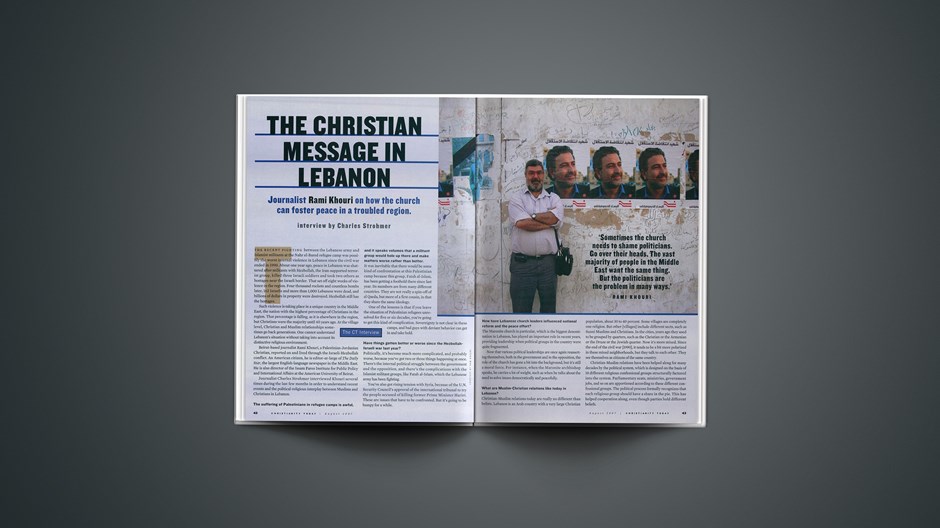
Beirut-based journalist Rami Khouri, a Palestinian-Jordanian Christian, reported on and lived through the Israeli-Hezbollah conflict. An American citizen, he is editor-at-large of The Daily Star, the largest English-language newspaper in the Middle East. He is also director of the Issam Fares Institute for Public Policy and International Affairs at the American University of Beirut.
Journalist Charles Strohmer interviewed Khouri several times during the last few months in order to understand recent events and the political-religious interplay between Muslims and Christians in Lebanon.
The suffering of Palestinians in refugee camps is awful, and it speaks volumes that a militant group would hole up there and make matters worse rather than better.
It was inevitable that there would be some kind of confrontation at this Palestinian camp because this group, Fatah al-Islam, has been getting a foothold there since last year. Its members are from many different countries. They are not really a spin-off of al Qaeda, but more of a first cousin, in that they share the same ideology.
One of the lessons is that if you leave the situation of Palestinian refugees unresolved for five or six decades, you're going to get this kind of complication. Sovereignty is not clear in these camps, and bad guys with deviant behavior can get in and take hold.
Have things gotten better or worse since the Hezbollah-Israeli war last year?
Politically, it's become much more complicated, and probably worse, because you've got two or three things happening at once. There's the internal political struggle between the government and the opposition, and there's the complications with the Islamist militant groups, like Fatah al-Islam, which the Lebanese army has been fighting.
You've also got rising tension with Syria, because of the U.N. Security Council's approval of the international tribunal to try the people accused of killing former Prime Minister Hariri. These are issues that have to be confronted. But it's going to be bumpy for a while.
'Sometimes the church needs to shame politicians. Go over their heads. The vast majority of people in the Middle East want the same thing. But the politicians are the problem in many ways.' —Rami Khouri
How have Lebanese church leaders influenced national reform and the peace effort?
The Maronite church in particular, which is the biggest denomination in Lebanon, has played an important role in recent years, providing leadership when political groups in the country were quite fragmented.
Now that various political leaderships are once again reasserting themselves, both in the government and in the opposition, the role of the church has gone a bit into the background, but it's still a moral force. For instance, when the Maronite archbishop speaks, he carries a lot of weight, such as when he talks about the need to solve issues democratically and peacefully.
What are Muslim-Christian relations like today in Lebanon?
Christian-Muslim relations today are really no different than before. Lebanon is an Arab country with a very large Christian population, about 30 to 40 percent. Some villages are completely one religion. But other [villages] include different sects, such as Sunni Muslims and Christians. In the cities, years ago they used to be grouped by quarters, such as the Christian or the Armenian or the Druze or the Jewish quarter. Now it's more mixed. Since the end of the civil war [1990], it tends to be a bit more polarized in these mixed neighborhoods, but they talk to each other. They see themselves as citizens of the same country.
Christian-Muslim relations have been helped along for many decades by the political system, which is designed on the basis of 18 different religious confessional groups structurally factored into the system. Parliamentary seats, ministries, government jobs, and so on are apportioned according to these different confessional groups. The political process formally recognizes that each religious group should have a share in the pie. This has helped cooperation along, even though parties hold different beliefs.
Article continues below
How has the church responded to the struggle for more democratic change in Lebanon?
The church has generally reacted at the broad level of principles, of wanting, for instance, to make sure that all the groups in the country are treated equally and fairly and get their basic rights guaranteed.
The church has also focused heavily on Christian values of peace, love, brotherhood, and forgiveness, and solving issues peacefully and democratically. This has been a very clear role of the churches.
What can American Christians learn about Islam from Lebanese Christians?
It's a different situation in the States. In the States, you have a much smaller Muslim community. In the Middle East, Christian, Muslims, and Jews have existed together for more than 1,000 years. Pluralism and understanding each other's religion isn't that big of a deal. Because these relationships are much newer in the U.S., there's a lot of effort being made to understand each other's religions better. The best antidote to misunderstandings, stereotypes, and racist misperceptions is for people to meet each other. There's nothing that has as much impact as physically getting together, chatting, having a cup of coffee, or going to someone's house. It doesn't matter what the context is, whether it's business or education or tourism or sports or political engagement.
American Christians could look at Christian Palestinians or Christian Arabs as a potential window into the minds of millions of Muslim Arabs. You would find that what Christian Arabs are feeling is very similar to what Muslim Arabs are feeling. So the real issues at play, in Lebanon and throughout the Middle East, are not religious but political. People may call on their religious vocabulary and metaphors and iconography, but we should look beyond the surface manifestations of those religious symbols to the political realities.
How can American Christians help the church in Lebanon?
Speak out for the rights of all people on the basis of Christian values that we all agree on, such as equality, mercy, and forgiveness. In June, I attended a memorial Mass in Beirut for Samir Kassir, a prominent Lebanese journalist and writer who was killed in a car bomb explosion two years ago.
The Greek Orthodox priest who spoke gave a short homily in which he said that when we look back at this murder and other deaths, we have to remember two things: love and forgiveness. It's the Christian message.
Article continues below
If you translate that into political terms, it means equality, making sure that all people are treated decently. American Christians should affirm that foreign policies of the United States reflect Christian values, should treat people equally, not discriminate, not use expediency, but be constantly seeking reconciliation and peaceful resolution of disputes according to the rule of law. [They should] translate Christian moral values into operative political policies.
What is a Christian strategy that could move the ball forward for a region-wide solution?
It would be fascinating to bring Christian, Muslim, and Jewish senior religious leaders together to talk about explicitly political issues. Religious leaders don't have enough impact on politics like what Martin Luther King Jr. did in the States or what Bishop Tutu and the church did in South Africa. I thought that was a good role for religious leaders to play.
Sometimes, it's not just about getting the ear of politicians. Sometimes, the church needs to shame politicians. Go over their heads. The vast majority of people in the Middle East want the same thing. But the politicians are the problem in many ways. So it would be good if various religious leaderships together explored a way to make the moral values of Christianity, Islam, and Judaism more pertinent to the resolution of political conflict. Political leaders need to affirm the relevance of moral and faith values and somehow get them to underpin the political process and negotiations. One way to do that is to get these religious leaders together to explicitly talk about political issues.
Charles Strohmer, a visiting research fellow at the Center for Public Justice in Washington, D.C., is writing a book on U.S. relations in the Middle East.















 While we pray for peace, we need moral clarity about this war.
 As my doubts about his teachings grew, so did a secret fascination with Jesus.
 Christian artists work at the intersection of music and climate change.






