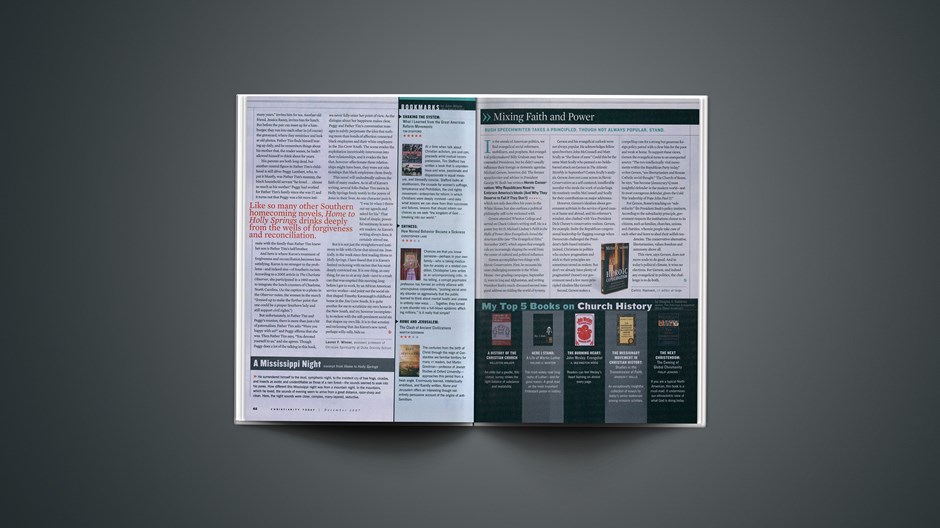
In the annals of American politics, we find evangelical social reformers, mobilizers, and prophets. But evangelical policymakers? Billy Graham may have counseled Presidents, but he didn't usually influence their foreign or domestic agendas. Michael Gerson, however, did. The former speechwriter and adviser to President George W. Bush has written Heroic Conservatism: Why Republicans Need to Embrace America's Ideals (And Why They Deserve to Fail If They Don't), which not only describes his years in the White House, but also outlines a political philosophy still to be reckoned with.
Gerson attended Wheaton College and served on Chuck Colson's writing staff. He is a poster boy for D. Michael Lindsay's Faith in the Halls of Power: How Evangelicals Joined the American Elite (see "The Evangelical Elite"), which argues that evangelicals are increasingly shaping the world from the center of cultural and political influence.
Gerson accomplishes two things with Heroic Conservatism. First, he recounts his most challenging moments in the White House—two grueling campaigns, September 11, wars in Iraq and Afghanistan, and writing President Bush's much-discussed second inaugural address on ridding the world of tyranny.
Gerson and his evangelical outlook were not always popular. He acknowledges fellow speechwriters John McConnell and Matt Scully as "the finest of men." Could this be the same Matt Scully who penned a no-holds-barred attack on Gerson in The Atlantic Monthly in September? Contra Scully's analysis, Gerson does not come across in Heroic Conservatism as a self-centered, insufferable moralist who steals the work of underlings. He routinely credits McConnell and Scully for their contributions on major addresses.
However, Gerson's idealism about government activism in the service of good causes at home and abroad, and his reformer's mindset, also clashed with Vice President Dick Cheney's conservative realism. Gerson, for example, faults the Republican congressional leadership for flagging courage when Democrats challenged the President's faith-based initiative. Indeed, Christians in politics who eschew pragmatism and stick to their principles are sometimes tarred as zealots. But don't we already have plenty of pragmatists? Doesn't our government need a few more principled idealists like Gerson?
Second, Gerson makes a compelling case for a strong but generous foreign policy, paired with a clear bias for the poor and weak at home. To support these views, Gerson the evangelical turns to an unexpected source: "The two intellectually vital movements within the Republican Party today," writes Gerson, "are libertarianism and Roman Catholic social thought." The Church of Rome, he says, "has become [democracy's] most insightful defender in the modern world—and its most courageous defender, given the Cold War leadership of Pope John Paul II."
For Gerson, Rome's teaching on "subsidiarity" fits President Bush's policy instincts. According to the subsidiarity principle, government respects the institutions closest to its citizens, such as families, churches, unions, and charities, wherein people take care of each other and learn to shed their selfish tendencies. The conservative alternative, libertarianism, values freedom and autonomy above all.
This view, says Gerson, does not move souls to do good. And in today's political climate, it wins no elections. For Gerson, and indeed any evangelical in politics, the challenge is to do both.

















 While we pray for peace, we need moral clarity about this war.
 As my doubts about his teachings grew, so did a secret fascination with Jesus.
 Interview with leader of new evangelical alliance describes his escape from Khartoum and the pressure to pick a side.






