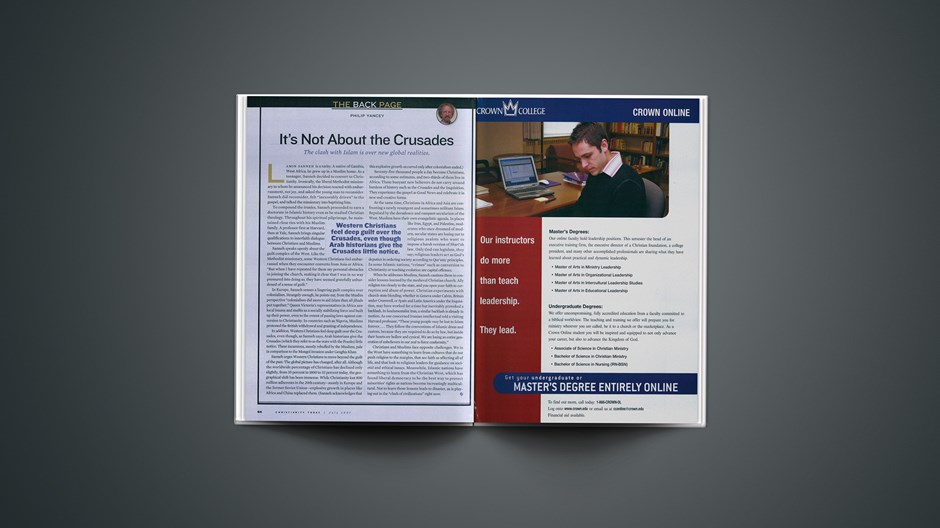
Lamin Sanneh is a rarity. A native of Gambia, West Africa, he grew up in a Muslim home. As a teenager, Sanneh decided to convert to Christianity. Ironically, the liberal Methodist missionary to whom he announced his decision reacted with embarrassment, not joy, and asked the young man to reconsider. Sanneh did reconsider, felt "inexorably driven" to the gospel, and talked the missionary into baptizing him.
To compound the ironies, Sanneh proceeded to earn a doctorate in Islamic history even as he studied Christian theology. Throughout his spiritual pilgrimage, he maintained close ties with his Muslim family. A professor first at Harvard, then at Yale, Sanneh brings singular qualifications to interfaith dialogue between Christians and Muslims.
Sanneh speaks openly about the guilt complex of the West. Like the Methodist missionary, some Western Christians feel embarrassed when they encounter converts from Asia or Africa. "But when I have repeated for them my personal obstacles in joining the church, making it clear that I was in no way pressured into doing so, they have seemed gratefully unburdened of a sense of guilt."
In Europe, Sanneh senses a lingering guilt complex over colonialism. Strangely enough, he points out, from the Muslim perspective "colonialism did more to aid Islam than all jihads put together." Queen Victoria's representatives in Africa saw local imams and muftis as a socially stabilizing force and built up their power, even to the extent of passing laws against conversion to Christianity. In countries such as Nigeria, Muslims protested the British withdrawal and granting of independence.
In addition, Western Christians feel deep guilt over the Crusades, even though, as Sanneh says, Arab historians give the Crusades (which they refer to as the wars with the Franks) little notice. These incursions, mostly rebuffed by the Muslims, pale in comparison to the Mongol invasion under Genghis Khan.
Sanneh urges Western Christians to move beyond the guilt of the past. The global picture has changed, after all. Although the worldwide percentage of Christians has declined only slightly, from 35 percent in 1800 to 33 percent today, the geographical shift has been immense. While Christianity lost 800 million adherents in the 20th century—mostly in Europe and the former Soviet Union—explosive growth in places like Africa and China replaced them. (Sanneh acknowledges that this explosive growth occurred only after colonialism ended.)
Seventy-five thousand people a day become Christians, according to some estimates, and two-thirds of them live in Africa. These buoyant new believers do not carry around burdens of history such as the Crusades and the Inquisition. They experience the gospel as Good News and celebrate it in new and creative forms.
At the same time, Christians in Africa and Asia are confronting a newly resurgent and sometimes militant Islam. Repulsed by the decadence and rampant secularism of the West, Muslims have their own evangelistic agenda. In places like Iran, Egypt, and Palestine, moderates who once dreamed of modern, secular states are losing out to religious zealots who want to impose a harsh version of Shari'ah law. Only God can legislate, they say; religious leaders act as God's deputies in ordering society according to Qur'anic principles. In some Islamic nations, "crimes" such as conversion to Christianity or teaching evolution are capital offenses.
When he addresses Muslims, Sanneh cautions them to consider lessons learned by the medieval Christian church. Ally religion too closely to the state, and you open your faith to corruption and abuse of power. Christian experiments with church-state blending, whether in Geneva under Calvin, Britain under Cromwell, or Spain and Latin America under the Inquisition, may have worked for a time but inevitably provoked a backlash. In fundamentalist Iran, a similar backlash is already in motion. As one concerned Iranian intellectual told a visiting Harvard professor, "These young people may be lost to Islam forever. … They follow the conventions of Islamic dress and custom, because they are required to do so by law, but inside their hearts are hollow and cynical. We are losing an entire generation of unbelievers in our zeal to force conformity."
Christians and Muslims face opposite challenges. We in the West have something to learn from cultures that do not push religion to the margins, that see faith as affecting all of life, and that look to religious leaders for guidance on societal and ethical issues. Meanwhile, Islamic nations have something to learn from the Christian West, which has found liberal democracy to be the best way to protect minorities' rights as nations become increasingly multicultural. Not to learn those lessons leads to disaster, as is playing out in the "clash of civilizations" right now.
Putting the Crusades in Perspective | Do your homework before you see Sir Ridley Scott's "Kingdom of Heaven" this May. (Christian News & Research, February 22, 2005)
A Muslim Perspective on War | "Muslim response to the Crusades showed jihad in action, and while the grievances have changed, the rhetoric still echoes." (October 1, 2001)
Yancey's other columns on the Middle East include:
Middle East Morass | Learning to regard people in light of what they suffer
Fear and Faith in the Middle East | As I remember my trip to Lebanon, I think how easy it is to write about the gospel from my serene perch in Colorado.
Have something to add about this? See something we missed? Share your feedback here.
Philip Yancey is editor at large of Christianity Today and cochair of the editorial board for Books and Culture. Yancey's most recent book is What Good Is God?: In Search of a Faith That Matters. His other books include Prayer (2006), Rumors of Another World (2003), Reaching for the Invisible God (2000), The Bible Jesus Read (1999), What's So Amazing About Grace? (1998), The Jesus I Never Knew (1995), Where is God When It Hurts (1990), and many others. His Christianity Today column ran from 1985 to 2009.















 While we pray for peace, we need moral clarity about this war.
 A Christian reconciliation group in Israel and Palestine warned that war would come. Now the war threatens their relevance.العربيةFrançais
 We must always be people of the Word, but we’ll have to reimagine deep engagement with Scripture.






