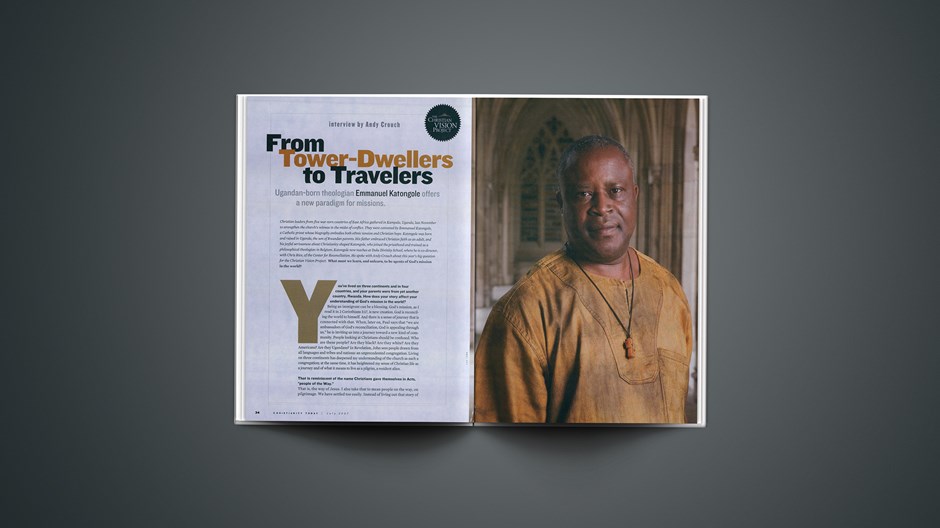
Christian leaders from five war-torn countries of East Africa gathered in Kampala, Uganda, last November to strengthen the church's witness in the midst of conflict. They were convened by Emmanuel Katongole, a Catholic priest whose biography embodies both ethnic tension and Christian hope. Katongole was born and raised in Uganda, the son of Rwandan parents. His father embraced Christian faith as an adult, and his joyful seriousness about Christianity shaped Katongole, who joined the priesthood and trained as a philosophical theologian in Belgium. Katongole now teaches at Duke Divinity School, where he is co-director, with Chris Rice, of the Center for Reconciliation. He spoke with Andy Crouch about this year's big question for the Christian Vision Project: What must we learn, and unlearn, to be agents of God's mission in the world?
You've lived on three continents and in four countries, and your parents were from yet another country, Rwanda. How does your story affect your understanding of God's mission in the world?
Being an immigrant can be a blessing. God's mission, as I read it in 2 Corinthians 5:17, is new creation. God is reconciling the world to himself. And there is a sense of journey that is connected with that. When, later on, Paul says that "we are ambassadors of God's reconciliation, God is appealing through us," he is inviting us into a journey toward a new kind of community. People looking at Christians should be confused. Who are these people? Are they black? Are they white? Are they Americans? Are they Ugandans? In Revelation, John sees people drawn from all languages and tribes and nations: an unprecedented congregation. Living on three continents has deepened my understanding of the church as such a congregation; at the same time, it has heightened my sense of Christian life as a journey and of what it means to live as a pilgrim, a resident alien.
That is reminiscent of the name Christians gave themselves in Acts, "people of the Way."
That is, the way of Jesus. I also take that to mean people on the way, on pilgrimage. We have settled too easily. Instead of living out that story of journey toward a new creation, we tend to live out the stories of nationality. And then we forget what it means to journey. It's not difficult to see why we settle, because our nations or tribes or races try to convince us that life can't get any better than this. They ask us, "Where would you want to go? Why would you want to leave?" This is not just something that happens in a superpower like America. Even small nations like Rwanda, even small tribes, have an America-sized imagination of themselves!
The challenge that Christianity faces in our time is the challenge of tribalism. There's a church in Rwanda where the baptismal font still stands. But it bears the scars of being hacked by machetes, and the church was littered with thousands of bones of people who were killed. You couldn't find a more strange and ironic and tragic image than that: a common baptism surrounded by killing in the name of Hutu and Tutsi.
Many of us feel we are beyond that, but the dynamics of national identity remain—even of ecclesial identity. We can be settled in our Catholic power. We can be settled in our Baptist, Episcopalian, Pentecostal, or evangelical identity, and we feel a certain power from that. We think that our mission derives from that power.
The story of the tower of Babel begins with people settled in the land. The tower speaks of strength, power, and stability. It speaks of the ability to stand above the land and survey it. Pilgrims don't build a tower! In our day, I think what God is doing is exactly what he did for that tower—dispersing people, spreading them out, scattering them. Scattering, the way I read it in Genesis, is a good thing. It is part of God's purpose for God's people. It is meant to be good news for both Israel and the nations.
What's the difference between being scattered in that fruitful way and assimilation, in which cultures are subsumed and forgotten?
The drive to preserve culture grows out of the belief that the only way we can protect ourselves is if we consolidate. So even small nations try to build up their power—and even small congregations and communities try to mimic the powerful. This is happening today in African Christianity. "This is the age of Africa," we hear. Given the numerical strength of Christianity in Africa, there is a growing sense that this is Africa's time to flex our muscles. Africa has come into her own now! I think Christianity has been easily drawn into the language and grammar of power.
I don't think as Christians we are called upon to conserve our culture. We are called upon to share the gifts that we have received. Those may be from our culture, or they may be from another. Coming to America from Africa, I've come to appreciate pizza, so when I go back, I take a pizza home and say, "I want you to try this!" Likewise, when I come from Africa, I bring a song or a story to share with my American congregation.
Article continues below
But isn't there a place for preserving culture? What would you say to an ethnic group like the Kurds who are trying to survive amid dominant cultures around them?
The gospel certainly provides skills for resisting the power of dominant cultures. But this word culture can be mystifying. I don't know what it is. When the Kurds are living in their land, they're not "protecting their culture." They are feeding their children. They are communicating in a way they can understand. Certainly, we are right to be offended and to resist if anybody would forbid the Kurds to speak Kurdish or to play their music. But what needs to be passed on is not "culture" as a whole but specific cultural goods. We need to be able to dance, sing, tell stories, and pass along the habits of eating and cooking that have been passed on to us—but I don't know what "preserving a culture" is.
Are specific places and local identities important in a life of pilgrimage?
Absolutely. Pilgrimage actually makes us more aware of localness, because it brings us into contact with specific places and people. People sometimes ask me how "the church in America" should relate to "the church in Rwanda." But that level of abstraction grows out of a tower-building mentality. There are only specific Americans from specific places with specific gifts and stories; there are only specific Rwandans.
The language of culture actually prevents us from engaging other people. It leads us to see ourselves as permanently separate from them: We have our culture, and they have theirs. It keeps us from allowing others to radically challenge us—that's just their culture, you see, and it does not have anything to do with our culture.
What would it mean for Christians to have a certain naiveté about all these things called culture? How do we inhabit what we might call tactics instead of strategies? Strategy is the posture of an army, of a nation state, of a business that is able to conduct surveillance of its territory and all others. Tactics, on the other hand, are weapons of the weak, of those who have no place to call their own, who live in a territory that is surveilled and controlled by others.
Isn't that a waste of our capacity to think strategically?
There are two dominant models of mission in our time. There is the model of mission as aid, which arises out of the great need we see in the world—famine, AIDS, poverty—and also out of a recognition of how much American Christians have. So American Christians go to Africa to help. This can be criticized as giving a person a fish for a day, but if that person is starving, then this model of mission actually does some good. A lot of people are being helped by this kind of mission. But the problem is that from this mission, Christians return to a tower. Their world remains their world, and Africa's world remains Africa's world.
Article continues below
Then there is the model of mission as partnership. It arises out of a sense of mutuality and solidarity between churches in the North and the South. So churches develop sister-parish relationships and so forth. The hope is to teach people how to fish, to equip them to do the fishing.
But as far as I can see, the pond in which they fish is still their pond. Christians in America have their own pond. We are still talking about your pond and our pond!
This model also overlooks the difference in power between America and the rest of the world. One gets an impression that because of the numerical strength of Africa's church, Africans Christians can be equal partners with their Western counterparts. But we cannot pretend that the power of America does not exist. There is a new desire to learn from one another, but how deep does the learning go? I have a hard time getting a serious answer when I ask American churches what they have learned from their African "partnerships." Perhaps instead of spending $2.5 million on a building, they scale it down to $2.3 million. But they're still constructing baptismal fonts that automatically adjust the temperature! In a world where millions of Christians have no clean water, how much has been learned here?
Maybe they turn the temperature in the baptismal font down by two degrees.
Right! I'm not saying that either of these models is heretical—they have biblical foundations. Mission as aid often draws from the story of the Good Samaritan, and mission as partnership invokes Paul's image of the Body, which has many parts. It is only that these models do not go far enough in bridging the neat divisions or tribalism between "us" and "them." That is why we need to learn another model—mission as pilgrimage, which is based on a vision of the Christian life as a journey. This model grows out of the sense of being pilgrims together, pilgrims who feel the dust under their feet and come to know the places where they sojourn.
The problem with the world is not that we do not see others. We do. We know the needs of the world. But to feel the gifts and needs of the world—that means learning to journey with people in different parts of the world. This kind of journeying is slower than mission done as delivery of aid, slower even than partnership. It takes time just to learn the history, for example, of Gulu in northern Uganda, to learn what is happening there. But when we take time for that, it begins to transform the pilgrim. You have learned the names of people and places, these far-flung places with names very difficult to pronounce. You have inhaled the dust.
Article continues below
Mission as pilgrimage is about that transformation. It's not about fixing northern Uganda. You're not going to fix northern Uganda! It's not even about partnering with "northern Uganda." How can you partner with all of northern Uganda? Where do you begin? Instead, the pilgrim begins to know, to feel, that northern Uganda, with all its tragedy and terror, is a Christian story. That it is not just their story, but that it is our story.
Do Africans need to make pilgrimages to America as well?
I doubt whether many people from my village will be able to afford to come here. But when American Christians go to a village in Africa, it may not only allow them to see Africa differently but also allow Africa to see America afresh.
Most Africans see America through Hollywood or through the news about the war in Iraq. These Americans, people think, they are a war-loving people. But if they are able to connect with real individuals and to eat and drink with them, a new journey of mutual transformation might begin.
There is a Rwandan proverb, "Unless you hear the mouth eating, you cannot hear the mouth crying." You have to begin by eating together. Then you begin to realize that the dividing wall has been broken down, and we are no longer strangers.
Can short-term mission trips be understood as pilgrimages?
At their best, yes. But many short-term trips from America are based on a misleading sense of mission. They are based on a sense of power—that American Christians are going to do something for Africa, save Africa. Maybe it is America that needs saving, and this is a truth that can only be learned through a sense of pilgrimage.
You see, not every trip to a foreign land can be called a pilgrimage. Pilgrimage is a particular form of journeying that involves a number of elements, including encounter, reflection, transformation, and the readiness to be drawn into a new sense of community with those different from us. It is pilgrimage that gives rise to the church as a unique fellowship of people drawn from different nations, tribes, languages, and races.
The Mission of the Trinity | Singaporean theologian Simon Chan says 'missional theology' has not gone far enough. (June 4, 2007)
Christ, My Bodhisattva | Multinational businessman and politician Ram Gidoomal talks about 'translating' the gospel in today's world. (April 27, 2007)
Living with Islamists | A year in Pakistan gave me a glimpse of what Christian witness might look like today. (March 30, 2007)
On a Justice Mission | Thanks to William Wilberforce, we already know the key to defeating slavery. By Gary Haugen (Feb. 22, 2007)
A Community of the Broken | A young organization models what it might mean to be the church in a suffering world. By Christopher L. Heuertz (Feb. 9, 2007)
An Upside-Down World | Distinguishing between home and mission field no longer makes sense. By Christopher J. H. Wright (Jan. 28, 2007)
Christian Vision Project articles on culture are available on the Christian Vision Project website.
Have something to add about this? See something we missed? Share your feedback here.
Our digital archives are a work in progress. Let us know if corrections need to be made.

















 While we pray for peace, we need moral clarity about this war.
 A Christian reconciliation group in Israel and Palestine warned that war would come. Now the war threatens their relevance.العربيةFrançais
 Helping marine biodiversity flourish is a means of participating in God’s work, says an Indonesian theologian.






