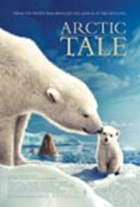
Adam Ravetch and his wife Sarah Robertson spent 15 years filming Arctic wildlife in its harsh and glorious habitat. In Arctic Tale, the results of that labor of love have been edited down to 96 minutes and arranged (somewhat artificially) to tell the story of a polar bear, Nanu, and a walrus, Seela.
The movie is aimed at children, particularly the kind of kid who is enthralled by the cable channel Animal Planet. These kids have a more realistic view of the interdependence of life on earth than we did at that age, educated by things like Disney's Bambi. So, although Arctic Tale doesn't go for the full horror treatment (I haven't quite gotten over the moment in Winged Migration where a big mower relentlessly advances on a tiny peeping bird), neither does it look away from some bracing truths.
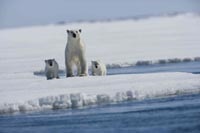
Nanu and her family take a little walk
I wonder if the Animal Planet Kid is becoming a recognizable demographic; in Evan Almighty, the youngest son in the family is ever piping up with factoids gleaned from its shows. My companion at the screening, granddaughter Hannah, is another fan, and at 6 she already knows a lot more about wildlife than I do. As an adorable pair of polar babies and their mom emerged from their icy winter den, I was surprised at how dark their fur was—more brown than white. Though I hadn't said a word, Hannah whispered, "In the spring, polar bears are brown; they're white in winter." Oh.
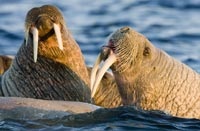
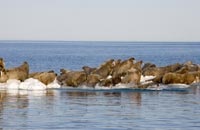
After we're introduced to Nanu and her mother and twin brother, we meet Seela, a baby walrus. Seela will be raised by her mother and another female walrus, referred to as "Auntie." It wasn't clear whether walrus babies routinely have two mommies, but in general walruses stick together, forming large, cohesive herds. Since they weigh from 1800 to 2600 pounds, they're not particularly lively while on land, but lie scattered and piled on the rocks haphazardly, like clothes on a teenager's floor. I was just thinking that the tusks look like a nuisance and wondering what they were for when Hannah whispered, "Did you know walruses use their tusks to get out of the water?" Gee.
Even a 6-year-old would know what those tusks are used for
Things are not so chummy among polar bears, and one of the first things we learn is that the mother must protect her babies from adult male bears, who will not hesitate to attack her cubs. Some children may be troubled at the thought that, not only is there no polar daddy to help raise Nanu, but daddy bears actually kill baby bears. Overall, things are pretty tough for Nanu's little family. They travel far in search of food without success, and eventually the cold and hunger are too much for her brother. He collapses in the snow, and we see him lying motionless, his face soon crusted with ice. Before long, it's time for Nanu to leave her mother's side and enter solitary, self-supporting adulthood. The mom accomplishes this by growling at Nanu and driving her away, another moment kids may find difficult to watch and hard to understand.
So far the film has been tracking lives of polar bears and walruses separately, but now the stories come together unexpectedly and poignantly. A male polar bear, on the verge of starvation, surprises Seela's family on an island rock. As he lunges toward a baby, "Auntie" goes to save it, and ends up "making the ultimate sacrifice," as the narration says (which may be putting it too obscurely for children). Nanu joins the feast, and "a single death preserves the lives of many." This is unexpected but realistic, and presented in a way that is unequivocal without being gory.
Like clothes on a teenager's floor'
Arctic Tale comes from National Geographic Films, which two years ago brought us March of the Penguins. The film also comes from some of the same people who gave us An Inconvenient Truth, Al Gore's 2006 documentary supplying evidence for global warming (his daughter Kristen Gore was involved in both projects). That message is muted in Arctic Tale, however, conveyed through comments that winter is coming later this year, or that formerly solid ice is now brittle. At the end, a message states that "If present trends continue" there will be no ice at the North Pole by the summer of 2040—then all the words disappear except for "If." Over the final credits, children recite things people can do to protect the environment. It's not a hard sell.
There's nothing to hate about Arctic Tale (except possibly a sequence acquainting us with the intestinal effects of too many clams on a herd of walruses who have gorged themselves). It falls just short of loveable, though, for a handful of reasons. The stories of Seela and Nanu are fabricated, and in fact many different animals portray these parts. Regularly, an event is similarly fabricated, as when footage of a male bear waking up and lumbering to its feet are intercut with shots of Nanu and her mother running, and a narrator tells us they're fleeing from him. So, if you went expecting a real documentary, you'd feel kind of cheated.
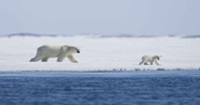
In time, Nanu will break away from her mom
On the other hand, if you went expecting a dramatic fictional depiction of life in the semi-frozen north, you'd find the stories pretty thin. This is not The Call of the Wild. You don't get to know distinctive personalities and are not gripped by their struggles. There's only the bare minimum of storytelling necessary to string the shots together. Excelling at neither documentary nor drama, Arctic Tale is a polite movie, but not a stirring one.
Article continues below
Queen Latifah is the narrator, and she is a good actress, but here she seems to be trying to portray someone reading a story to children, and the result is over-enunciated and stilted. Many reviewers have castigated the sound track, but it's actually pretty good: Aimee Mann, Cheryl Crow, the Shins, Pearl Jam, and others. But there is a great big blunder, which seems to permanently color viewers' impression: a shot of walruses piled up cozily on a rock is accompanied by Sister Sledge's over-exposed "We Are Family." If you get past that, you'll find the rest of the sound track amiable. Stay for the end of the credits and hear a brand-new song by Brian Wilson, produced by Van Dyke Parks: "Live Let Live."
Talk About It
Discussion starters
When Nanu and her family are desperately hungry, the mother scents a ring seal hiding under the ice and tries to catch it. Whose side were you on in that scene? Did you want the mother to feed her children, or the ring seal to escape? Why?
No plants or trees are visible in the Arctic; the only thing for the animals to eat are other animals. Why did God make it this way, do you think? Is it wrong to kill for food? Why did God show Peter a sheet full of all kinds of animals, and say, "Rise, Peter, kill and eat" (Acts 10:13)?
The walruses live together as a very close herd, lying on top of each other when resting on land. Yet the polar bears are extremely solitary, so that a mother even drives her own daughter away. Why would each way of life be best for each creature? Are humans socially more like walruses, polar bears, or somewhere in between? Discuss.
Some people disagree about the evidence for global warming, but there is no disagreement that energy-saving measures can materially benefit the planet. Of the many suggestions made during the final credits, which are you already doing? Are you doing some that were not mentioned? Which would you like to learn more about?
The Family Corner
For parents to consider
Arctic Tale is rated G. There's no bad language or inappropriate images. Mating is dealt with briefly and discretely. The killing and eating of animals is realistic enough—we see a fox and bears pulling at a fallen animal—but there are no close-ups and not much visible blood. One sequence depicts a group of walruses experiencing a great deal of flatulence after an overabundant meal. And animals do die during the course of the film, which could be disturbing for some sensitive children.
C.S. Lewis recommended discernment over diatribes in exactly the moments we’re most eager to indulge in critique.
Bonnie Kristian
Arctic Tale
1 of 4
Nanu and her family take a little walkEven a 6-year-old would know what those tusks are used forLike clothes on a teenager's floor'In time, Nanu will break away from her mom













 While we pray for peace, we need moral clarity about this war.
 We’ve got little information on Jesus’ appearance and personality. But that’s the way God designed it.españolFrançais
 C.S. Lewis recommended discernment over diatribes in exactly the moments we’re most eager to indulge in critique.