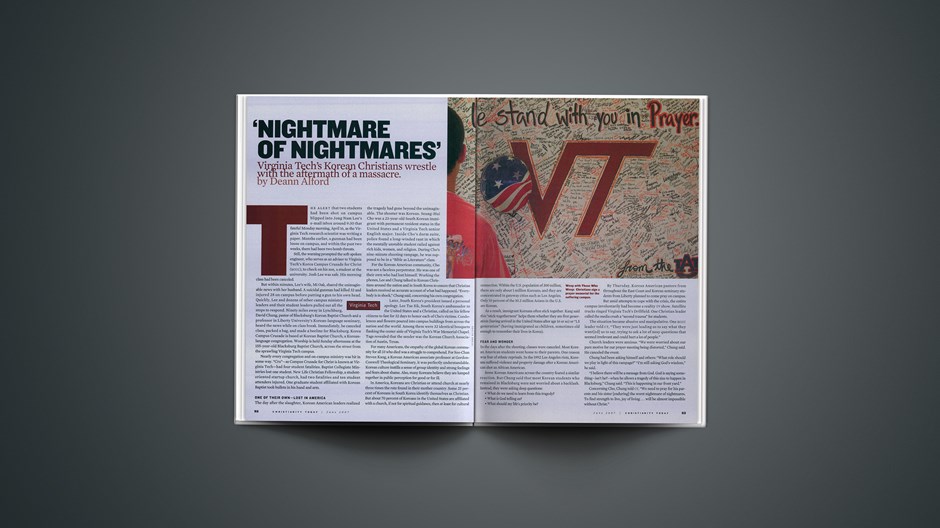
The alert that two students had been shot on campus blipped into Jong Nam Lee's e-mail inbox around 9:30 that fateful Monday morning, April 16, as the Virginia Tech research scientist was writing a paper. Months earlier, a gunman had been loose on campus, and within the past two weeks, there had been two bomb threats.
Still, the warning prompted the soft-spoken engineer, who serves as an adviser to Virginia Tech's Korea Campus Crusade for Christ (KCCC), to check on his son, a student at the university. Josh Lee was safe. His morning class had been canceled.
But within minutes, Lee's wife, Mi Oak, shared the unimaginable news with her husband. A suicidal gunman had killed 32 and injured 28 on campus before putting a gun to his own head. Quickly, Lee and dozens of other campus ministry leaders and their student leaders pulled out all the stops to respond. Ninety miles away in Lynchburg, David Chung, pastor of Blacksburg's Korean Baptist Church and a professor in Liberty University's Korean-language seminary, heard the news while on class break. Immediately, he canceled class, packed a bag, and made a beeline for Blacksburg. Korea Campus Crusade is based at Korean Baptist Church, a Korean-language congregation. Worship is held Sunday afternoons at the 155-year-old Blacksburg Baptist Church, across the street from the sprawling Virginia Tech campus.
Nearly every congregation and on-campus ministry was hit in some way. "Cru"—as Campus Crusade for Christ is known at Virginia Tech—had four student fatalities. Baptist Collegiate Ministries lost one student. New Life Christian Fellowship, a student-oriented startup church, had two fatalities and ten student attenders injured. One graduate student affiliated with Korean Baptist took bullets in his hand and arm.
One of Their Own—Lost in America
The day after the slaughter, Korean American leaders realized the tragedy had gone beyond the unimaginable. The shooter was Korean. Seung-Hui Cho was a 23-year-old South Korean immigrant with permanent resident status in the United States and a Virginia Tech senior English major. Inside Cho's dorm suite, police found a long-winded rant in which the mentally unstable student railed against rich kids, women, and religion. During Cho's nine-minute shooting rampage, he was supposed to be in a "Bible as Literature" class.
For the Korean American community, Cho was not a faceless perpetrator. He was one of their own who had lost himself. Working the phones, Lee and Chung talked to Korean Christians around the nation and in South Korea to ensure that Christian leaders received an accurate account of what had happened. "Everybody is in shock," Chung said, concerning his own congregation.
Later, South Korea's president issued a personal apology. Lee Tae Sik, South Korea's ambassador to the United States and a Christian, called on his fellow citizens to fast for 32 days to honor each of Cho's victims. Condolences and flowers poured into campus buildings from across the nation and the world. Among them were 32 identical bouquets flanking the center aisle of Virginia Tech's War Memorial Chapel. Tags revealed that the sender was the Korean Church Association of Austin, Texas.
For many Americans, the empathy of the global Korean community for all 33 who died was a struggle to comprehend. For Soo-Chan Steven Kang, a Korean American associate professor at Gordon-Conwell Theological Seminary, it was perfectly understandable. Korean culture instills a sense of group identity and strong feelings and fears about shame. Also, many Koreans believe they are lumped together in public perception for good or for ill.
In America, Koreans are Christian or attend church at nearly three times the rate found in their mother country. Some 25 percent of Koreans in South Korea identify themselves as Christian. But about 70 percent of Koreans in the United States are affiliated with a church, if not for spiritual guidance, then at least for cultural connection. Within the U.S. population of 300 million, there are only about 1 million Koreans, and they are concentrated in gateway cities such as Los Angeles. Only 10 percent of the 10.2 million Asians in the U.S. are Korean.
As a result, immigrant Koreans often stick together. Kang said this "stick-togetherness" helps them whether they are first generation (having arrived in the United States after age 16 or so) or "1.5 generation" (having immigrated as children, sometimes old enough to remember their lives in Korea).
Fear and Wonder
In the days after the shooting, classes were canceled. Most Korean American students went home to their parents. One reason was fear of ethnic reprisals. In the 1992 Los Angeles riots, Koreans suffered violence and property damage after a Korean American shot an African American.
Some Korean Americans across the country feared a similar reaction. But Chung said that most Korean students who remained in Blacksburg were not worried about a backlash. Instead, they were asking deep questions:
Article continues below
• What do we need to learn from this tragedy?
• What is God telling us?
• What should my life's priority be?
By Thursday, Korean American pastors from throughout the East Coast and Korean seminary students from Liberty planned to come pray on campus. But amid attempts to cope with the crisis, the entire campus involuntarily had become a reality TV show. Satellite trucks ringed Virginia Tech's Drillfield. One Christian leader called the media crush a "second trauma" for students.
The situation became abusive and manipulative. One KCCC leader told CT, "They were just leading us to say what they want[ed] us to say, trying to ask a lot of nosy questions that seemed irrelevant and could hurt a lot of people."
Church leaders were anxious. "We were worried about our pure motive for our prayer meeting being distorted," Chung said. He canceled the event.
Chung had been asking himself and others: "What role should we play in light of this rampage?" "I'm still asking God's wisdom," he said.
"I believe there will be a message from God. God is saying something—isn't he?—when he allows a tragedy of this size to happen in Blacksburg," Chung said. "This is happening in our front yard."
Concerning Cho, Chung told CT, "We need to pray for his parents and his sister [enduring] the worst nightmare of nightmares. To find strength to live, joy of living … will be almost impossible without Christ."
Korean Baptist Church, a first-generation immigrant church established in the early 1980s, is a congregation of 250.
Blacksburg's other Korean church, Cornerstone Christian Fellowship, is a 1.5- and second-generation church that favors English-language worship. Korea Campus Crusade for Christ, the Baptist church's de facto student outreach arm, arrived at Virginia Tech about 10 years ago. Perhaps a quarter of the 90 students involved with KCCC are "seekers"—young people interested in knowing more about a relationship with Christ.
The dynamic within the Korean American community is not unlike that of many American communities. University students leave their families, which range in faith from unchurched and uninterested to devoutly Christian. Like other students, they are dealing with identity issues and deciding where God and the church fit into their lives.
Korean American Christian leaders focus on relational dynamics. They fellowship over familiar Korean foods, share their faith, and strengthen each other's walk with Christ.
Each fall, Virginia Tech's KCCC "servants" (as leaders are called) dig through freshman rosters, looking for Korean names. Going two by two, they visit dorm rooms and leave fliers with contact information and invitations to a cookout, fellowships, and Bible studies. They help newcomers by taking them shopping and helping them move into their dorms. All hear the gospel eventually.
Article continues below
According to Gordon-Conwell's Kang, that kind of gospel-centered support is vital to overcoming a strong sense of isolation. Because Korean parents come to the United States eager to provide materially for their children in ways they believed they could not in Korea, mothers and fathers often work 60 hours a week or more. "The younger generation is left alone to grow up by themselves [and] figure out their life by themselves, whether at home or at the church," Kang said.
Because many 1.5-generation and second-generation children adopt American culture and English as their preferred language, he said, parents and children find communication increasingly difficult as the years go by. Cho himself was a 1.5-generation child.
At Virginia Tech, a system is in place to make such students feel welcomed into a community. "We ask, 'Do you need anything? Is there anything we can do for you?'" said Eun Sook Ji, a Virginia Tech sophomore and KCCC member. Student reaction is typically appreciative, though sometimes KCCC students hear, "Thanks, but no thanks."
Like many Christians at Virginia Tech, Ji wonders how Cho never connected with the Korean Christian community. There has been no shortage of introspection on that issue. Kang said that since 70 percent of Korean Americans say they attend church regularly, he knew "from the get-go" that Cho was probably part of the church, at least growing up. But Korean American churches sometimes find it hard to reach out to troubled members. Smaller churches, such as the northern Virginia Presbyterian church that Cho's family occasionally attended, usually have only one full-time pastor. In addition, Peter Cha, an associate professor at Trinity Evangelical Divinity School, told CT that shame often deters Asian families from seeking outside professional help.
In the meantime, Korean Americans continue to grapple with the massacre. Korean Baptist's Chung quotes Alexander Solzhenitsyn, who wrote, "The line dividing good and evil cuts through the heart of every human being."
Kang said the fundamental issue is the problem of evil. "We ask, 'Why does God allow these things to happen?'" he said, "rather than seeing this as the natural consequences of sinful society that Christ came to redeem.
Article continues below
"Western Christians struggle to make meaning of what happens in America because we're insulated. It's a dying and degenerate world. We're [experiencing] the consequences of sin."
Asked whether Cho had slipped through the cracks, Jim Pace, a pastor of Virginia Tech's New Life Christian Fellowship, answered, "Ultimately, yeah." Even so, he said, "You can't assume responsibility for someone's free will."
Six days after the bloodbath, on a cool but sunny Sunday afternoon, Chung preached at Korean Baptist using Psalm 13 as his text. His congregation was half its normal size. Many regulars had gone home, and only a few new faces appeared in the congregation.
"We have to pray that we are ready to be used by God," he told them. "We need to pray that we can be used as God's tool to share his loving-kindness to the community of Blacksburg."
Chung told CT that David's lament in Psalm 13 perfectly fit their situation. "Satan is working," he said. "We are devastated. God doesn't seem to be around. Like David, we have to seek his loving-kindness."
Deann Alford is a senior writer for Christianity Today.















 While we pray for peace, we need moral clarity about this war.
 As my doubts about his teachings grew, so did a secret fascination with Jesus.
 Beyoncé’s right. Whether listening to Cowboy Carter or reading theology, diversity is a good thing.






