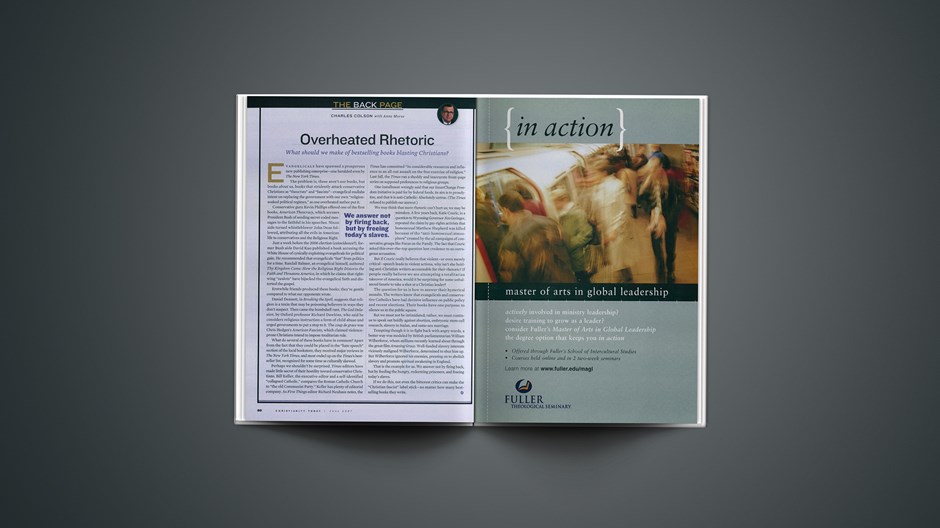
Evangelicals have spawned a prosperous new publishing enterprise—one heralded even by The New York Times.
The problem is, these aren't our books, but books about us, books that stridently attack conservative Christians as "theocrats" and "fascists"—evangelical mullahs intent on replacing the government with our own "religion-soaked political regimes," as one overheated author put it.
Conservative guru Kevin Phillips offered one of the first books, American Theocracy, which accuses President Bush of sending secret coded messages to the faithful in his speeches. Nixon aide turned whistleblower John Dean followed, attributing all the evils in American life to conservatives and the Religious Right.
Just a week before the 2006 election (coincidence?), former Bush aide David Kuo published a book accusing the White House of cynically exploiting evangelicals for political gain. He recommended that evangelicals "fast" from politics for a time. Randall Balmer, an evangelical himself, authored Thy Kingdom Come: How the Religious Right Distorts the Faith and Threatens America, in which he claims that right-wing "zealots" have hijacked the evangelical faith and distorted the gospel.
Erstwhile friends produced these books; they're gentle compared to what our opponents wrote.
Daniel Dennett, in Breaking the Spell, suggests that religion is a toxin that may be poisoning believers in ways they don't suspect. Then came the bombshell rant, The God Delusion, by Oxford professor Richard Dawkins, who said he considers religious instruction a form of child abuse and urged governments to put a stop to it. The coup de grace was Chris Hedges's American Fascists, which claimed violence-prone Christians intend to impose totalitarian rule.
What do several of these books have in common? Apart from the fact that they could be placed in the "hate speech" section of the local bookstore, they received major reviews in The New York Times, and most ended up on the Times's bestseller list, recognized for some time as culturally skewed.
Perhaps we shouldn't be surprised. Times editors have made little secret of their hostility toward conservative Christians. Bill Keller, the executive editor and a self-identified "collapsed Catholic," compares the Roman Catholic Church to "the old Communist Party." Keller has plenty of editorial company. As First Things editor Richard Neuhaus notes, the Times has committed "its considerable resources and influence to an all-out assault on the free exercise of religion." Last fall, the Times ran a shoddy and inaccurate front-page series on supposed preferences to religious groups.
One installment wrongly said that our InnerChange Freedom Initiative is paid for by federal funds, its aim is to proselytize, and that it is anti-Catholic: Absolutely untrue. (The Times refused to publish our answer.)
We may think that mere rhetoric can't hurt us; we may be mistaken. A few years back, Katie Couric, in a question to Wyoming Governor Jim Geringer, repeated the claim by gay-rights activists that homosexual Matthew Shepherd was killed because of the "anti-homosexual atmosphere" created by the ad campaigns of conservative groups like Focus on the Family. The fact that Couric asked this over-the-top question lent credence to an outrageous accusation.
But if Couric really believes that violent—or even merely critical—speech leads to violent actions, why isn't she holding anti-Christian writers accountable for their rhetoric? If people really believe we are attempting a totalitarian takeover of America, would it be surprising for some unbalanced fanatic to take a shot at a Christian leader?
The question for us is how to answer their hysterical assaults. The writers know that evangelicals and conservative Catholics have had decisive influence on public policy and recent elections. Their books have one purpose: to silence us in the public square.
But we must not be intimidated; rather, we must continue to speak out boldly against abortion, embryonic stem-cell research, slavery in Sudan, and same-sex marriage.
Tempting though it is to fight back with angry words, a better way was modeled by British parliamentarian William Wilberforce, whom millions recently learned about through the great film Amazing Grace. Well-funded slavery interests viciously maligned Wilberforce, determined to shut him up. But Wilberforce ignored his enemies, pressing on to abolish slavery and promote spiritual awakening in England.
That is the example for us. We answer not by firing back, but by feeding the hungry, redeeming prisoners, and freeing today's slaves.
If we do this, not even the bitterest critics can make the "Christian fascist" label stick—no matter how many bestselling books they write.















 While we pray for peace, we need moral clarity about this war.
 We’ve got little information on Jesus’ appearance and personality. But that’s the way God designed it.españolFrançais
 When I married into a Jewish family, antisemitism hit home. Now, the holy day reminds me of our future hope.






