Jehovah's Witnesses are America's favorite punch line, says Joel P. Engardio, co-producer of Knocking, a documentary on the 7 million-member sect, which, he says, spends 1.3 billion hours per year knocking on doors.
The film, which airs tonight on PBS's Independent Lens, begins with the sound of knocking, followed by a deep sigh. Is it the sound of apprehension? The dullness of routine? Weariness of the present evil age?
And then come the jokes—clips from The Simpsons and Letterman.
But Engardio is not joking. His mother converted when he was a child, and he has observed the Witnesses at close range, although he himself never became a member—he chose journalism over fundamentalism, he says.
Engardio helps viewers to get past the joke by following the stories of two men: one an aged survivor of the Holocaust and one a 20-something with a rare disease.
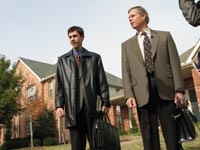
Seth and his father canvas the neighborhood
The young man, named Seth, has a rare genetic disorder that is attacking his liver. Eventually, he will need a liver transplant, and that is nearly impossible because Witnesses refuse blood transfusions. Baylor University Medical Center and Texas Medical Center both turn him down. Indeed, he can't get a donor organ through the usual channels. The committees that allocate organs for transplant won't assign him one because of the extremely low chances for a successful surgery.
Eventually, his father decides to become a live donor, and University of Southern California Hospital agrees to let him be the subject for an unproven and highly experimental "bloodless" surgical technique.
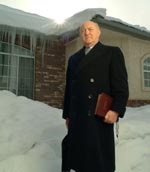
The old man is a Jew named Joseph. After surviving six concentration camps, he converted to the Witnesses, in part because he saw how their faith held up under the Nazis.
'Kind of like' a cult
Both men's stories illustrate the difficulty and family tensions being a Witness can cause. Seth's grandmother doesn't want to call the Witnesses a cult, she says, but "it's kind of like that." Because celebrating birthdays and holidays like Easter and Christmas are banned in Witness circles, she feels excluded from the family.
Joseph survived six concentration camps
Joseph begins the story alienated from his daughter. He was married briefly after World War II to a Jewish woman who bore him a baby girl and died shortly afterward. In his grief, Joseph gave his daughter to his sister, who raised her as a Jew. His becoming a Witness estranged him from the family. Now, years later, he seeks an on-camera reunion. It goes well, but the tensions are palpable.
And yet, both Seth and Joseph experience much affection, love, and support in the context of their present immediate families. The bonds of affection are intensified among religious minorities and invested with an extra layer of meaning precisely because of their separation from the world.
Knocking reveals this paradoxical emotional reality—being both isolated from family outside the group and intensely bonded to those within.
Good extremists
But Engardio's Knocking is not just about Jehovah's Witnesses. It is also about fundamentalism and the fear of religious "extremism" abroad in our land.
There is the fundamentalism that everybody's so afraid of in this post-9/11 world—the kind that wants to destroy "the other." But then there's the kind of fundamentalism that works to ensure tolerance and civil liberties for itself and others. Knocking is a not-too-subtle argument that the Witnesses represent the "right kind" of fundamentalism.
The brief slices of history Engardio reports help to make that point: Founded in 1879, Jehovah's Witnesses have always played an outsider role in society. Part of that outsider status is a commitment to shun all civic involvement—everything from the violence of military service to the seemingly innocuous Pledge of Allegiance. Because they resisted the sweeping nationalism of the 1940s, their kids were kicked out of school and Jehovah's Witness teachers were fired. They sued the government and the Supreme Court voted 8 to 1 in favor of the right of the state to require acts of allegiance from its citizens. Three years later the Court reversed itself, but not before mobs in 44 states beat Jehovah's Witnesses, and Kingdom Halls were vandalized and burned.
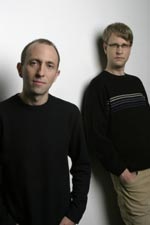
Filmmakers Joel P. Engardio and Tom Shepard
According to an ACLU spokesman in the film, Witnesses were in the Supreme Court 45 times between 1935 and 1958 fighting for their rights of freedom of religion, freedom of expression, and (because of their conscientious opposition to blood transfusions) patients' rights. Long before the founding of Christian public interest law firms, such as the Liberty Fund, The Becket Fund, and the ACLJ, the Jehovah's Witnesses were using the courts to establish liberties.
And, claims Engardio, Witnesses were among the first to report and condemn Hitler's persecution of the Jews. Because of their anti-military stand, the Nazis bundled off to concentration camps about 10,000 of the 25,000 Witnesses in Germany. (The rest went underground.) Witness prisoners smuggled out accounts of the brutality and slaughter as well as detailed diagrams of the camps' layout. Their leadership in America publicized the atrocities.
Article continues below
This film offers a one-sided portrait, and I would welcome a careful assessment by a knowledgeable historian. Nevertheless, Engardio's point is powerful. Religious minorities—as exasperating as they can be—serve to test our capacity for freedom. And those who suffer in order to secure our civil liberties deserve our gratitude.
Knocking premieres on PBS, Tuesday, May 22; check local listings. Visit the Independent Lens website for more information on Knocking. The film is also available on DVD here.














 While we pray for peace, we need moral clarity about this war.
 We’ve got little information on Jesus’ appearance and personality. But that’s the way God designed it.españolFrançais
 Christian artists work at the intersection of music and climate change.