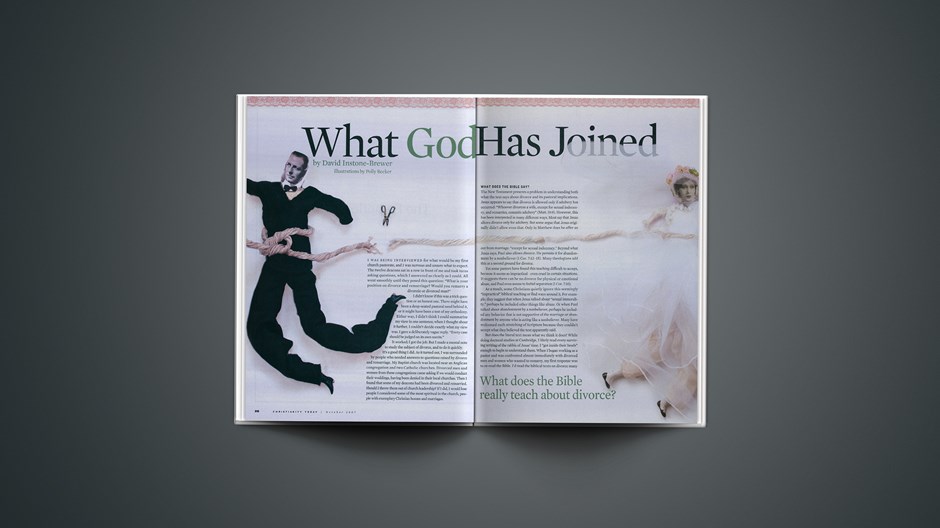
I was being interviewed for what would be my first church pastorate, and I was nervous and unsure what to expect. The twelve deacons sat in a row in front of me and took turns asking questions, which I answered as clearly as I could. All went smoothly until they posed this question: "What is your position on divorce and remarriage? Would you remarry a divorcée or divorced man?"
I didn't know if this was a trick question or an honest one. There might have been a deep-seated pastoral need behind it, or it might have been a test of my orthodoxy. Either way, I didn't think I could summarize my view in one sentence; when I thought about it further, I couldn't decide exactly what my view was. I gave a deliberately vague reply. "Every case should be judged on its own merits."
It worked; I got the job. But I made a mental note to study the subject of divorce, and to do it quickly.
It's a good thing I did. As it turned out, I was surrounded by people who needed answers to questions raised by divorce and remarriage. My Baptist church was located near an Anglican congregation and two Catholic churches. Divorced men and women from these congregations came asking if we would conduct their weddings, having been denied in their local churches. Then I found that some of my deacons had been divorced and remarried. Should I throw them out of church leadership? If I did, I would lose people I considered some of the most spiritual in the church, people with exemplary Christian homes and marriages.
What Does the Bible Say?
The New Testament presents a problem in understanding both what the text says about divorce and its pastoral implications. Jesus appears to say that divorce is allowed only if adultery has occurred: "Whoever divorces a wife, except for sexual indecency, and remarries, commits adultery" (Matt. 19:9). However, this has been interpreted in many different ways. Most say that Jesus allows divorce only for adultery. But some argue that Jesus originally didn't allow even that. Only in Matthew does he offer an out from marriage: "except for sexual indecency." Beyond what Jesus says, Paul also allows divorce. He permits it for abandonment by a nonbeliever (1 Cor. 7:12-15). Many theologians add this as a second ground for divorce.
Yet some pastors have found this teaching difficult to accept, because it seems so impractical—even cruel in certain situations. It suggests there can be no divorce for physical or emotional abuse, and Paul even seems to forbid separation (1 Cor. 7:10).
As a result, some Christians quietly ignore this seemingly "impractical" biblical teaching or find ways around it. For example, they suggest that when Jesus talked about "sexual immorality," perhaps he included other things like abuse. Or when Paul talked about abandonment by a nonbeliever, perhaps he included any behavior that is not supportive of the marriage or abandonment by anyone who is acting like a nonbeliever. Many have welcomed such stretching of Scripture because they couldn't accept what they believed the text apparently said.
But does the literal text mean what we think it does? While doing doctoral studies at Cambridge, I likely read every surviving writing of the rabbis of Jesus' time. I "got inside their heads" enough to begin to understand them. When I began working as a pastor and was confronted almost immediately with divorced men and women who wanted to remarry, my first response was to re-read the Bible. I'd read the biblical texts on divorce many times in the past, but I found something strange as I did so again. They now said something I hadn't heard before I read the rabbis!
'Any Cause' Divorce
The texts hadn't changed, but my knowledge of the language and culture in which they were written had. I was now reading them like a first-century Jew would have read them, and this time those confusing passages made more sense. My book, Divorce and Remarriage in the Church (InterVarsity Press), is a summary of several academic papers and books I began writing with this new understanding of what Jesus taught.
One of my most dramatic findings concerns a question the Pharisees asked Jesus: "Is it lawful to divorce a wife for any cause?" (Matt. 19:3). This question reminded me that a few decades before Jesus, some rabbis (the Hillelites) had invented a new form of divorce called the "any cause" divorce. By the time of Jesus, this "any cause" divorce had become so popular that almost no one relied on the literal Old Testament grounds for divorce.
The "any cause" divorce was invented from a single word in Deuteronomy 24:1. Moses allowed divorce for "a cause of immorality," or, more literally, "a thing of nakedness." Most Jews recognized that this unusual phrase was talking about adultery. But the Hillelite rabbis wondered why Moses had added the word "thing" or "cause" when he only needed to use the word "immorality." They decided this extra word implied another ground for divorce—divorce for "a cause." They argued that anything, including a burnt meal or wrinkles not there when you married your wife, could be a cause! The text, they said, taught that divorce was allowed both for adultery and for "any cause."
Article continues below
Another group of rabbis (the Shammaites) disagreed with this interpretation. They said Moses' words were a single phrase that referred to no type of divorce "except immorality"—and therefore the new "any cause" divorces were invalid. These opposing views were well known to all first-century Jews. And the Pharisees wanted to know where Jesus stood. "Is it lawful to divorce your wife for any cause?" they asked. In other words: "Is it lawful for us to use the 'any cause' divorce?"
When Jesus answered with a resounding no, he wasn't condemning "divorce for any cause," but rather the newly invented "any cause" divorce. Jesus agreed firmly with the second group that the phrase didn't mean divorce was allowable for "immorality" and for "any cause," but that Deutermonomy 24:1 referred to no type of divorce "except immorality."
This was a shocking statement for the crowd and for the disciples. It meant they couldn't get a divorce whenever they wanted it—there had to be a lawful cause. It also meant that virtually every divorced man or women was not really divorced, because most of them had "any cause" divorces. Luke and Matthew summarized the whole debate in one sentence: Any divorced person who remarried was committing adultery (Matt. 5:32; Luke 16:18), because they were still married. The fact that they said "any divorced person" instead of "virtually all divorced people" is typical Jewish hyperbole—like Mark saying that "everyone" in Jerusalem came to be baptized by John (Mark 1:5). It may not be obvious to us, but their first readers understood clearly what they meant.
Within a few decades, however, no one understood these terms any more. Language often changes quickly (as I found out when my children first heard the Flintstones sing about "a gay old time"). The early church, and even Jewish rabbis, forgot what the "any cause" divorce was, because soon after the days of Jesus, it became the only type of divorce on offer. It was simply called divorce. This meant that when Jesus condemned "divorce for 'any cause,' " later generations thought he meant "divorce for any cause."
Article continues below
Reaffirming marriage
Now that we know what Jesus did reject, we can also see what he didn't reject. He wasn't rejecting the Old Testament—he was rejecting a faulty Jewish interpretation of the Old Testament. He defended the true meaning of Deuteronomy 24:1. And there is one other surprising thing he didn't reject: Jesus didn't reject the other ground for divorce in the Old Testament, which all Jews accepted.
Although the church forgot the other cause for divorce, every Jew in Jesus' day knew about Exodus 21:10-11, which allowed divorce for neglect. Before rabbis introduced the "any cause" divorce, this was probably the most common type. Exodus says that everyone, even a slave wife, had three rights within marriage—the rights to food, clothing, and love. If these were neglected, the wronged spouse had the right to seek freedom from that marriage. Even women could, and did, get divorces for neglect—though the man still had to write out the divorce certificate. Rabbis said he had to do it voluntarily, so if he resisted, the courts had him beaten till he volunteered!
These three rights became the basis of Jewish marriage vows—we find them listed in marriage certificates discovered near the Dead Sea. In later Jewish and Christian marriages, the language became more formal, such as "love, honor, and keep." These vows, together with a vow of sexual faithfulness, have always been the basis for marriage. Thus, the vows we make when we marry correspond directly to the biblical grounds for divorce.
The three provisions of food, clothing, and love were understood literally by the Jews. The wife had to cook and sew, while the husband provided food and materials, or money. They both had to provide the emotional support of marital love, though they could abstain from sex for short periods. Paul taught the same thing. He said that married couples owed each other love (1 Cor. 7:3-5) and material support (1 Cor. 7:33-34). He didn't say that neglect of these rights was the basis of divorce because he didn't need to—it was stated on the marriage certificate. Anyone who was neglected, in terms of emotional support or physical support, could legally claim a divorce.
Divorce for neglect included divorce for abuse, because this was extreme neglect. There was no question about that end of the spectrum of neglect, but what about the other end? What about abandonment, which was merely a kind of passive neglect? This was an uncertain matter, so Paul deals with it. He says to all believers that they may not abandon their partners, and if they have done so, they should return (1 Cor. 7:10-11). In the case of someone who is abandoned by an unbeliever—someone who won't obey the command to return—he says that the abandoned person is "no longer bound."
Article continues below
Anyone in first-century Palestine reading this phrase would think immediately of the wording at the end of all Jewish, and most Roman, divorce certificates: "You are free to marry anyone you wish."
Putting all this together gives us a clear and consistent set of rules for divorce and remarriage. Divorce is only allowed for a limited number of grounds that are found in the Old Testament and affirmed in the New Testament:
Adultery (in Deuteronomy 24:1, affirmed by Jesus in Matthew 19)
Abandonment and abuse (included in neglect, as affirmed in 1 Corinthians 7)
Jewish couples listed these biblical grounds for divorce in their marriage vows. We reiterate them as love, honor, and keep and be faithful to each other. When these vows were broken, it threatened to break up the marriage. As in any broken contract, the wronged party had the right to say, "I forgive you; let's carry on," or, "I can't go on, because this marriage is broken."
Therefore, while divorce should never happen, God allows it (and subsequent remarriage) when your partner breaks the marriage vows.
Reading the Bible and ancient Jewish documents side-by-side helped me understand much more of the Bible's teaching about divorce and marriage, not all of which I can summarize here. Dusty scraps of parchment rescued from synagogue rubbish rooms, desert caves, and neglected scholarly collections shone fresh light on the New Testament. Theologians who have long felt that divorce should be allowed for abuse and abandonment may be vindicated. And, more importantly, victims of broken marriages can see that God's law is both practical and loving.
David Instone-Brewer is senior research fellow in rabbinics and the New Testament at Tyndale House, Cambridge. He is married with two daughters.
Lives of Quiet Turbulence | Elizabeth Marquardt on what happens in the souls of children of divorce. (March 1, 2006)
Dissecting Divorce | A new book by Elizabeth Marquardt offers a child's-eye-view of divorce. (Oct. 25, 2005)
The Next Sexual Revolution | By practicing what it preaches on marriage, the church could transform society. A Christianity Today editorial (August 27, 2003)
Can One Become Two? | What Scripture says about Christians and divorce. (August 31, 2000)
Remarriage: Two Views | Two New Testament professors debate whether remarriage is acceptable for Christians. (August 31, 2000)















 While we pray for peace, we need moral clarity about this war.
 As my doubts about his teachings grew, so did a secret fascination with Jesus.
 After lobbying from fellow Southern Baptists and Christians affected by the war, the House speaker moves a package forward.






