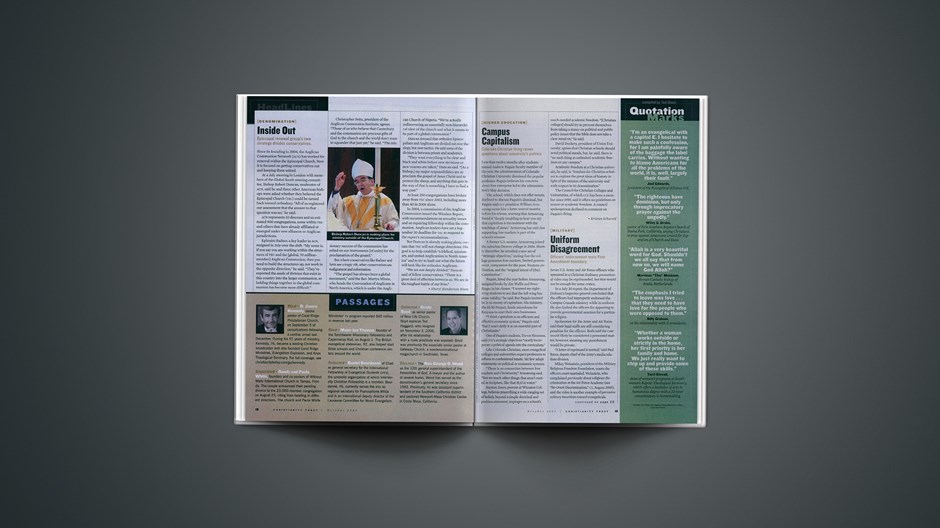
Since its founding in 2004, the Anglican Communion Network (ACN) has worked for renewal within the Episcopal Church. Now it is focused on getting conservatives out and keeping them united.
At a July meeting in London with members of the Global South steering committee, Bishop Robert Duncan, moderator of ACN, said he and three other American bishops were asked whether they believed the Episcopal Church (TEC) could be turned back toward orthodoxy. "All of us registered our assessment that the answer to that question was no," he said.
ACN represents 10 dioceses and an estimated 900 congregations, some within TEC and others that have already affiliated or emerged under new alliances or Anglican jurisdictions.
Ephraim Radner, a key leader in ACN, resigned in July over the shift. "My sense is, if you say you are working within the structures of TEC and the [global, 70 million-member] Anglican Communion, then you need to build the structures up, not work in the opposite direction," he said. "They've exported the seeds of division that exist in this country into the larger communion, so holding things together in the global communion has become more difficult."
Christopher Seitz, president of the Anglican Communion Institute, agrees. "Those of us who believe that Canterbury and the communion are precious gifts of God to the church and the world don't want to squander that just yet," he said. "The missionary success of the communion has relied on our instruments [of unity] for the proclamation of the gospel."
But where conservatives like Radner and Seitz see a tragic rift, other conservatives see realignment and reformation.
"The gospel has always been a global movement," said the Rev. Martyn Minns, who heads the Convocation of Anglicans in North America, which is under the Anglican Church of Nigeria. "We're actually rediscovering an essentially non-hierarchical view of the church and what it means to be part of a global communion."
Duncan stressed that orthodox Episcopalians and Anglicans are divided not over theology, but over tactics. He said some of the division is between priests and academics.
"They want everything to be clear and black and white before new decisions or new courses are taken," Duncan said. "[As a bishop,] my major responsibilities are to proclaim the gospel of Jesus Christ and to protect the sheep, and anything that gets in the way of that is something I have to find a way past."
At least 250 congregations have broken away from TEC since 2003, including more than 40 in 2006 alone.
In 2004, a commission of the Anglican Communion issued the Windsor Report, with recommendations on sexuality issues and on repairing fellowship within the communion. Anglican leaders have set a September 30 deadline for TEC to respond to the report's recommendations.
But Duncan is already making plans, certain that TEC will not change directions. His goal is to help establish "a biblical, missionary, and united Anglicanism in North America" and to try to hash out what the future will look like for orthodox Anglicans.
"We are not deeply divided," Duncan said of fellow conservatives. "There is a great deal of affection between us. We are in the toughest battle of our lives."
















 While we pray for peace, we need moral clarity about this war.
 As my doubts about his teachings grew, so did a secret fascination with Jesus.
 C.S. Lewis recommended discernment over diatribes in exactly the moments we’re most eager to indulge in critique.






