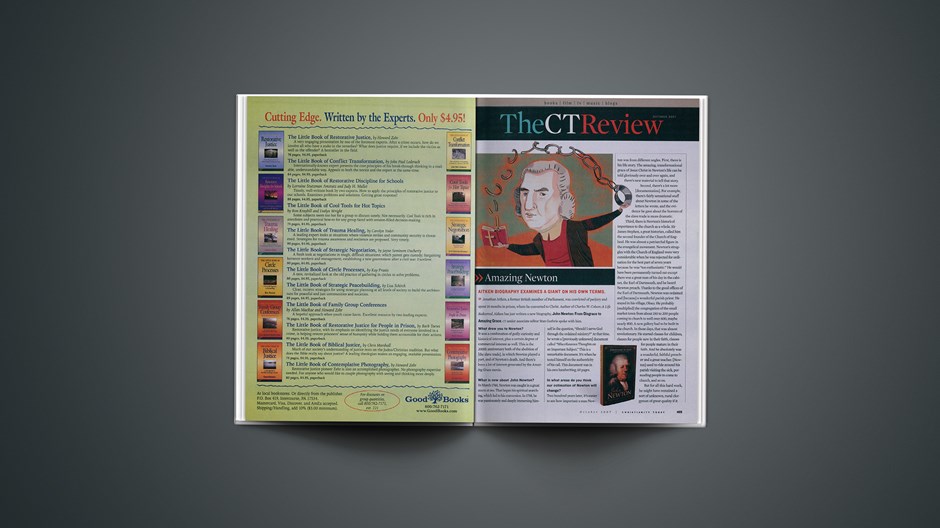
Jonathan Aitken, a former British member of Parliament, was convicted of perjury and spent 18 months in prison, where he converted to Christ. Author of Charles W. Colson: A Life Redeemed, Aitken has just written a new biography, John Newton: From Disgrace to Amazing Grace. CT senior associate editor Stan Guthrie spoke with him.
What drew you to Newton?
It was a combination of godly curiosity and historical interest, plus a certain degree of commercial interest as well. This is the 200th anniversary both of the abolition of [the slave trade], in which Newton played a part, and of Newton's death. And there's been a lot of interest generated by the Amazing Grace movie.
What is new about John Newton?
In March 1748, Newton was caught in a great storm at sea. That began his spiritual searching, which led to his conversion. In 1758, he was passionately and deeply immersing himself in the question, "Should I serve God through the ordained ministry?" At that time, he wrote a [previously unknown] document called "Miscellaneous Thoughts on an Important Subject." This is a remarkable document. It's when he tested himself on the authenticity of his call. This document was in his own handwriting, 60 pages.
In what areas do you think our estimation of Newton will change?
Two hundred years later, it's easier to see how important a man Newton was from different angles. First, there is his life story. The amazing, transformational grace of Jesus Christ in Newton's life can be told gloriously over and over again, and there's new material to tell that story.
Second, there's a lot more [documentation]. For example, there's fairly sensational stuff about Newton in some of the letters he wrote, and the evidence he gave about the horrors of the slave trade is more dramatic.
Third, there is Newton's historical importance to the church as a whole. Sir James Stephen, a great historian, called him the second founder of the Church of England. He was almost a patriarchal figure in the evangelical movement. Newton's struggles with the Church of England were very considerable when he was rejected for ordination for the best part of seven years because he was "too enthusiastic." He would have been permanently turned out except there was a great man of his day in the cabinet, the Earl of Dartmouth, and he heard Newton preach. Thanks to the good offices of the Earl of Dartmouth, Newton was ordained and [became] a wonderful parish priest. He stayed in his village, Olney. He probably [multiplied] the congregation of the small market town from about 150 to 200 people coming to church to well over 600, maybe nearly 800. A new gallery had to be built in the church. In those days, that was almost revolutionary. He started classes for children, classes for people new in their faith, classes for people mature in their faith. And he absolutely was a wonderful, faithful preacher and a great teacher. [Newton] used to ride around his parish visiting the sick, persuading people to come to church, and so on.
But for all this hard work, he might have remained a sort of unknown, rural clergyman of great quality if it hadn't been for two key people in his life. One was William Wilberforce. But before that, there was an 18th-century poet of considerable distinction who came into Newton's life, because he'd heard Newton preach and he was really unstable. His name was William Cowper. Cowper, almost as a matter of therapy, was put to work by Newton in the parish and then became a marvelous help to Newton and was very good himself with the parishioners. They were the only two educated men in the small town of Olney.
Cowper was a far superior poet. Newton was much more of a man who believed in simplicity and clarity in his verse. He was writing in language the poor lace makers and artisans could understand. Of the 146 words of Amazing Grace, 125 of them are one syllable. He was a very, very good teacher as well as a good preacher.
What was John Newton's biggest struggle as a Christian?
I think his biggest struggle was the struggle with self or ego. In his private journal, it's noticeable that when it comes to the days he thinks are the most important, they are not Jesus' resurrection or crucifixion or birth or death or Christmas/Easter and so on, but the anniversaries of Newton's own conversion experience, Newton's birthday, the date of his marriage to his wife, and her birthday. There were times he had to wrestle with his self-centeredness. [But] the more I got to know Newton through his diaries and prayer journal, the more I admired him as an authentic Christian, probably because he did struggle with pride, and he did struggle with self-centeredness. On the whole, I think he won those struggles. He was a great servant of Jesus Christ, and he was a truly humble man. But he struggled with Mr. Self, as he called him, all his life.
What do you think Newton would say about slavery in our world today?
I think he'd be horrified to know that there is as much slavery today as there is, and I think he'd be deeply affected, for example, by the stories of the Dalits of India. I think Newton always regretted how long it took for his own moral conscience to be roused. Even long after becoming a vicar, he didn't speak out against slavery, but he got there in the end.
Article continues below
How would Newton address the problem today?
He was a most effective campaigner because he had eyewitness authenticity. His pamphlets—"Thoughts on the Slave Trade" and so on—were magnificent campaigning documents. I think he would be absolutely in the forefront of changing the climate of public opinion by his writing. But I think it's much harder now to change public opinion, given the way the public thinks and the multiplicity of sources.
Also, Britain in the 18th century was still strongly a Christian nation. He was planting his seeds on good ground, and the ground has become a lot more secular and harder and stonier now.
How would you sum up Newton's legacy?
I seek to alert readers to how colorful, how historically important, how politically effective, and how deeply spiritual a man Newton was. He understood perfectly about getting hold of Wilberforce and mentoring him spiritually.
The story goes that Wilberforce came to see Newton to say, "Mr. Newton, I think I want to go into the church." Newton said, "No, no, Mr. Wilberforce, stay where you are and serve God in Parliament."
If Newton had gone the other way, I think we would probably not have heard of Wilberforce and the abolition of the slave trade. Wilberforce would have been a very fine Church of England vicar, but he wouldn't have had worldwide impact as an abolitionist.
It's often said there would have been no abolition of the slave trade without William Wilberforce, but it's absolutely fair to say there would have been no spiritually motivated William Wilberforce as a determined campaigner if it hadn't been for the friendship and mentoring of John Newton.
Stan Guthrie previously interviewed Aitken about his Charles Colson biography.
Christian History & Biography published an issue about Newton.
Articles about Newton and British abolitionists include:
Article continues below
What Would Wilberforce Do? | The 19th-century abolitionists have much to teach us about politics today. A Christianity Today editorial. (February 19, 2007)
Story Behind the Song: "Amazing Grace" | John Newton was a wild, young man lost in darkness. Then he found grace. (Today's Christian, January/February 2007)
For Sentimental Reasons | How the emotional stories of Christian preachers and writers shaped a movement. (February 17, 2006)
















 While we pray for peace, we need moral clarity about this war.
 We’ve got little information on Jesus’ appearance and personality. But that’s the way God designed it.españolFrançais
 Christians can disciple each other toward action, prayer, and hope.






