With industry analysts predicting a box-office take of over $300 million, The Passion of The Christ is easily the biggest religious blockbuster in decades. But for sheer popularity, staying power and cultural clout, it would be hard to top the biblical epics of the 1950s.
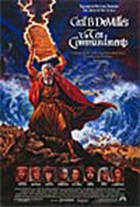
One film towers above them all. According to BoxOfficeMojo.com, Cecil B. DeMille's The Ten Commandments—which now releases for the first time as a "special collector's edition" DVD—grossed the equivalent of $790 million in its day, and thus remains one of the five most successful films of all time.
DeMille's film, still the definitive depiction of the Exodus in the popular imagination, and a staple of Easter television broadcasts, is widely mocked these days for its campy performances and its strange, eclectic cast. The unique lineup includes Anne Baxter as the lusty, manipulative Egyptian queen; Vincent Price as a smug Egyptian slavemaster; John Derek (future husband and director of Bo) as a very earnest Joshua; and, of course, Edward G. Robinson as the Hebrew traitor who ultimately convinces his fellow Israelites to worship a golden calf—who can see him, now, without hearing Billy Crystal's impression of him saying, "Where's your Moses now, see?"
But for those who can accept the film's Victorian theatricality, there is much to enjoy here, from the overpolished dialogue, which is full of quotable lines, to the domineering performances of Charlton Heston as Moses and Yul Brynner as his nemesis, the Pharaoh Rameses. Perhaps most surprising, and affecting, is the genuinely tender, stern, humorous, and conflicted humanity Sir Cedric Hardwicke brings to the role of Seti, the father-figure Pharaoh who knows Moses would be a better king than Rameses, but is forced by his own prejudice to give the throne to the one prince who is not the child of Hebrew slaves.
The collector's edition DVD includes about 40 minutes of new documentary material and a full 3½ -hour audio commentary by Katherine Orrison, author of Written in Stone, a book on the making of the film. Alas, these bonus features do not offer many insights into the political and religious agenda with which DeMille made this film, or into what made this genre so popular; for the most part, they focus on movie-set anecdotes and the incredible attention to detail with which the sets, props, and costumes were made.
The biblical epics of the '50s were partly the product of an increasingly religious sensibility within American culture, which at the time was consciously opposed to the atheistic Communism of the Soviet Union. It was also a decade in which the words "under God" were added to the Pledge of Allegiance while "In God We Trust" became the standard slogan on American currency. But the biblical epics also came out at this time because Hollywood was fighting for its survival against the arrival of television, and the studios achieved this, in part, by cashing in on the public's nostalgia for lavish 1920s spectacles.
Many of the biblical epics, such as Quo Vadis? and Ben Hur, were remakes of silent movies. DeMille himself had made an earlier version of The Ten Commandments in 1923. The prologue, which told the story of the Exodus and the golden calf, capitalized on the public's thirst for all things Egyptian following the discovery of King Tut's tomb, while the second half of the film, which told a modern story set in the present day, was critical of both atheistic skepticism and harsh religious fundamentalism.
In his 1956 remake of The Ten Commandments, DeMille set the story entirely in the ancient world, but he still addressed contemporary issues. DeMille makes his intentions plain in his personal introduction to the film, in which he alludes to the Cold War and says the theme of his film is the ongoing battle between freedom and dictatorship.
Curiously, Orrison does not touch on this particular theme in her commentary, though she does allude to the film's "civil rights" subtext, noting that Moses' benediction at the end of the film ("Go, proclaim liberty throughout all the lands, unto all the inhabitants thereof") is taken from the Liberty Bell in Philadelphia. However, she does not mention that the line originally comes from Leviticus 25:10; moreover, whereas the Bible talks of proclaiming liberty throughout all the "land" (singular) during the Year of Jubilee, the film's Moses tells the Hebrews to proclaim liberty throughout all the "lands" (plural), and thus encourages the spread of western democracy.
Orrison also reveals that DeMille was able to film much of the movie in Egypt because President Gamal Abdel Nasser was a big fan of DeMille's 1935 film The Crusades, which cast a favorable light on the Muslim warrior Saladin. As a result, many of the extras who play Hebrews in the film's climactic Exodus sequence are actually members of the modern Egyptian army! But here again, Orrison misses an opportunity to explore how the film subtly revises the Scriptures to address a modern concern. In the Bible, Moses' wife Sephorah (Yvonne DeCarlo) comes from the tribe of Midian, but in the film, she is identified as a descendant of Ishmael—so the marriage between these characters is a symbolic call for peace between the Arab and Israeli nations, which were then between wars.
Article continues below
The DVD also includes three trailers for the film—one each from the '50s, '60s and '80s—and it is fascinating to watch the audience's attention span dwindle over the decades, as each trailer uses faster cuts and quicker edits than the one before. The first trailer clocks in at ten minutes, and consists mostly of DeMille relishing his role as cultural curator as he discusses the scholarly and artistic influences on his film; among other things, he notes that Charlton Heston's profile is just like that of Michelangelo's famous Moses sculpture.
DeMille also claims his script relies on the writings of ancient historians like Josephus and Philo to fill in the missing early years of Moses' life; however, he does not mention that much of the material in those writings is of little historical value, or that his film is also inspired by modern romances such as Dorothy Clarke Wilson's Prince of Egypt.
There are echoes of this sort of thing in some of today's hype around Mel Gibson's film about the death of Jesus. Gibson has often claimed his film is an historically accurate adaptation of the Gospels, but it also includes material from the visions of an uncredited 19th-century nun, as well as some elements that appear to be Gibson's own invention.
It is impossible to say, at this point, whether The Passion of The Christ will look as much like a product of its own time 50 years from now as The Ten Commandments does today. But watching older biblical epics can help us to see how filmmakers sometimes rework the Scriptures to speak to their own times, and thus can help us to develop our discernment skills as newer and seemingly more authentic movies come along.
Talk About It
Discussion starters
What do you think about the movie's theatrical conventions? Should movies based on the Bible be more "realistic"? What might be the benefit of a more stylized, and less "realistic," adaptation of the Bible?
How has Cecil B. DeMille "Christianized" the Moses story? Where did he get such plot elements as the star that predicts the birth of the deliverer? In what ways does the life of Christ parallel the life of Moses? What does it mean that Christ was crucified at Passover?
How is God portrayed in this film? Loving? Wrathful? Patient? Powerful? Come up with your own list of adjectives, and discuss specific scenes where God is depicted in that manner.
Article continues below
Related Elsewhere:
A ready-to-download Movie Discussion Guide related to this movie is available at ChristianityTodayMoviesStore.com. Use this guide after the movie to help you and your small group better connect your faith to pop culture.
The Family Corner
For parents to consider
This G-rated film has moments of violence, most of which are taken from the Bible, and much of which is implied, not shown—including the slaughter of the Hebrew infants, a few murders (including Moses killing an Egyptian taskmaster), the death of the firstborn, and the drowning of the Egyptian army in the Red Sea. There is also some sexual tension in the film's two love triangles: before he learns he is a Hebrew, Moses competes with Rameses for the love of Princess Nefertiri; and a Hebrew taskmaster forces Joshua's girlfriend to marry him. The film includes an orgy before the golden calf (implied, not graphic), which is promptly punished by divine lightning and an earthquake. The DVD's bonus features include at least one mild profanity, as well as some speculation that the miracles reported in the Book of Exodus may have had "natural" causes.
Related Elsewhere:
A ready-to-download Movie Discussion Guide related to this movie is available at ChristianityTodayMoviesStore.com. Use this guide after the movie to help you and your small group better connect your faith to pop culture.













 While we pray for peace, we need moral clarity about this war.
 We’ve got little information on Jesus’ appearance and personality. But that’s the way God designed it.españolFrançais
 We must always be people of the Word, but we’ll have to reimagine deep engagement with Scripture.





