In the far-flung span of human history, only twelve men have ever stepped on the surface of another celestial body. And yet, somehow we have managed to convince ourselves that such acts of mind-boggling ingenuity and stunning heroism are now commonplace.
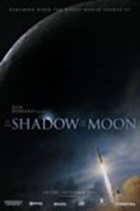
The new documentary, In the Shadow of the Moon, reminds us all that America's space program is nothing short of astonishing and that humankind's venture into the vast, freezing abyss of outer space is one of the most extraordinary and significant moments in the history of our species. It celebrates the know-how of thousands of engineers and the derring-do of dozens of astronauts who embraced the most audacious act of outlandish genius ever proposed.
In the Shadow of the Moon scoured NASA's film vaults, coming away with a treasure trove of archival footage. Gone are the overused, iconic images so familiar to all of us. The filmmakers digitally re-mastered footage sealed in bins for more than three decades, much of it of such breathtaking quality and magisterial beauty that it is almost unthinkable that it has gone unseen until now.
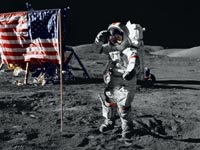
Saluting the flag on the surface of the moon
In the Shadow of the Moon is a shimmering tribute to the brave men who, almost half a century ago, made the unthinkable a reality. Concentrating exclusively on the Apollo Program, the documentary eschews narration and simply lets the film progress through interviews with all of the remaining Apollo astronauts, minus its "team captain" and the first man to set foot on the Moon, the notoriously camera shy Neil Armstrong. Some of the astronauts are staid and stoic, paradigms of professionalism. Others, like Alan Bean and Michael Collins, are fun and animated, like children fresh off an amusement park ride.
These are the coolest guys alive, yet you'd never know it from their unassuming and self-deprecating demeanors. The space program comes to life through their humanizing reminiscences. They admit, through voices that occasionally crack with emotion, that they often have to pinch themselves to make sure it wasn't all a dream. "I called the moon my home for three days of my life," says Gene Cernan. "Now that's science fiction!"
The film traces the space race from its earliest birth pains to its most magnificent triumphs. In 1961, President John F. Kennedy set an impossibly audacious goal before the American people: send a man to the Moon and return him safely back to Earth before the close of the decade. Tragically, Kennedy never lived to see his inspirational words plucked from the air and fashioned into the steel, wiring and propellant that would, just eight years later, send us racing into lunar orbit and beyond.
It's not as if there was any sort of guarantee that the newly formed National Aeronautics and Space Administration (NASA) would be successful. Kennedy's national dare was the stuff of science fiction. Placing a man on top of a giant rocket sounded ludicrous at the time. "It was a quick way to have a short career," Jim Lovell recalls.
The astronaut corps was cobbled together from daredevil test pilots always on the lookout for new ways to go faster, higher, further. Engineers using slide rules and legal pads went to work designing and building the most sophisticated machines ever constructed. Nothing close to this had ever been attempted, and the intrepid scientists had no choice but to blaze a new, uncharted frontier.
The film follows the engineers and astronauts through the design, construction, training and implementation phase of the program. Though the outcome is well known, the film does a magnificent job of building tension into an enterprise that was fraught with uncertainty. When the first Saturn rocket plunged into space with a crew aboard, even the astronauts admit they were surprised.
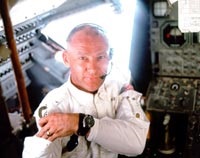
Buzz Aldrin onboard the spacecraft
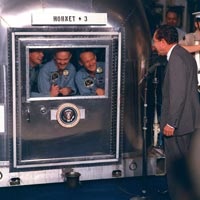
"It was a time when we made bold moves," Lovell says, realizing that scientific and technological advances are made possible only by walking the knife's edge. For those in the Apollo program, hazards and peril were around every corner. Tragedy struck on what would come to be known as Apollo 1 when a launch pad fire killed Virgil Grissom, Ed White and Roger Chaffee during a drill. And President Richard Nixon recorded a never-aired statement in case the crew of Apollo 11 was marooned forever on the moon's surface.
When the Eagle's landing pads made contact with lunar sediment on July 20, 1969, the world stood still. Across the globe, human civilization rejoiced as one. This was not an American achievement, the astronauts explain, it was a human achievement. Between 1968 and 1972, nine Apollo spacecraft journeyed to the moon, and a dozen men walked on its surface. As America imploded beneath the trauma of war, assassinations and divisive social unrest, the Apollo program was said to have redeemed the entire decade.
For all their courage and scientific acumen, the astronauts of Apollo fumble with and in due course abandon using technical jargon to describe their other-worldly experiences. Ultimately, rationality cannot illuminate what is a metaphysical voyage of discovery. So it should come as no surprise that, in Shadow's final moments, the moonwalkers' speech alters into something far more elegiac, whimsical and fundamentally spiritual. They are the first to say that they are nothing special—blessed men who just happened to be in the right place at the right time. But to a man, they have been changed. They exude a modest, philosophical side that comes, one assumes, from having left our world and viewed it, in all of its fragility, from afar.
Article continues below
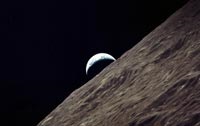
Earthrise on the moon
Some speak of our connectedness to the universe, others the need to protect and cherish the environment. Several of the astronauts describe a categorical belief in God and his sacred, creative hand in fashioning the cosmos. Jim Lovell, Frank Borman, and William Anders, aboard Apollo 8 on Christmas Eve, 1968, transmit a message in what was the most watched television broadcast to date: "For all the people on Earth, the crew of Apollo 8 has a message we would like to send you: 'In the beginning God created the heavens and the earth … '" Charlie Duke recounts returning to Earth after his mission, attending Bible studies and soon after giving his life over to Christ. "My walk on the moon lasted three days," he says, "My walk with God will last forever."
British director David Sington has crafted an awe-inspiring film suffused with reverence and wonder. In the Shadow of the Moon is one of those rare films with the power to coax tears and goosebumps from even the most jaded viewer. Its scope is so grand, it subject so inspirational, that audiences can't help but leave the theater staggered by the monumental human achievement it recounts.
Following a dozen or so more missions in the next few years, America's remaining space shuttles will be permanently retired. At that time, NASA will turn its energies, once again, toward the moon. Engineers are already hard at work designing the Ares rockets that will hurl the Orion crew exploration vehicle—the technological progeny of Apollo—into outer space. However, this time the moon is not the ultimate goal, but a stepping-stone to something far more extraordinary—a human footprint on the scarlet soil of Mars.
Talk About It
Discussion starters
The astronauts claim that their achievement was larger than any one country or nationality. It is a fact poignantly driven home when one of them points out that, from the surface of the moon, the Earth and all of its problems can be covered up merely by holding up one's thumb. In what other ways do mankind's territorial squabbles and self-made problems seem inconsequential when placed in such a cosmic context?
Article continues below
Does watching a film like In the Shadow of the Moon—in which humans push at the frontier of the heavens—strengthen or weaken your faith? How?
Do the astronauts' overt proclamations of faith surprise you? What about their inclusion in the film? Why or why not?
In what ways is NASA's ingenuity and stick-to-it-iveness an example for our own lives?
The Family Corner
For parents to consider
In the Shadow of the Moon is rated PG for mild language, brief violent images and incidental smoking. It's appropriate for most all ages. The "mild language" warning is for a single, barely off-color reference that may raise a few eyebrows. As for "brief violent images," the film shows American warplanes bombing the Vietnamese countryside, as well as the aftermath of the Apollo 1 fire. And "Buzz" Aldrin admits to standing on the Eagle ladder and "taking care of some business" before making the second giant leap for mankind.













 While we pray for peace, we need moral clarity about this war.
 As my doubts about his teachings grew, so did a secret fascination with Jesus.
 We must always be people of the Word, but we’ll have to reimagine deep engagement with Scripture.