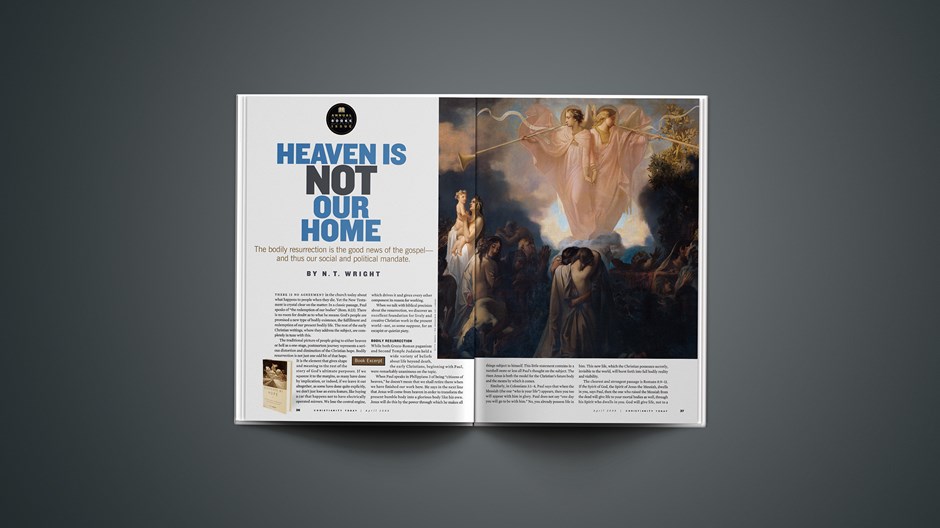
There is no agreement in the church today about what happens to people when they die. Yet the New Testament is crystal clear on the matter: In a classic passage, Paul speaks of "the redemption of our bodies" (Rom. 8:23). There is no room for doubt as to what he means: God's people are promised a new type of bodily existence, the fulfillment and redemption of our present bodily life. The rest of the early Christian writings, where they address the subject, are completely in tune with this.
The traditional picture of people going to either heaven or hell as a one-stage, postmortem journey represents a serious distortion and diminution of the Christian hope. Bodily resurrection is not just one odd bit of that hope. It is the element that gives shape and meaning to the rest of the story of God's ultimate purposes. If we squeeze it to the margins, as many have done by implication, or indeed, if we leave it out altogether, as some have done quite explicitly, we don't just lose an extra feature, like buying a car that happens not to have electrically operated mirrors. We lose the central engine, which drives it and gives every other component its reason for working.
When we talk with biblical precision about the resurrection, we discover an excellent foundation for lively and creative Christian work in the present world—not, as some suppose, for an escapist or quietist piety.
Bodily Resurrection
While both Greco-Roman paganism and Second Temple Judaism held a wide variety of beliefs about life beyond death, the early Christians, beginning with Paul, were remarkably unanimous on the topic.
When Paul speaks in Philippians 3 of being "citizens of heaven," he doesn't mean that we shall retire there when we have finished our work here. He says in the next line that Jesus will come from heaven in order to transform the present humble body into a glorious body like his own. Jesus will do this by the power through which he makes all things subject to himself. This little statement contains in a nutshell more or less all Paul's thought on the subject. The risen Jesus is both the model for the Christian's future body and the means by which it comes.
Similarly, in Colossians 3:1–4, Paul says that when the Messiah (the one "who is your life") appears, then you too will appear with him in glory. Paul does not say "one day you will go to be with him." No, you already possess life in him. This new life, which the Christian possesses secretly, invisible to the world, will burst forth into full bodily reality and visibility.
The clearest and strongest passage is Romans 8:9–11. If the Spirit of God, the Spirit of Jesus the Messiah, dwells in you, says Paul, then the one who raised the Messiah from the dead will give life to your mortal bodies as well, through his Spirit who dwells in you. God will give life, not to a disembodied spirit, not to what many people have thought of as a spiritual body in the sense of a nonphysical one, but "to your mortal bodies also."
Other New Testament writers support this view. The first letter of John declares that when Jesus appears, we shall be like him, for we shall see him as he is. The resurrection body of Jesus, which at the moment is almost unimaginable to us in its glory and power, will be the model for our own. And of course within John's gospel, despite the puzzlement of those who want to read the book in a very different way, we have some of the clearest statements of future bodily resurrection. Jesus reaffirms the widespread Jewish expectation of resurrection in the last day, and announces that the hour for this has already arrived. It is quite explicit: "The hour is coming," he says, "indeed, it is already here, when the dead will hear the voice of the Son of Man, and those who hear will live; when all in the graves will come out, those who have done good, to the resurrection of life, and those who have done evil, to the resurrection of judgment."
Life After Life After Death
Here we must discuss what Jesus means when he declares that there are "many dwelling places" in his Father's house. This has regularly been taken, not least when used in the context of bereavement, to mean that the dead (or at least dead Christians) will simply go to heaven permanently rather than being raised again subsequently to new bodily life. But the word for "dwelling places" here, monai, is regularly used in ancient Greek not for a final resting place, but for a temporary halt on a journey that will take you somewhere else in the long run.
This fits closely with Jesus' words to the dying brigand in Luke: "Today you will be with me in paradise." Despite a long tradition of misreading, paradise here means not a final destination but the blissful garden, the parkland of rest and tranquility, where the dead are refreshed as they await the dawn of the new day. The main point of the sentence lies in the apparent contrast between the brigand's request and Jesus' reply: "Remember me," he says, "when you come in your kingdom," implying that this will be at some far distant future. Jesus' answer brings this future hope into the present, implying of course that with his death the kingdom is indeed coming, even though it doesn't look like what anyone had imagined: "Today you will be with me in paradise." There will, of course, still be a future completion involving ultimate resurrection; Luke's overall theological understanding leaves no doubt on that score. Jesus, after all, didn't rise again "today," that is, on Good Friday. Luke must have understood him to be referring to a state of being-in-paradise. With Jesus, the future hope has come forward into the present. For those who die in faith, before that final reawakening, the central promise is of being "with Jesus" at once. "My desire is to depart," wrote Paul, "and be with Christ, which is far better."
Article continues below
Resurrection itself then appears as what the word always meant in the ancient world. It wasn't a way of talking about life after death. It was a way of talking about a new bodily life after whatever state of existence one might enter immediately upon death. It was, in other words, life after life after death.
What then about such passages as 1 Peter 1, which speaks of a salvation that is "kept in heaven for you" so that in your present believing you are receiving "the salvation of your souls"? Here, I suggest, the automatic assumption of Western Christianity leads us badly astray. Most Christians today, reading a passage like this, assume that it means that heaven is where you go to receive this salvation—or even that salvation consists in "going to heaven when you die." The way we now understand that language in the Western world is totally different from what Jesus and his hearers meant and understood.
For a start, heaven is actually a reverent way of speaking about God, so that "riches in heaven" simply means "riches in God's presence." But then, by derivation from this primary meaning, heaven is the place where God's purposes for the future are stored up. It isn't where they are meant to stay so that one would need to go to heaven to enjoy them. It is where they are kept safe against the day when they will become a reality on earth. God's future inheritance, the incorruptible new world and the new bodies that are to inhabit that world, are already kept safe, waiting for us, so that they can be brought to birth in the new heavens and new earth.
Article continues below
From Worship to Mission
The mission of the church is nothing more or less than the outworking, in the power of the Spirit, of Jesus' bodily resurrection. It is the anticipation of the time when God will fill the earth with his glory, transform the old heavens and earth into the new, and raise his children from the dead to populate and rule over the redeemed world he has made.
If that is so, mission must urgently recover from its long-term schizophrenia. The split between saving souls and doing good in the world is not a product of the Bible or the gospel, but of the cultural captivity of both. The world of space, time, and matter is where real people live, where real communities happen, where difficult decisions are made, where schools and hospitals bear witness to the "now, already" of the gospel while police and prisons bear witness to the "not yet." The world of space, time, and matter is where parliaments, city councils, neighborhood watch groups, and everything in between are set up and run for the benefit of the wider community, the community where anarchy means that bullies (economic and social as well as physical) will always win, where the weak and vulnerable will always need protecting, and where the social and political structures of society are part of the Creator's design.
And the church that is renewed by the message of Jesus' resurrection must be the church that goes to work precisely in that space, time, and matter. The church claims this world in advance as the place of God's kingdom, of Jesus' lordship, and of the Spirit's power. Councils and parliaments can and often do act wisely, though they will always need scrutiny and accountability, because they in turn may become agents of bullying and corruption.
Thus the church that takes sacred space seriously (not as a retreat from the world but as a bridgehead into it) will go straight from worshiping in the sanctuary to debating in the council chamber; to discussing matters of town planning, of harmonizing and humanizing beauty in architecture, green spaces, and road traffic schemes; and to environmental work, creative and healthy farming methods, and proper use of resources. If it is true, as I have argued, that the whole world is now God's holy land, we must not rest as long as that land is spoiled and defaced. This is not an extra to the church's mission. It is central.
Article continues below
The church that takes seriously the fact that Jesus is Lord of all will not just celebrate quietly every time we write the date on a letter or document, will not just set aside Sunday as far as humanly and socially possible as a celebration of God's new creation, will not just seek to order its own life in an appropriate rhythm of worship and work. Such a church will also seek to bring wisdom to the rhythms of work in offices and shops, in local government, in civic holidays, and in the shaping of public life. These things cannot be taken for granted. The enormous shifts during my lifetime, from the whole town observing Good Friday and Easter, to those great days being simply more occasions for football matches and yet more televised reruns of old movies, are indices of what happens when a society loses its roots and drifts with prevailing social currents. The reclaiming of time as God's good gift (as opposed to time as simply a commodity to be spent for one's own benefit, which often means fresh forms of slavery for others) is not an extra to the church's mission. It is central.
Whatever is Holy
One of the things I most enjoy about being a bishop is watching ordinary Christians (not that there are any "ordinary" Christians, but you know what I mean) going straight from worshiping Jesus in church to making a radical difference in the material lives of people down the street by running playgroups for children of single working moms; by organizing credit unions to help people at the bottom of the financial ladder find their way to responsible solvency; by campaigning for better housing, against dangerous roads, for drug rehab centers, for wise laws relating to alcohol, for decent library and sporting facilities, for a thousand other things in which God's sovereign rule extends to hard, concrete reality. Once again, all this is not an extra to the mission of the church. It is central.
This way of coming at the tasks of the church in terms of space, time, and matter leads directly to evangelism. When the church is seen to move straight from worship of God to affecting much-needed change in the world; when it becomes clear that the people who feast at Jesus' table are the ones at the forefront of work to eliminate hunger and famine; when people realize that those who pray for the Spirit to work in and through them are the people who seem to have extra resources of love and patience in caring for those whose lives are damaged, bruised, and shamed—then it is natural for people to recognize that something is going on that they want to be part of.
Article continues below
No single individual can attempt more than a fraction of this mission. That's why mission is the work of the whole church, the whole time. Paul's advice to the Philippians—even though he and they knew they were suffering for their faith and might be tempted to retreat from the world into a dualistic, sectarian mentality—was upbeat. "These are the things you should think through," he wrote: "whatever is true, whatever is holy, whatever is upright, whatever is pure, whatever is attractive, whatever has a good reputation; anything virtuous, anything praiseworthy." And in thinking through these things, we will discover more and more about the same Creator God whom we know in and through Jesus Christ and will be better equipped to work effectively not over against the world, but with the grain of all goodwill, of all that seeks to bring and enhance life.
N. T. Wright is Bishop of Durham for the Church of England. This article is excerpted from his latest book, Surprised by Hope: Rethinking Heaven, the Resurrection, and the Mission of the Church (HarperOne).
















 While we pray for peace, we need moral clarity about this war.
 As my doubts about his teachings grew, so did a secret fascination with Jesus.
 Eastern Orthodox poet Scott Cairns reflects on his new collection, his journey of faith, and poetry’s capacity to apprehend inexhaustible realities.






