NASCAR embodies a brave and futile rejection of Benjamin Franklin's famous aphorism, "In this world, nothing can be said to be certain, except death and taxes." In this way, it is a gospel sport, because while the rest of America lives in denial of death and has made peace with cultural conformity, NASCAR fans instinctively know that we are made for more. This is, I believe, one of the subconscious reasons for NASCAR's broadening appeal in American life.
Take taxes. NASCAR's story begins with young bootleggers in modified cars outrunning the law in the back hills of Georgia. We're not just talking about the Prohibition era, but decades following it, when avoiding heavy federal and state liquor taxes—a key tool of state power—was the engine that drove the business. Such bootlegging was partly about poor Southerners finding a way to make a living. Yet it was also about evading a creeping federal government still resented by Confederate holdouts. It was a defiance of the Constitution of the United States by otherwise good and law-abiding citizens, even churchgoers.
NASCAR blossomed just as the country was increasingly conformed to Northern mores, especially to the suburban culture that swears allegiance to Sobriety, Safety, and Security. NASCAR would not bend the knee, and we still see residual outlaw resentment in T-shirts and bumper stickers sported at NASCAR events: BEERIODIC TABLE OF ELEMENTS, GUN CONTROL MEANS USING BOTH HANDS, AND DRIVE IT LIKE YOU STOLE IT. It's enough to make well-to-do suburban parents tremble—and cover their children's ears and eyes. The ubiquitous presence of the Confederate flag at NASCAR races signals this continued defiance of the larger culture, or as another T-shirt slogan puts it, IT'S A BUBBA THING; YOU WOULDN'T UNDERSTAND.
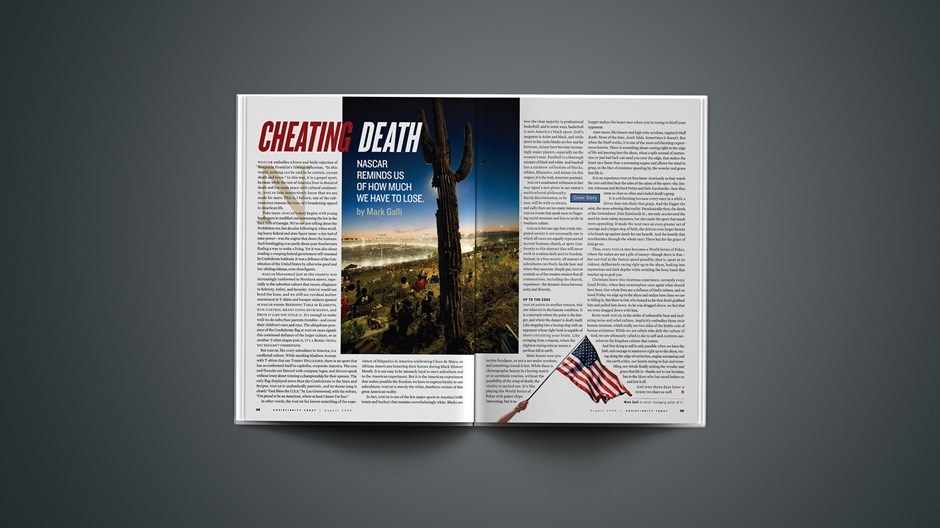
But NASCAR, like every subculture in America, is a conflicted culture. While mocking Madison Avenue with T-shirts that say TOMMY HELLRAISER, there is no sport that has so conformed itself to capitalist, corporate America. The cars and firesuits are littered with company logos, and drivers speak without irony about winning a championship for their sponsor. The only flag displayed more than the Confederate is the Stars and Stripes. NASCAR is unabashedly patriotic, and its theme song is clearly "God Bless the U.S.A." by Lee Greenwood, with the refrain, "I'm proud to be an American, where at least I know I'm free."
In other words, the NASCAR fan knows something of the experience of Hispanics in America celebrating Cinco de Mayo, or African Americans honoring their heroes during Black History Month. It is not easy to be intensely loyal to one's subculture and to the American experiment. But it is the American experiment that makes possible the freedom we have to express loyalty to our subcultures. NASCAR is merely the white, Southern version of this great American reality.
In fact, NASCAR is one of the few major sports in America (with tennis and hockey) that remains overwhelmingly white. Blacks are now the clear majority in professional basketball, and in some ways, basketball is now America's black sport. Golf's megastar is Asian and black, and while down in the ranks blacks are few and far between, Asians have become increasingly major players, especially on the women's tour. Football is a thorough mixture of black and white. And baseball has a rainbow collection of blacks, whites, Hispanics, and Asians (in this respect, it is the truly American pastime).
NASCAR's unashamed whiteness in fact may signal a new phase in our nation's multicultural philosophy. Racial discrimination, to be sure, will be with us always, and sadly there are too many instances at NASCAR events that speak more to lingering racial tensions and less to pride in Southern culture.
NASCAR is but one sign that a truly integrated society is not necessarily one in which all races are equally represented in every business, church, or sport. Conformity to this abstract idea will never work in a nation dedicated to freedom. Instead, in a free society, all manner of subcultures can freely decide how and where they associate. Simply put, NASCAR reminds us of the creative tension that all communities, including the church, experience—the dynamic dance between unity and diversity.
Up to the Edge
NASCAR points to another tension, this one inherent in the human condition. It is a spectacle where the point is the danger, and where the danger is death itself. Like stepping into a boxing ring with an opponent whose right hook is capable of short-circuiting your brain. Like swinging from a trapeze, where the slightest timing miscue means a perilous fall to earth.
Make boxers wear protective headgear, or put a net under acrobats, and something crucial is lost. While there is choreographic beauty in a boxing match or an acrobatic routine, without the possibility of the sting of death, the vitality is sucked out. It's like playing the World Series of Poker with poker chips. Interesting, but it no longer makes the heart race when you're trying to bluff your opponent.
Article continues below
Auto racers, like boxers and high-wire acrobats, regularly bluff death. Most of the time, death folds. Sometimes it doesn't. But when the bluff works, it is one of the most exhilarating experiences known. There is something about coming right to the edge of life and peering into the abyss, when a split second of inattention or just bad luck can send you over the edge, that makes the heart race faster than a screaming engine and allows the mind to grasp, in the blur of existence speeding by, the wonder and grace that life is.
It is an experience NASCAR fans know vicariously as they watch the race and then hear the tales of the saints of the sport—the Jimmie Johnsons and Richard Pettys and Dale Earnhardts—how they came so close so often and eluded death's grasp.
It is exhilarating because every once in a while a driver does not elude that grasp. And the bigger the saint, the more sobering that reality. Paradoxically then, the death of the Intimidator, Dale Earnhardt Sr., not only accelerated the need for more safety measures, but also made the sport that much more appealing. It made the next race an even greater act of courage and a larger step of faith, the drivers even larger heroes who brush up against death for our benefit. And the homily that reverberates through the whole race: There but for the grace of God go we.
Thus, every NASCAR race becomes a World Series of Poker, where the stakes are not a pile of money—though there is that—but survival at the fastest speed possible; that is, sport at its riskiest, deliberately racing right up to the abyss, looking into mysterious and dark depths while avoiding the bony hand that reaches up to grab you.
Christians know this vicarious experience, certainly every Good Friday, when they contemplate once again what should have been. Our whole lives are a defiance of God's culture, and on Good Friday we edge up to the abyss and realize how close we are to falling in. But there is One who leaned so far that death grabbed him and pulled him down. As he was dragged down, we feel that we were dragged down with him.
Every week NASCAR, in the midst of unbearable heat and deafening noise and rebel culture, implicitly embodies these twin human tensions, which really are two sides of the brittle coin of human existence. While we are rebels who defy the culture of God, we are ultimately called to die to self and conform ourselves to the kingdom culture that comes.
Article continues below
And that dying to self is only possible when we have the faith and courage to maneuver right up to the abyss, racing along the edge of extinction, engine screaming and the earth a blur, our hearts racing in fear and trembling, our minds finally seizing the wonder and grace that life is—thanks not to our heroism, but to the Hero who has raced before us and lost it all.
And won three days later: a victory we share as well.
















 While we pray for peace, we need moral clarity about this war.
 As my doubts about his teachings grew, so did a secret fascination with Jesus.
 After lobbying from fellow Southern Baptists and Christians affected by the war, the House speaker moves a package forward.






