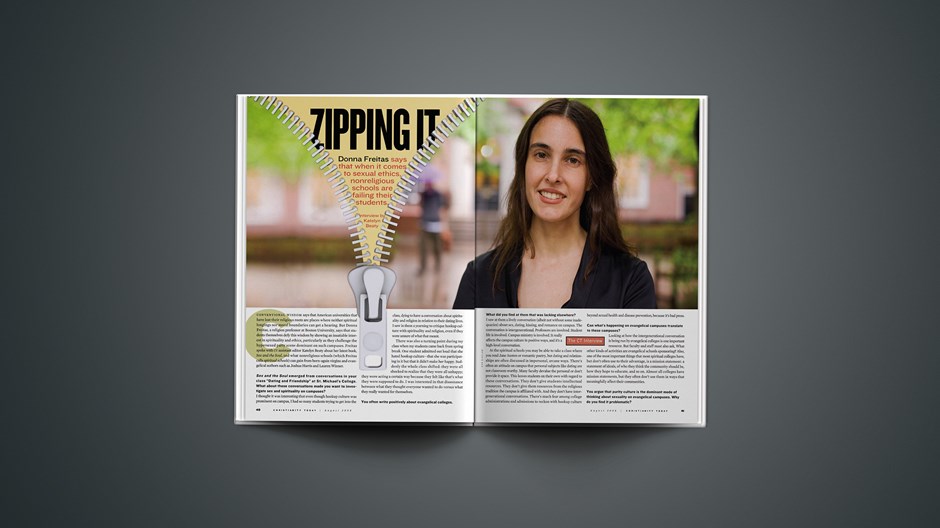
Conventional wisdom says that American universities that have lost their religious roots are places where neither spiritual longings nor moral boundaries can get a hearing. But Donna Freitas, a religion professor at Boston University, says that students themselves defy this wisdom by showing an insatiable interest in spirituality and ethics, particularly as they challenge the hypersexed party scene dominant on such campuses. Freitas spoke with CT assistant editor Katelyn Beaty about her latest book, Sex and the Soul, and what nonreligious schools (which Freitas calls spiritual schools) can gain from born-again virgins and evangelical authors such as Joshua Harris and Lauren Winner.
Sex and the Soul emerged from conversations in your class "Dating and Friendship" at St. Michael's College. What about those conversations made you want to investigate sex and spirituality on campuses?
I thought it was interesting that even though hookup culture was prominent on campus, I had so many students trying to get into the class, dying to have a conversation about spirituality and religion in relation to their dating lives. I saw in them a yearning to critique hookup culture with spirituality and religion, even if they were unsure of what that meant.
There was also a turning point during my class when my students came back from spring break. One student admitted out loud that she hated hookup culture—that she was participating in it but that it didn't make her happy. Suddenly the whole class shifted: they were all shocked to realize that they were all unhappy; they were acting a certain way because they felt like that's what they were supposed to do. I was interested in that dissonance between what they thought everyone wanted to do versus what they really wanted for themselves.
You often write positively about evangelical colleges. What did you find at them that was lacking elsewhere?
I saw at them a lively conversation (albeit not without some inadequacies) about sex, dating, kissing, and romance on campus. The conversation is intergenerational. Professors are involved. Student life is involved. Campus ministry is involved. It really affects the campus culture in positive ways, and it's a high-level conversation.
At the spiritual schools you may be able to take a class where you read Jane Austen or romantic poetry, but dating and relationships are often discussed in impersonal, arcane ways. There's often an attitude on campus that personal subjects like dating are not classroom worthy. Many faculty devalue the personal or don't provide it space. This leaves students on their own with regard to these conversations. They don't give students intellectual resources. They don't give them resources from the religious tradition the campus is affiliated with. And they don't have intergenerational conversations. There's much fear among college administrations and admissions to reckon with hookup culture beyond sexual health and disease prevention, because it's bad press.
Can what's happening on evangelical campuses translate to these campuses?
Looking at how the intergenerational conversation is being run by evangelical colleges is one important resource. But faculty and staff must also ask, What other kinds of activities are evangelical schools sponsoring? Also, one of the most important things that most spiritual colleges have, but don't often use to their advantage, is a mission statement: a statement of ideals, of who they think the community should be, how they hope to educate, and so on. Almost all colleges have mission statements, but they often don't use them in ways that meaningfully affect their communities.
You argue that purity culture is the dominant mode of thinking about sexuality on evangelical campuses. Why do you find it problematic?
Both young men and women within purity culture experience enormous pressure to erase sexual desire completely. While there's a lot of support for students to think about what purity means and how to maintain it, the real question is, What happens when they don't? What happens when they fall short or make a mistake? It can have a shattering effect on their relationship with God and, often, their relationship with the larger community. For both men and women, this leaves them silent. I interviewed students for whom I was the only person they had told about what they were doing; they had no idea whom to talk to about it.
Then there's the issue of "ring by spring or your money back" or the "senior scramble," which I encountered across the board at the evangelical colleges. It is largely something that falls on women's shoulders. In purity culture, college is a place where women are supposed to find a husband, almost to a point that to them it seems more important than their education. I encountered a real fear among women that they wouldn't have that ring. Even though they didn't necessarily agree with this standard, they all experienced the pressure to get engaged. I think this expectation is amazing—that to be married by the time you graduate is not only part of what it means to be a good Christian girl, but also a good Christian college graduate.
Article continues below
But there are also positive elements of purity culture, especially born-again virginity. A lot of people in the non-evangelical world laugh at the idea that a person could wake up one morning and declare themselves a renewed virgin. But I met students who spent years becoming born-again virgins. I feel like it's not widely advocated enough: people who spend a lot of time reflecting on their sexual experience, repairing their relationship with God, doing so with a mentor, and then getting themselves in a place where they're not denying they were sexually active, but they're owning it. They're saying, "I'm spiritually pure again, and I'm going to be confident about it."
I may not love all of [born-again virginity], but I think it's a way out of hookup culture. People need conversion or redemption narratives for their sexual experiences and their sexual pasts. Those are really absent on the spiritual campuses.
Most evangelicals would say that students on spiritual campuses not only need redemption narratives—they need redemption itself. In a sense, students need more than the story that makes change possible.
This is to me where the real hope lies for students at spiritual schools. The other piece of my survey was that I found that students across the board register a tremendous amount of religious desire during their college experience, and some begin to see spirituality as a way they can begin to change their lives and their pasts. The question is, Will universities pay attention to that religious desire and try to give students resources to have conversations about what to do with that desire?
The cultural myth says that secular schools are the places where faith goes to die. Or, secular colleges are for adults who don't need religious beliefs to prop up their worldview. But what you found is that spirituality, even though it takes various forms and is often private, is thriving. Students are just not being given the tools to know what to do with it.
Absolutely. For example, take the sexuality and spirituality class I taught last fall at Boston University, where we studied books by Joshua Harris, Lauren Winner, and Rob Bell in addition to different sexual-ethics scholars. Almost all the students were as liberal as liberal can get. One of the big hits of the semester was Wendy Shalit's A Return to Modesty. The students were floored by her critique of hookup culture, and they spent so much time talking about modesty as a virtue. It allowed them to say, "Wow, we're witness to all this vulgarity on campus. We pretend that we're okay with it, but we're not." I actually had students who for their final project proposed a modesty club. I'm sitting here thinking, This is Boston University. It made me think Shalit published her book 10 years too early, because the Left reviled her when she published it [in 1999]. For my class, she could do no wrong. I think that's really telling.
Article continues below
At different points I have received flak from scholars for the in-class resources I use. You're not supposed to teach Harris's I Kissed Dating Goodbye or Winner's Real Sex because they're not "ivory tower material"—except that it's in these books where robust conversations are happening about the things students care about. I'm a feminist and a liberal, but this is something beyond ideology. It's not a Left or Right issue. It's about responding to young people who are struggling. It's a mistake of many people to tense up about ideology in the middle of this kind of conversation. Part of my job is to figure out what professors do about the issues students are struggling with. They want modesty. And we can give them rich resources on modesty. So why don't we then?


















 While we pray for peace, we need moral clarity about this war.
 A Christian reconciliation group in Israel and Palestine warned that war would come. Now the war threatens their relevance.españolالعربيةFrançais
 C.S. Lewis recommended discernment over diatribes in exactly the moments we’re most eager to indulge in critique.






