'God Never wrought miracle to convince atheism, because his ordinary works convince it.' Francis Bacon
I have often wondered what Christianity would look like if Jesus had appeared after the Scientific Revolution. Would our awareness of the vast cosmos and the likelihood of other life forms have altered the emphasis on the universal character of the Incarnation? How would our understanding of nature's order and rationality have informed the doctrine of Creation and God's revelation in nature? Would we be so inclined to say that "all Creation is fallen" if we knew that Creation included planets orbiting stars a billion light years away that are perhaps populated by creatures cavorting in blissful ignorance of Eden's shenanigans? How would knowledge of our kinship with the rest of the animal world, especially our primate cousins, reshape our understanding of humanity and our role in Creation?
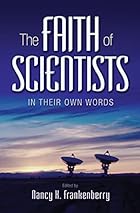
These questions burned in my mind as I read Nancy Frankenberry's ambitious new volume, The Faith of Scientists: In Their Own Words (Princeton University Press), a collection of the writings of leading scientists from Galileo to Richard Dawkins.
Advisors who were totally unskilled at astronomical observations ought not to clip the wings of reflective intellects by means of rash prohibitions.
Galileo (1564—1642)
Frankenberry's volume is a frustrating reminder of science's struggle against numerous would-be wing clippers to find a home within the Christian faith. This struggle, I suspect, has much to do with its arrival so long after the biblical canon was closed and the creeds created.
Frankenberry starts with Galileo, Johannes Kepler, Francis Bacon, Blaise Pascal, and Isaac Newton, who all lived in the deeply religious 17th century. Their uncritical, even naïve, acceptance of the truth of difficult biblical passages—such as Joshua's long day, or the psalmist's assertion that the earth is fixed—is striking. But these architects of modern science all labored mightily to prevent their new science from contradicting the Bible.
An undercurrent of natural theology permeates their writings, born of their excitement in uncovering the deep and rational structures built into Creation. But they were frustrated that so many of their peers rejected the new science. Kepler, the most enthusiastic of the group, critiqued anyone "too weak to believe Copernicus without affecting his faith," recommending instead that they go home to "scratch in [their] own dirt patch, abandoning this wandering about in the world."
The God of Christians does not consist of a God who is simply the author of mathematical truths and the order of the elements.
Blaise Pascal (1623—1662)
Faith for these founders of modern science was a given. But the Subject of their faith was neither generic nor confined. Christianity was not a limited, parochial worldview, or the Old Testament a collection of Bronze Age myths. Convinced that both nature and the Bible were revelations from God, they found ways to harmonize science and their faith. But they did more than harmonize. The eloquent and even devotional prose of Kepler, Pascal, Newton, and others shows that their science was inspired and even informed by their faith. This contrasts greatly with leading contemporary scientists who, if they care at all about religion, see it as something that interferes with science.
I can indeed hardly see how anyone ought to wish Christianity to be true; for if so the plain language of the text seems to show that the men who do not believe, and this would include my father, brothers, and almost all my friends, will be everlastingly punished. And this is a damnable doctrine.
Charles Darwin (1809—1882)
Charles Darwin, the gentle Victorian naturalist who went from aspiring parson to the (supposed) archenemy of Christianity, is a watershed in Frankenberry's story, straddling that great gulf separating the mystical Kepler from today's crusading atheists such as Richard Dawkins and Steven Weinberg.
Darwin's critics often treat him unfairly, unaware that his theory of evolution was not an attempt to rationalize his unbelief. The Faith of Scientists recounts Darwin's struggles with the age-old problem of evil, especially the death of his beloved daughter Annie. His loss of faith was just that—a loss, never once experienced as liberation and certainly not the motivation for his famous theory. Darwin described himself as "very unwilling to give up my belief," and, as an old man, recalled the efforts he made to preserve his faith.
Of the 15 scientists after Darwin in Frankenberry's volume, only one, John Polkinghorne, holds conventional Christian beliefs. Yet he was selected mainly as a counterpoint to Weinberg, with whom he had a famous debate, excerpted in this volume. Weinberg, who won a Nobel Prize for his work on unification in physics, believes that "on balance the moral influence of religion has been awful." Of course, Richard Dawkins and Carl Sagan make the same familiar argument, but without the winsome sadness that permeates Weinberg's contemplations of a world he finds "pointless."
Article continues below
Natural beauty has a necessary place in the spiritual development of any individual or any society.
Rachel Carson (1954—)
The most interesting writings in this volume—from theists and atheists alike—share a provocative theme, namely that the contemplation of both nature and the scientific picture of the world can be a religious experience. I write this now from my gazebo at the edge of the woods behind my house. A bird choir sings vigorously, accompanied by rustling leaves and the gurgle of a small waterfall. Towering hardwoods rise behind me in the forest. Newport plums and andromeda are at my elbow.
Ursula Goodenough, who closes this volume, speaks of the "sacred depths of nature." Goodenough's worldview is shaped by the values of the scientific community. Yet she very much enjoys worship and even sings in a church choir. She is inspired by cathedrals. But she cannot believe in the supernatural: "Such faith," she laments, "is simply not available to me."
I wonder what God thinks of Ursula Goodenough. Can God be worshiped by those who celebrate the Creation without acknowledging the Creator? In conversation, someone once praised one of my books but could not remember the author's name. The praise was strangely more genuine for its inarticulate anonymity. I suspect, as C. S. Lewis once speculated, that God may have more connection with honest atheists than many think.
The Faith of Scientists is a feast of provocative, sobering reflections. Why so many leading scientists find conventional belief in God so difficult is a mystery to me. And yet I am equally baffled that so many faithful Christians find it hard to appreciate the "sacred depths of nature."
Correction: 'God's Other Good Book' originally incorrectly identified Isaac Newton. Nancy Frankenberry includes Newton, a well-known scientist, in her book The Faith of Scientists. We regret the error.


















 While we pray for peace, we need moral clarity about this war.
 We’ve got little information on Jesus’ appearance and personality. But that’s the way God designed it.españolFrançais
 As Haiti is uprooted by violence, church leaders treat gunshot wounds, give up homes for strangers, and rescue dignitaries.Français






