Last spring, something was stirring under the white steeple of the Billy Graham Center at Wheaton College.
A motley group of young and clean-cut, goateed and pierced, white-haired and bespectacled filled the center's Barrows Auditorium. They joined their voices to sing of "the saints who nobly fought of old" and "mystic communion with those whose rest is won." A speaker walked an attentive crowd through prayers from the 5th-century Gelasian Sacramentary, recommending its forms as templates for worship in today's Protestant churches. Another speaker highlighted the pastoral strengths of the medieval fourfold hermeneutic. Yet another gleefully passed on the news that Liberty University had observed the liturgical season of Lent. The t-word—that old Protestant nemesis, tradition—echoed through the halls.
Just what was going on in this veritable shrine to pragmatic evangelistic methods and no-nonsense, back-to-the-Bible Protestant conservatism? Had Catholics taken over?
No, this was the 2007 Wheaton Theology Conference, whose theme was "The Ancient Faith for the Church's Future." Here, the words spoken 15 years ago by Drew University theologian and CT senior editor Thomas Oden rang true: "The sons and daughters of modernity are rediscovering the neglected beauty of classical Christian teaching. It is a moment of joy, of beholding anew what had been nearly forgotten, of hugging a lost child."
The conference's Call for Papers likewise rejoiced: "One of the most promising developments among evangelical Protestants is the recent 'discovery' of the rich biblical, spiritual, and theological treasures to be found within the early church." In particular, it said, evangelicals are beginning to "reach back behind the European Enlightenment for patterns and models of how to faithfully read Scripture, worship, and engage a religiously diverse culture."
Baylor University's D. H. Williams, author of Evangelicals and Tradition, testified at the conference to the recent upsurge of evangelical interest in patristics (the study of the church fathers in the first seven centuries of the church): "Who would have thought, a decade ago, that one of the most vibrant and serious fields of Christian study at the beginning of the 21st century would be the ancient church fathers? There has been an opening of new avenues, especially among free-church Protestants, by the almost overnight popularity of bishops and monks, martyrs and apologists, philosophers and historians who first fashioned a Christian culture 1,500 years ago."
This conference was certainly not the first of its kind; in fact, many evangelicals had been looking to the early church for guidance for years. But in some ways, the conference represented a coming of age for a worship renewal movement begun some 30 years before.
Surge Into the Past
If only the man behind the conference, the elder statesman of "ancient-future faith," could have been there to watch the excitement of young and old conferees alike. But Robert Webber of Northern Seminary (and formerly of Wheaton) could not be present. He was in the late stages of cancer. His chair at the conference banquet table was vacant, as colleagues stood to honor his influence on them personally and on the whole church. Weeks after the conference, evangelical Christianity lost its premier ambassador for reengagement with history.
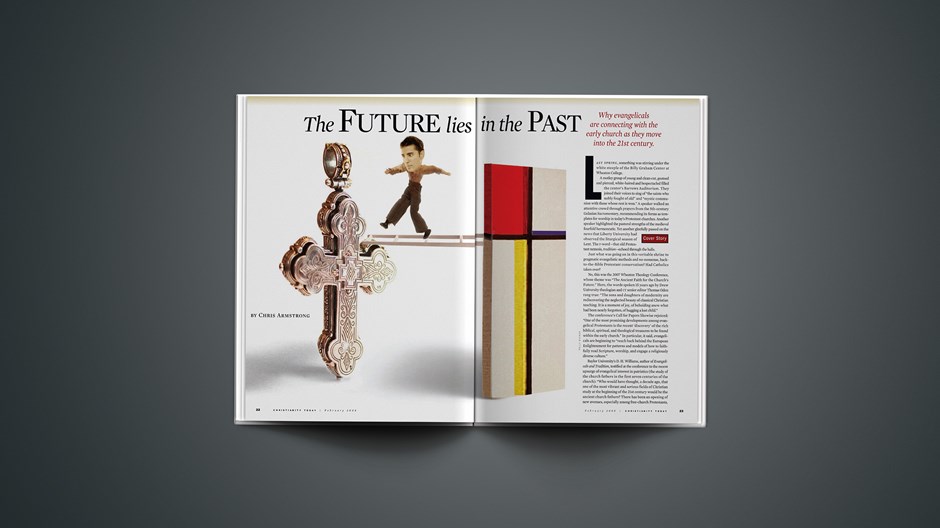
In 1978, Webber had begun his groundbreaking Common Roots: A Call to Evangelical Maturity by throwing down the gauntlet: "My argument is that the era of the early church (A.D. 100–500), and particularly the second century, contains insights which evangelicals need to recover." Twenty-five years later, he could rejoice in the pages of his Younger Evangelicals that they "want to immerse themselves in the past and form a culture that is connected to the past, a culture that remembers its tradition as it moves into the future." Webber observed—with what we now know was not mere wishful thinking—that evangelicals had entered the new millennium by surging into the past.
As I sat in sessions and listened to hallway and cafeteria conversations during that week in April, it became clear that the message Webber had been pressing in more than 40 books was now attracting more people than ever—and more committed, careful study, as well. All signs point to the maturing of the ancient-future church.
This was not always so. The 1970s pioneers of the movement at times indulged in naïve romanticism, as do many of their heirs today. Like G. K. Chesterton once said of the 19th-century recovery of the medieval era, ancient-future evangelicals have often viewed the early church "by moonlight." But the Wheaton conference showed signs that the movement had moved from naïveté to maturity.
D. H. Williams insisted that evangelicals try not "to tame the early fathers" by making them appear to speak to our current situation. Instead, he said, "We must be willing to be taught and, as it were, 'broken in,' before we start adopting and adapting this doctrine or that practice for our own purposes in the 21st century." Trinity Western's Mark Charlton offered caution about using monastic teachings. And InterVarsity Press's Joel Scandrett reminded conferees, "Retrieval of the tradition is not a simple matter, but requires an understanding of the intellectual context in which that tradition developed."
Article continues below
While all the presenters celebrated evangelicals' newfound enthusiasm for the early fathers, many simultaneously warned of its dangers, as articulated by Scandrett:
1. Anachronism: Naively interpreting the tradition in light of contemporary assumptions;
2. Traditionalism: Being unwilling to see the flaws in the early church's traditions;
3. Eclecticism: Selectively appropriating ancient practices without regard to their original purposes or contexts.
We must, as Eastern University's Christopher Hall put it in his plenary address, attend carefully to "best practices" for drawing on the insights of the Christian past, while approaching earlier periods "honestly and openly."
Ancient-Future Infancy: The 1970s
A look at the birth of the ancient-future movement will give clues to its meaning for today. The movement seems to have exploded in a 24-month period in 1977–1978, which saw the publication of Richard Foster's bestselling Celebration of Discipline: The Path to Spiritual Growth and Robert Webber's Common Roots: A Call to Evangelical Maturity. It also saw a monastic straw in the wind: former Bethel College and Seminary president Carl Lundquist's CT cover story on worldwide "renewal communities." During this same period, Campus Crusade leader Peter Gillquist founded an early church-focused school and press, and brought a group of former evangelicals into union talks with the Orthodox Church. At the same time, Drew University's Tom Oden began his transformation from a theological liberal to a leading spokesman for evangelicals' return to tradition.
Also in 1977, upon the urging of Robert Webber, Donald Bloesch, and Thomas Howard, 45 evangelical academics and leaders gathered to pen "The Chicago Call: An Appeal to Evangelicals," whose prologue declared evangelicals' "pressing need to reflect upon the substance of the biblical and historic faith and to recover the fullness of this heritage." This historic document began by issuing a "Call to Historic Roots and Continuity":
"We confess that we have often lost the fullness of our Christian heritage, too readily assuming that the Scripture and the Spirit make us independent of the past. In so doing, we have become theologically shallow, spiritually weak, blind to the work of God in others and married to our cultures. … We dare not move beyond the biblical limits of the gospel; but we cannot be fully evangelical without recognizing our need to learn from other times and movements concerning the whole meaning of that gospel."
Article continues below
Out of this push emerged a small but growing response. By 1982, Ken Curtis, founder of Vision Video and a pioneer in evangelical video production and distribution, had begun the magazine Christian History, now called Christian History & Biography, which today has some 40,000 loyal, mostly evangelical, readers. From Oden's pen flowed a series of books aimed at returning evangelical readers to the "classical tradition of Christianity"—that is, the works of the church fathers. In 1988, Richard Foster founded Renovaré, a parachurch renewal ministry dedicated to bringing the church's historical resources to bear on Christians' spiritual lives.
These developments emerged from the previous decade. Arguably, the 1970s marked the beginning—or at least intensification—of an evangelical identity crisis from which we have yet to emerge. Gordon-Conwell historian Richard Lovelace made this case in his 1978 book expanding on the themes of the Chicago Call: "Evangelicalism has been growing rapidly since it began to reform its tradition in the 1940s, and it has reached an adolescent stage in which some of its latent powers are still undeveloped."
This evangelical "growth spurt," which became a media focus particularly after the 1977 election of the "born-again" President Jimmy Carter, had "left the movement with multiple crises of identity." Speaking words that could apply to today's Emergent movement, Lovelace found many younger evangelicals "almost postevangelical in their reaction against the perceived weaknesses of the movement." This was a shame, he felt, because these young critics "have rarely grasped the essential genius of the movement that gave them birth, and they have not tried to distinguish between its ideal form and its accidental corruptions."
Lovelace's prescription for these ills mirrored what some evangelicals were already doing: "Research into the historical roots of evangelicalism is one of the most fruitful and illuminating methods of resolving the identity crisis of this movement." And by "roots," Lovelace did not only mean the standard gallery of evangelical heroes, from John Wesley to Billy Graham. Rather, he included in the evangelical family album everyone from the early church's Tertullian and Clement of Alexandria, to the medieval church's Bernard of Clairvaux and Hugh of St. Victor, to the Reformers and the Puritans.
Article continues below
In other words, Lovelace argued that evangelicalism was not a wholly unique phenomenon that appeared on the scene with Wesley and Jonathan Edwards. "The evangelical spirit," rather, is rooted in the ages. Why study those old dead folks? To travel vibrant "avenues to other parts of the church's tradition" that will broaden and deepen our own evangelical experience. As the yellow brick road led Dorothy and her gang to self-knowledge, these highways of history will guide us out of our adolescent identity crisis and into "reformation and maturity."
How Firm the Foundation?
Lovelace's argument hits me on a personal level. In 1985, I gave my life to Christ in a Canadian charismatic church. It was a modern-church setting with a giant, auditorium-like sanctuary that someone had decorated to look like a suburban living room, complete with sea foamgreen carpeting and rubber plants. On Sunday mornings, I would walk in and feel the palpable presence of the all-powerful and all-loving Lord. On Saturday nights, at cell-group prayer meetings, I was mentored by wise "fathers and mothers in the Lord." On Monday nights, I participated in the music ministry of a dynamic youth group.
Yet through the years, though this wonderful church formed me in the joy of the Lord that was my strength, I felt like we were missing something. As a stalwart outpost of the kingdom in a threatening world, our faith seemed somehow precarious. We stood, as we faced that world, on a foundation made of the words of our favorite Bible passages—our "canon within the Canon"—and the sermons of our pastors and a roster of approved visiting evangelists. There was utterly no sense of the mystical massiveness of a church that had stood firmly for 2,000 years. No sense that our foundation actually stretched down and back through time. I didn't have a clue who John Wesley, Martin Luther, Bernard of Clairvaux, and Ignatius of Antioch were. I just knew that I felt like I was part of a church that was in some ways powerful, but in other ways shallow and insecure in a threatening world that did not share our faith.
I now see that my early sense of the church's insecurity stemmed from what J. I. Packer has called evangelicalism's "stunted ecclesiology," rooted in our alienation from our past. Without a healthy engagement with our past, including historical definitions of "church," we are being true neither to Scripture nor to our theological identity as the church. Though Packer doesn't put it this way, it is easy to see ways in which their stunted ecclesiology has led evangelicals to allow the world to shape the church.
Article continues below
The Evangelical Identity Crisis Today
The recent growth of this trend, especially among the young, suggests that evangelicals are still struggling with an identity crisis. Many 20- and 30-something evangelicals are uneasy and alienated in mall-like church environments; high-energy, entertainment-oriented worship; and boomer-era ministry strategies and structures modeled on the business world. Increasingly, they are asking just how these culturally camouflaged churches can help them rise above the values of the consumerist world around them.
In Younger Evangelicals, Webber discerned three phases of evangelicalism since 1950, each dominated by a different paradigm of church life and discipleship. Each group continues in some form today, but the first two have been superseded by the third: "traditional" (1950–1975), "pragmatic" (1975–2000), and "younger" (2000–).
Traditionals focus on doctrine—or as Webber grumps, on "being right." They pour their resources into Bible studies, Sunday school curricula, and apologetics materials. The pragmatics "do" church growth, spawning the culturally engaged (and hugely successful) seeker-sensitive trend, with full-service megachurches and countless outreach programs. Currently, the younger evangelicals seek a Christianity that is "embodied" and "authentic"—distinctively Christian. In this they follow Stanley Hauerwas's and William H. Willimon's widely read 1989 manifesto, Resident Aliens: Life in the Christian Colony, which calls the church to reject individualism, consumerism, and a host of other modern malaises.
For the younger evangelicals (Webber's tag refers to "emerging," if not Emergent, evangelicalism), traditional churches are too centered on words and propositions. And pragmatic churches are compromising authentic Christianity by tailoring their ministries to the marketplace and pop culture. The younger evangelicals seek a renewed encounter with a God beyond both doctrinal definitions and super-successful ministry programs.
So what to do? Easy, says this youth movement: Stop endlessly debating and advertising Christianity, and just embody it. Live it faithfully in community with others—especially others beyond the white suburban world of many megachurch ministries. Embrace symbols and sacraments. Dialogue with the "other two" historic confessions: Catholicism and Orthodoxy. Recognize that "the road to the church's future is through its past." And break out the candles and incense. Pray using the lectio divina. Tap all the riches of Christian tradition you can find.
Article continues below
Some thoughtful youth have continued, like Gillquist's 1960s group, to yearn for a golden time and place (say, before Constantine, or in the medieval monasteries, or the anti-state ranks of the 16th-century Anabaptists) when the church seemed to have its own culture, standing against the stream. And as they come into contact with older, traditional churches, the younger evangelicals believe they have found links to that countercultural church.
Like Webber, journalist Colleen Carroll Campbell has surveyed this youth movement that's dissatisfied with culturally co-opted Christianity and wants a more historically rooted form of the faith. Her results, featured in her 2004 book, The New Faithful: Why Young Adults Are Embracing Christian Orthodoxy, show that these young people recognize the anti-Christian nature of the culture in which they grew up. They have been "reared in a media culture that relentlessly lobbies for their attention and panders to their whims," and thus "find it refreshing when religious leaders demand sacrifice, service, and renunciation of consumerism." They feel not restricted but "strangely liberated" by the focus on objective morality and obedience in these churches. To them, this is finally a form of religion that stands over and against individualism and relativism. And they are "captivated by groups that stress stability, commitment, and integration—the very values they found wanting in their splintered, mobile families and fragmented, impersonal communities."
Campbell found that the informal, spontaneous style of many free-church Protestant groups does not give these young adults enough of an anchor. In Massachusetts, Campbell spoke with Sharon Carlson, a young woman raised in the Plymouth Brethren movement, a free-church tradition that eschews liturgy, tradition, and hierarchy. Carlson described the Communion experience as "tearing up bread and passing around cups of grape juice after men in the assembly spontaneously stood and repeated the words that they felt prompted by the Holy Spirit to say," and she felt that was no longer enough. As Campbell reports, " 'I want to be more connected to history, the history of the Christian church,' said Carlson, who relishes the knowledge that she is worshiping the way Christians have for centuries. 'There have been generations of people before me saying the same prayers.' "
Article continues below
Carlson found it difficult to attend emotional, upbeat, and impromptu services on those days when she did not feel the fervor to worship. When she encountered liturgical worship as a student at Gordon College in Wenham and during a year in Oxford, England, she noticed herself gravitating toward the Anglican churches, where she could reaffirm her beliefs with a creed, regardless of her feelings. She also liked following a church calendar that connected the seasons of the year with the seasons of Christ's life. Now Carlson uses the Book of Common Prayer regularly and worships at Christ Church, a theologically conservative and highly liturgical Episcopalian church.
In this shift, Carlson is not alone, writes Campbell. Her new church has attracted "throngs of students and faculty" from evangelical Gordon College. Many of these became full-blown "converts" to the liturgical style of Episcopalians. This, despite the misgivings many share about the theological directions of that denomination. Surely something is afoot among the younger evangelicals.
Their fragmented upbringing leads some young Christians not only to traditional forms of religion, but also to the most countercultural of those forms. Campbell quotes Father Thomas Brindley, an Episcopal priest at St. Columba Retreat Center in Inverness, California, who sees young people gravitating toward the lifestyle of the monks at the Orthodox Church in America (OCA) monastery near his parish. They say to the monks: "Wow, we don't like the world any more than you do."
The Road Less Taken: Conversion
Ever since the 1960s and 1970s, one possible response to the evangelical "identity crisis" has been conversion to Roman Catholicism or Orthodoxy. For example, about a half-dozen of the signers of the Chicago Call left Protestantism for other pastures. Most prominent among them were Thomas Howard, formerly of Gordon College and now Catholic, and Gillquist, formerly of Thomas Nelson Publishers and now Eastern Orthodox. By the late 1970s, evangelical Protestant ecumenism was growing. Observes historian Timothy Weber, "At the beginning of the 1970s, most rank-and-file evangelicals probably still viewed Catholicism in … negative terms; but a growing number was ready to reconsider."
Article continues below
Why the new ecumenical openness? Some Protestants and Catholics found a common experience in the charismatic movement. Others began looking at evangelical low-church (and at times anti-sacramental) worship styles in light of the early church, and found the former wanting. Still others found evangelical theology ungrounded in historic Christianity, and sought to reconnect doctrinally with "the one, holy, catholic, and apostolic church"—which inevitably meant "examining the differences that still divided evangelicals and Catholics of various kinds."
Some regard the occasional conversions resulting from dissatisfactions with the evangelical church as historically naïve. Weber concludes this about Gillquist's "New Covenant Apostolic Order," a group led by ex-Campus Crusade folks who eventually left Protestantism altogether, joining themselves to the Eastern Orthodox Church. Weber derives from their story a moral about the dangers of the evangelical proclivity toward "primitivism" (the belief that one can discover and return to a mythical "golden age" of the church). Robert Webber himself fell into this naïveté at the beginning of his decades-long crusade to raise evangelicals' awareness of their heritage. In Common Roots, he seemed to be saying that we can return to the pristine, original church. He called for "a purging of our modernity and a return to Christianity in its historic form" and argued that "if evangelicalism as a movement is going to be more representative of the historic faith it must become more conscious … of … the aspects of the historic Christian faith which it has forgotten."
But some evangelical "deconversions" have been deeply considered. Take, for example, the reversion to Roman Catholicism last spring of Francis Beckwith, former president of the Evangelical Theological Society. There's no denying that sustained engagement with the historic church in its two major non-Protestant forms, Roman Catholic and Orthodox, reveals a "hole in evangelicalism" that must be filled by reengaging historic Christianity. Evangelicals can be pardoned for wondering whether Cardinal John Henry Newman, himself a famous convert from Anglicanism to Catholicism and no mean historian, had it right: that "to read deeply in history is to cease being Protestant."
The evangelical abandonment of historical liturgy, doctrinal understanding, and church discipline may seem to constitute, in the words of D. G. Hart, "the lost soul of American Protestantism," or to have resulted in what Nathan Hatch called "churches without walls." At least some evangelicals have concluded that therefore, the only option left is to jump ship.
Article continues below
Not Jumping Ship
The evangelical scholars of the Wheaton conference, however, were united in their insistence that to read history is not to cease being Protestant. D. H. Williams has dedicated several excellent books to making this counterargument. And Mark Noll and Caroline Nystrom, authors of Is the Reformation Over? argue likewise, both that the historic search is necessary and that it does not necessarily lead to conversion: "Most other evangelicals who also long with similar intensity for certainty, history, unity, and authority do not become Catholics. For them, the objections to Rome remain weightier than what Catholicism offers. Yet to observe why some evangelicals become Roman Catholics is certainly to gain a better sense of contemporary Catholic-evangelical terrain and of weaknesses in evangelicalism that require attention."
One of the thousands of bloggers who weighed in on Beckwith's conversion made this same point, expressing it as a hope: that conversions of prominent evangelicals such as Beckwith will "continue to stir Protestant evangelicals to become more acquainted with who they are in light of the broader tradition of the church." In short, the search for historic roots can and should lead not to conversion, but to a deepening ecumenical conversation, and a recognition by evangelicals that the Roman Catholics and Eastern Orthodox are fellow Christians with much to teach us.
Nowhere has this been more evident than in the recent launch of InterVarsity Press's Ancient Christian Commentary series. This momentous project brought together, in the words of editor Tom Oden, "conservative Protestants with Eastern Orthodox, Baptists with Roman Catholics, Reformed with Arminians and charismatics, Anglican with Pentecostals, high with low-church adherents, and premodern traditionalists with postmodern classicists."
Why did it take such a parachurch group to put together this patristic Bible commentary? For the very good reason, writes Oden, that "all of these traditions have an equal right to appeal to the early history of Christian exegesis. … Protestants have a right to the Fathers. Athanasius is not owned by Copts, nor is Augustine owned by North Africans. These minds are the common possession of the whole church. The Orthodox do not have exclusive rights over Basil, nor do the Romans over Gregory the Great. Christians everywhere have equal claim to these riches and are discovering them and glimpsing their unity in the body of Christ."
Article continues below
The Task Ahead
Today's ancient-future Christians have begun recovering buried veins of treasure—in exegesis, theology, spirituality, praxis, and ecclesiology—from the deepest deposits of our shared tradition. Today we live in a world more complex than ever before: more broken families, more disparity between rich and poor, a more confusing variety of life choices, and fewer accepted standards by which to sort it all out. We live in the ruins of modernity and have witnessed the failure of so many social silver bullets and "sure things" that we now distrust advertisers, politicians, and religious leaders alike. We viscerally feel the deceitfulness and woundedness of the human heart, and we know it does not yield to any one-size-fits-all solution, religious or otherwise.
It should not surprise us, then, that some of the ancient-future Christians, having recovered older truths and practices, are indulging a tendency to wield them as a stick to beat aspects of the traditional way of doing church.
They know intuitively that the individualism, consumerism, rationalism, and worldly definitions of success and happiness that have crept into some churches fail to touch hearts and mend relationships—human or divine.
And so, rejecting both rigid propositional definitions of the faith and the pragmatic promises of the church-growth movement, these Christians are seeking a way of living the faith that can be for them an anchor and a bulwark against the culture. At the same time, they seem to have learned the lessons of postmodernity, and thus are moving beyond the "golden age" approach of earlier attempts. Instead, they have begun to mix critique with appreciation and even reverence as they return to the historical sources. And it will take a great deal of wisdom to learn both the strengths and the limits of each phase of the history in which they hungrily seek answers.
From Dallas Willard, Richard Foster, and living, practicing monks and nuns, they must learn both the strengths and the limits of the historical ascetic disciplines.
From Tom Oden, D. H. Williams, and living, practicing Eastern Orthodox and Catholic brothers and sisters, they must learn both the strengths and the limits of engagement with the whole tradition of the whole church—one, holy, catholic, and apostolic.
Article continues below
From "missional" pioneers such as Lesslie Newbigin and George Hunsberger, and from such diverse sources as the Anabaptists and the Anglicans, they must learn the crucial power of the church. And they must understand it not as a pragmatic set of programs and organizations to be manipulated by managers into a cash machine for the needs of modern Westerners, but as the powerful, untamable, Spirit-driven, Mysterious Body of which Paul spoke.
This is the road to maturity. That more and more evangelicals have set out upon it is reason for hope for the future of gospel Christianity. That they are receiving good guidance on this road from wise teachers is reason to believe that Christ is guiding the process. And that they are meeting and learning from fellow Christians in the other two great confessions, Roman Catholic and Eastern Orthodox, is reason to rejoice in the power of love.
Chris Armstrong is associate professor of church history at Bethel Seminary, and former managing editor of CT sister publication Christian History & Biography.
Other Christianity Today articles on reclaiming ancient church practices and Robert Webber's Ancient-Future theology include:
A Higher Ecclesiology for Evangelicals | Bryan Litfin, author of Getting to Know the Church Fathers, says that we need to reclaim our spiritual heritage. (October 26, 2007)
Spirituality Squared | Webber's Divine Embrace touches both head and heart. (July 26, 2007)
The New Monasticism | A fresh crop of Christian communities is blossoming in blighted urban settings all over America. (September 2005)
Looking Back to Go Forward | Robert Webber urges churches to catch the spirit of the ancient model. (February 1, 2004)
Advent's Spiritual Pilgrimage | The birth of Christ is only the final stop when meditating this holiday season. An excerpt from Ancient-Future Time: Forming Spirituality Through the Christian Year. (Robert Webber, December 1, 2004)
Remonking the Church | Would a Protestant form of monasticism help liberate evangelicalism from its cultural captivity? (August 12, 1988)















 While we pray for peace, we need moral clarity about this war.
 We’ve got little information on Jesus’ appearance and personality. But that’s the way God designed it.españolFrançais
 Beyoncé’s right. Whether listening to Cowboy Carter or reading theology, diversity is a good thing.






