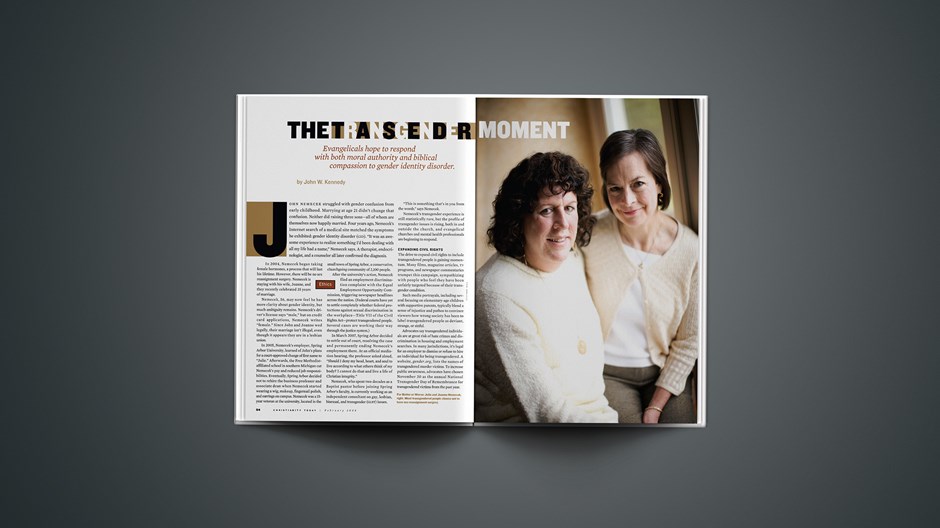
John Nemecek struggled with gender confusion from early childhood. Marrying at age 21 didn't change that confusion. Neither did raising three sons—all of whom are themselves now happily married. Four years ago, Nemecek's Internet search of a medical site matched the symptoms he exhibited: gender identity disorder (GID). "It was an awesome experience to realize something I'd been dealing with all my life had a name," Nemecek says. A therapist, endocrinologist, and a counselor all later confirmed the diagnosis.
In 2004, Nemecek began taking female hormones, a process that will last his lifetime. However, there will be no sex reassignment surgery. Nemecek is staying with his wife, Joanne, and they recently celebrated 35 years of marriage.
Nemecek, 56, may now feel he has more clarity about gender identity, but much ambiguity remains. Nemecek's driver's license says "male," but on credit card applications, Nemecek writes "female." Since John and Joanne wed legally, their marriage isn't illegal, even though it appears they are in a lesbian union.
In 2005, Nemecek's employer, Spring Arbor University, learned of John's plans for a court-approved change of first name to "Julie." Afterwards, the Free Methodist-affiliated school in southern Michigan cut Nemecek's pay and reduced job responsibilities. Eventually, Spring Arbor decided not to rehire the business professor and associate dean when Nemecek started wearing a wig, makeup, fingernail polish, and earrings on campus. Nemecek was a 15-year veteran at the university, located in the small town of Spring Arbor, a conservative, churchgoing community of 2,100 people.
After the university's action, Nemecek filed an employment discrimination complaint with the Equal Employment Opportunity Commission, triggering newspaper headlines across the nation. (Federal courts have yet to settle completely whether federal protections against sexual discrimination in the workplace—Title VII of the Civil Rights Act—protect transgendered people. Several cases are working their way through the justice system.)
In March 2007, Spring Arbor decided to settle out of court, resolving the case and permanently ending Nemecek's employment there. At an official mediation hearing, the professor asked aloud, "Should I deny my head, heart, and soul to live according to what others think of my body? I cannot do that and live a life of Christian integrity."
Nemecek, who spent two decades as a Baptist pastor before joining Spring Arbor's faculty, is currently working as an independent consultant on gay, lesbian, bisexual, and transgender (GLBT) issues.
"This is something that's in you from the womb," says Nemecek.
Nemecek's transgender experience is still statistically rare, but the profile of transgender issues is rising, both in and outside the church, and evangelical churches and mental health professionals are beginning to respond.
Expanding Civil Rights
The drive to expand civil rights to include transgendered people is gaining momentum. Many films, magazine articles, TV programs, and newspaper commentaries trumpet this campaign, sympathizing with people who feel they have been unfairly targeted because of their transgender condition.
Such media portrayals, including several focusing on elementary-age children with supportive parents, typically blend a sense of injustice and pathos to convince viewers how wrong society has been to label transgendered people as deviant, strange, or sinful.
Advocates say transgendered individuals are at great risk of hate crimes and discrimination in housing and employment searches. In many jurisdictions, it's legal for an employer to dismiss or refuse to hire an individual for being transgendered. A website, gender.org, lists the names of transgendered murder victims. To increase public awareness, advocates have chosen November 20 as the annual National Transgender Day of Remembrance for transgendered victims from the past year.
There is little research on the public's opinion of transgender behavior. One 2002 poll for the Human Rights Campaign found that 48 percent of the people surveyed would have "no problem working with a transgendered person."
Experts believe there are about 400,000 transgendered persons, less than one-half of one percent of the population, in America. In order to be diagnosed with gender identity disorder, there must be a strong desire to be the other sex and a persistent discomfort with one's body. The person may or may not have had sex reassignment surgery, and he or she may or may not have homosexual attractions.
There are six levels of GID according to what is known as the Harry Benjamin Scale. The occasional cross-dresser is stage one; someone who has had a surgical procedure, such as a vaginectomy or penectomy, has completed the final step.
A raft of transgender rights groups have formed in recent years to take up the civil rights cause. For example, there's the Transgender Legal Defense & Education Fund, the National Center for Transgender Equality, and the Transgender Law and Policy Institute. That's not to mention many sexual rights groups lending support. (The acronym GLBT is now a standard classification for such groups, referring to gays, lesbians, bisexuals, and transgendered persons.)
Article continues below
Such groups are seeking more than additional restrooms. The most vocal campaign is for special federal protections for employment and housing. However, through multiple lawsuits, transgender rights organizations are defending the transgendered homeless, college students, immigrants, and prisoners.
As of January 2008, some 13 states have laws prohibiting employers and landlords from discriminating against transgendered people. Ten states have enacted hate crime laws explicitly protecting "gender identity or expression." A growing number of major corporations have gender identity nondiscrimination policies.
Intense activism for transgender inclusion is having a ripple effect on local churches. Pastors are more likely to encounter a GLBT activist than a church member with GID; few pastors are trained to address either transgender advocacy or those with GID.
Debating Sexual Ethics
When church leaders include a transgendered individual who has "come out" into the spiritual life and leadership of a local congregation, it almost always provokes sharp controversy. But a number of liberal religious groups are rallying around the transgender movement in the name of social justice. The Raleigh, North Carolina-based Faith in America is at the forefront.
"Religion has been used in history to discriminate against various groups of people by justifying slavery, denying women the right to vote, and persecuting religious minorities," says Jimmy Creech, executive director of Faith in America. "Today it is being used to persecute lesbian, gay, bisexual, and transgendered people."
Creech likens the struggle for transgender liberties to the early civil rights movement to end racial bigotry. Creech, a former United Methodist Church (UMC) minister, says he spent three years studying Scripture before concluding that church teachings on homosexuality are fear-based and motivated by hate. Creech views the transgender movement as indistinguishable from the gay rights cause.
"We have to recognize the Bible in terms of the history and culture in which it was written," Creech says. "Scripture doesn't address the issues of transgender experience."
Whether mentioned in Scripture or not, the transgender movement clashes with traditional Christian theology that teaches the only God-given expression of human sexuality is between a man and woman who are married. "Transgender impulses are strong, but they don't match up with the Christian sexual ethic," says Warren Throckmorton, associate professor of psychology at Grove City College in Pennsylvania. "Desires must be brought into alignment with biblical teachings, but it will be inconvenient and distressful."
Article continues below
Throckmorton, past president of the American Mental Health Counselors Association, says he has advised transgendered people who are in absolute agony over their state. Typically, such individuals are desperately in search of hope and acceptance, he says. It may be uncomfortable to tell transgendered individuals that their desires don't align with the Bible, Throckmorton says, but pastors must do so. "Even if science does determine differentiation in the brain at birth," Throckmorton says, "even if there are prenatal influences, we can't set aside teachings of the Bible because of research findings."
So far, the church's response to transgender rights has been focused more on specific cases before denominational bodies or the civil courts, and less on the campaign for transgendered persons' rights. Those opposing the transgender movement are reluctant to call themselves experts because much about the condition remains a mystery and public debate is so new.
Individual evangelical congregations across the land are trying to figure out how to welcome lonely, hurting, seeking visitors who exhibit GID without offending long-term members.
As with homosexuality, it can be a delicate balance—accepting the person into the church without affirming that switching sexual identities is God's will for their lives.
A few years back, Calvary Assembly of God in Orlando, Florida, accepted a man who had complete sex reassignment surgery, and even allowed the person to do volunteer maintenance work at the church, according to administrator Bill Gray. The individual agreed to use a gender-neutral restroom in the office rather than upset females in the women's restroom.
One day, the individual appeared in Gray's office, weeping and confused. The person told Gray that after extensive counsel, he eventually realized that God didn't make creative mistakes and he resumed a male identity.
Pushing the Envelope
In Congress, legislators during 2007 considered three bills addressing GLBT issues: The Matthew Shepard Act places sexual orientation and gender identity as new categories covered under the federal hate crimes law; the Employment Non-Discrimination Act provides employment protection for GLBT workers; and the Military Enhancement Readiness Act repeals the ban on GLBT participation in the military.
Article continues below
But in the short term, none of the bills, caught up in Washington politics, are expected to pass.
In Washington, vocal conservative organizations don't see transgender rights as a matter of civil liberties. "The transgender lobby is following the example of the homosexual lobby in that they are co-opting the language of the civil rights movement in order to push their own radical and wacky agenda," says Matt Barber, policy director for cultural issues for Concerned Women for America (CWA).
Barber points out that the American Psychiatric Association, which declassified homosexuality as a mental disorder in 1973, still classifies the condition of transgender as a disorder. Barber says the political left wing is facilitating more gender confusion by counseling the afflicted to feel good about themselves rather than find a treatment for this disorder. "You are what you are—male or female," Barber says.
Peter Sprigg, Family Research Council (FRC) vice president for policy in Washington, D.C., says, "The pressure for acceptance is ultimately a challenge to the authority of Scripture and a violation of natural law. In the gay, lesbian, bisexual, transgender movement there is a tendency to continually push the envelope in trying to demand the acceptance of what most people perceive to be unusual behavior."
The everyday lives of transgendered people are often an agonizing interplay of nature and nurture. The experience of Ann Gordon/ Drew Phoenix has become a public example of this interplay in a faith-based environment.
As a child, Ann Gordon's parents allowed her to dress and act like a boy. Because of Ann's tomboyish appearance and conduct, her parents even publicly referred to her as their son in a small town north of Dayton, Ohio. But when puberty hit, Ann's parents expected her to start wearing dresses and look like a lady. She didn't know how to conform to parental wishes and societal expectations.
Eighteen years ago, Ann became an ordained United Methodist minister. In 2002, Ann began serving St. John's of Baltimore United Methodist Church. But the lifelong feelings of gender confusion were strong and persistent.
"I experienced a disconnect between my external physical self and my internal spiritual self," the minister says.
In 2006, Ann Gordon legally became Drew Phoenix, culminating in a sex-change operation. After the surgery, the bishop of the Baltimore-Washington conference reappointed Phoenix to the church. Some 20 of the 40 active St. John's members view themselves as part of the GLBT movement, according to Phoenix.
Article continues below
"I have no qualms about the transition," says Phoenix, 48. "It was the right thing to do. I feel happy, peaceful, and whole. I felt guided by the Spirit to do this."
In October, the nine-member UMC Judicial Council met to determine if Phoenix had broken any church law. Nothing in the denomination's Book of Discipline addresses the topic. The council upheld the bishop's decision that Phoenix could remain as a pastor in good standing. This summer, the UMC General Conference, which meets every four years, will likely discuss banning transgendered ministers.
Phoenix sets aside the biological fact that her body was originally female. "I believe I was born male," Phoenix says. "My body didn't match what I am. That's how God made me. God created me male."
Alan Chambers, president of Exodus International in Orlando, Florida, understands the ordeal that Phoenix is facing. "As a prepubescent boy I could have been diagnosed as transgender," Chambers says. "I dressed like a girl. I acted like a girl. I wanted to be a girl." Chambers is convinced that many of the children labeled as transgendered have been misdiagnosed.
Chambers, 35, says his parents didn't encourage him to try to be a female. He says his parents knew God didn't make mistakes and cited Genesis 1:27, in which God creates male and female. Preschoolers are incapable of knowing whether they would feel better as the other gender, Chambers says. His desire to be a girl subsided when he hit puberty.
"A lot of parents are allowing their children to switch identities from the sex that God created them to live," Chambers says. "That only sets kids up to be even more confused."
Call for Compassion
Jerry Leach, director of Reality Resources, a ministry in Lexington, Kentucky, to people dealing with gender confusion, shares Chambers's point of view. Leach says, "Rather than cutting tissue by invasive surgery and starting a new life, which for the most part doesn't work, people need to find help psychiatrically."
Leach has become the referral point person for several national Christian organizations on this topic. "The essence of who you are in your genetics, anatomy, chromosomes, and DNA does not suddenly change by surgical amputation."
Article continues below
Surgery or no surgery, there is no quick fix for transgendered people. Chambers says those who wrestle with such feelings don't start out with a desire to be involved in sinful behavior. It's merely a response to what they feel is natural.
"It's a psychological, emotional struggle that needs compassion," Chambers says. "It's an identity issue. At its core, there is absolute confusion about who someone is created to be."
Leach says, "This is a psychological and emotional malady. It's not like taking an appendix out."
Leach, 65, says only the sympathy of trusted Christian friends helped him emerge from his own conflict.
Sexual identity struggles consumed Leach beginning in early boyhood. His parents told him they wished he had been a girl and that they had planned to name him Jennifer. His mother made him wear dresses. His father told him he looked better as a female. The pattern of cross-dressing, applying lipstick and mascara, and wearing fingernail polish and pantyhose became a secret obsession years into his adult life. While some men who gazed at scantily clad females were overcome with lust, Leach had a different problem: jealousy. He wished he inhabited those bodies himself.
With God's help, Leach has learned to avoid occasions of temptation, including shopping for dresses with Charlene, his wife of 46 years.
Leach hoped marriage would make his gender-confused feelings go away, but it didn't. In 1989, after taking female hormones for 18 months, Leach scheduled sex reassignment surgery. But two weeks before the operation, he says he sensed God telling him to stop his covert double life.
Ultimately, Leach understood that God knit together his male body, as outlined in Psalm 139:15–16.
"God planned for me to be a man before I had ever been created," Leach says. "There was not a woman inside my body longing to be expressed. There is no human condition outside the redemptive circle of God's love and power."
The challenge before conservative evangelicals is persuading transgendered people, their families, and faith-based advocates that gender identity disorder is not beyond the reach of God's grace, compassionate church-based care, and professional help.
John W. Kennedy, a CT consulting editor, is a journalist in Springfield, Missouri. He is news editor of TPE magazine and a former CT news editor.
















 While we pray for peace, we need moral clarity about this war.
 We’ve got little information on Jesus’ appearance and personality. But that’s the way God designed it.españolFrançais
 When I married into a Jewish family, antisemitism hit home. Now, the holy day reminds me of our future hope.






