South Carolina pastor Ron Carpenter was a popular guy as the 2008 presidential candidates geared up for the primaries. After he gave seven minutes of pulpit time in October to Sen. Barack Obama to talk about his faith, other campaigns began calling the megachurch pastor, asking for equal time.
For Carpenter, it wasn't easy to determine where to draw the line for his Greenville, South Carolina, congregation, which sits in key territory for the early primaries. He decided elected officials could speak about their faith in the pulpit, but not candidates who are not in office.
"I'm not willing to open up the floodgates and let somebody different in here every Sunday," said Carpenter. "I'm not foolish, I know why they're here. I'm not going to subject the church just to political pandering."
Carpenter had been surprised when Obama's campaign notified him that the Democratic candidate would worship in his church. Candidates, especially Democratic ones, had long appeared in African American churches, but Redemption World Outreach Center is a multiracial Pentecostal church with mostly white leadership.
Whether or not candidates worship in his 8,000-member church, Carpenter is pleased that political candidates want to talk about their Christian faith.
"The problem is, who can say that it's genuine or whether it's just a ploy to get votes?" Carpenter said. "I think the jury is out on that."
Wooing Evangelicals
Many political scientists attributed President Bush's successful reelection to the 78 percent of white evangelicals who voted for him, compared to the 21 percent who voted for Sen. John Kerry. "There was kind of a wake-up call that we don't talk about those things," said Mike McCurry, former press secretary for Bill Clinton. "In the course of the last two and a half decades with the Democrats, we lost our vocabulary."
Now many of the campaigns have someone on staff who directs religious outreach. But they have a tough job ahead; like the rest of the electorate, evangelical voting patterns may be difficult to predict.
Some voters will look for an electable candidate who will provide evangelicals with the greatest access, argues Corwin Smidt, executive director of the Paul Henry Institute at Calvin College. Others will only want a candidate who will pass policies that are consistent with their views.
"If you're wanting access, there's no guarantee that your voice will be heeded," Smidt said. "If you are voting for someone who has no chance of being elected, you've lost the chance of being heard. There's a risk in both directions."
The staff in charge of religious outreach will have to figure out the best sell: highlight the values religious voters feel most strongly about, make connections to the candidate's faith, or foster relationships with religious leaders.
Michael Cromartie, vice president of the Ethics and Public Policy Center, thinks that although certain candidates have tried to talk about faith and have met with religious leaders, evangelicals will eventually vote for the candidate who most reflects their views.
"At the end of the day, voters are going to be asking not, Who have I seen you in pictures with? but, Where do you stand on the issues?" Cromartie said. "They've gone and hired these spiritual gurus to play to a constituency that they've never made inroads with. You won't get those inroads unless you change those policies."
Sidling Up and Saddling Up
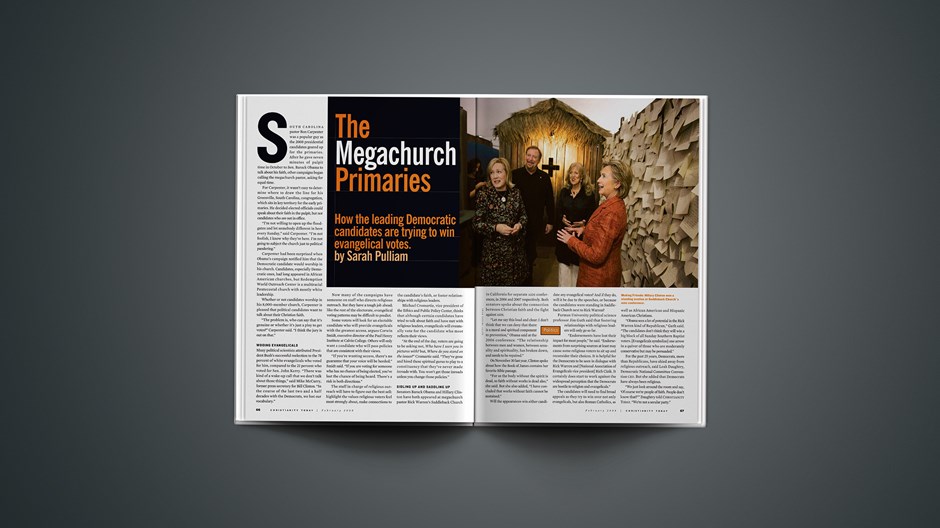
Senators Barack Obama and Hillary Clinton have both appeared at megachurch pastor Rick Warren's Saddleback Church in California for separate AIDS conferences, in 2006 and 2007 respectively. Both senators spoke about the connection between Christian faith and the fight against AIDS.
"Let me say this loud and clear: I don't think that we can deny that there is a moral and spiritual component to prevention," Obama said at the 2006 conference. "The relationship between men and women, between sexuality and spirituality, has broken down, and needs to be repaired."
On November 30 last year, Clinton spoke about how the Book of James contains her favorite Bible passage.
"For as the body without the spirit is dead, so faith without works is dead also," she said. But she also added, "I have concluded that works without faith cannot be sustained."
Will the appearances win either candidate any evangelical votes? And if they do, will it be due to the speeches, or because the candidates were standing in Saddleback Church next to Rick Warren?
Furman University political science professor Jim Guth said that fostering relationships with religious leaders will only go so far.
"Endorsements have lost their impact for most people," he said. "Endorsements from surprising sources at least may cause some religious voters to sit up and reconsider their choices. It is helpful for the Democrats to be seen in dialogue with Rick Warren and [National Association of Evangelicals vice president] Rich Cizik. It certainly does start to work against the widespread perception that the Democrats are hostile to religion and evangelicals."
Article continues below
The candidates will need to find broad appeals as they try to win over not only evangelicals, but also Roman Catholics, as well as African American and Hispanic American Christians.
"Obama sees a lot of potential in the Rick Warren kind of Republican," Guth said. "The candidates don't think they will win a big block of all Sunday Southern Baptist voters. [Evangelicals symbolize] one arrow in a quiver of those who are moderately conservative but may be persuaded."
For the past 25 years, Democrats, more than Republicans, have shied away from religious outreach, said Leah Daughtry, Democratic National Committee Convention CEO. But she added that Democrats have always been religious.
"We just look around the room and say, 'Of course we're people of faith. People don't know that?'" Daughtry told Christianity Today. "We're not a secular party."
Time magazine's nation editor Amy Sullivan thinks the Democrats are to blame for losing evangelical voters. She said that Democrats were hopeless when it came to religious voters.
"It was not just something they felt uncomfortable with. It was [considered] a lost cause," said Sullivan, whose book on the Democrats' recent religious outreach efforts, The Party Faithful, comes out this month from Scribner. "There were Democrats who were frightened that the conversation would start with abortion and never move on."
Now Democrats are hoping that evangelicals have changed their priorities to the Iraq War and the environment. There is some reason for this hope: In a recent survey by the Pew Forum on Religion & Public Life, 65 percent of evangelicals said the war in Iraq was very important to them. Seventy-two percent said that domestic issues like health care, the environment, and the economy are very important, while 56 percent said social issues like abortion and gay marriage were very important.
From Sojourners Intern to Rainmaker
Democrats' eagerness to actively seek out the religious vote began with John Kerry's presidential campaign, which hired a young Democrat named Mara Vanderslice to focus on religious outreach. The former intern at Jim Wallis's Sojourners organization desperately wanted to see Democrats talking with people of faith.
Vanderslice was marginalized during the campaign because other staffers worried that religious outreach would backfire. She was barred from speaking to the press, including CT. Now Kerry says he regrets not talking more about his faith during his failed White House bid.
Article continues below
Shortly after the 2004 election, Vanderslice and congressional staffer Eric Sapp, another self-described evangelical, opened Common Good Strategies, a political consulting firm, to help Democrats connect with religious voters.
The Democrats gained more support from evangelicals in the 2006 election, especially in states where Vanderslice's firm was active, such as Pennsylvania, Ohio, and Michigan. (The firm is not working on a presidential campaign during the primary season.)
"She had to bang down the door to get the Kerry campaign to hire her," said Dan Gilgoff, author of The Jesus Machine and political editor for Beliefnet. "Now she's getting paid to do this stuff. These strategists have become really hot commodities in the party."
John Green of the Pew Forum said Vanderslice used three strategies: She helped the candidates address their faith and policies, she connected candidates with religious leaders, and she encouraged the candidates to advertise on Christian radio stations.
"The Republicans are just as in need of consultants and strategists as the Democrats are," Green said. "Hiring this high-priced talent is critical. The candidates do not have time to find out [the pulse] themselves."
Wallis said that if Kerry's campaign ignored his former intern, they're listening now. The faith outreach directors, he said, are "not just off in a marginal religious subcommittee. They are central to the campaign."
Obama's Joshua DuBois
Sen. Obama hired Joshua DuBois to be his director of religious affairs. He maintains the religious outreach website and directs "faith forums," which are church-hosted discussions about the role of faith in politics. He grew up in the African Methodist Episcopal Church and is a former associate minister with the Assemblies of God.
"I'm certainly not a theologian, but there are fundamentals I know to be true. The foundations of my faith are in Jesus Christ and in his teachings, especially addressing the needs of the least of these," DuBois said. "That's certainly a model for me, and that's how I'm hoping to approach my work on the campaign."
DuBois said that while Obama's personal faith (Obama is a member of a United Church of Christ congregation in Chicago) shapes his approach to issues, the senator is a firm believer that church and state should be separated.
"Our democracy demands that when people are religiously motivated," DuBois said, "you have to translate your [policy] concerns into universal rather than religion-specific values. We're no longer just a Christian nation; we're also a Jewish nation, a Hindu nation, a Muslim nation, and a nation that does not adhere to a particular religion."
Article continues below
Clinton's Burns Strider
"This year, you've got the three leading candidates who are very comfortable talking about their faith, they enjoy opportunities to talk about their faith, and they all three have profound faith," said Burns Strider, a self-described evangelical who is Clinton's senior adviser and director of faith-based outreach.
"By talking about our faith, that doesn't change who we are as Democrats," he said. "It only showcases why we are Democrats." Strider, who grew up in a Southern Baptist church, said Clinton's faith impacts what she cares about, from Iraq to Darfur to creation care. Among his main duties is setting up conversations with clergy and faith leaders.
"If you're not talking to someone, if you're not having a conversation, you can surely conclude that your chances of having their support are greatly diminished," he said. "If faith is important to you, you put it in the campaign."
Our other articles on election 2008 are in our special section. Liveblog also has news and commentary on the candidates.
Other articles on Democratic faith advisors include:
Consultant Helps Democrats Embrace Faith, and Some in Party Are Not Pleased | As Democrats turn toward the 2008 presidential race, a novice evangelical political operative is emerging as a rising star in the party, drawing both applause and alarm for her courtship of theological conservatives in the midterm elections. (The New York Times)
Closing the God Gap | How a pair of Democratic strategists are helping candidates talk about their faith. (Hanna Rosin, The Atlantic Monthly)
How the Democrats Got Religion | Candidates are competitors, which means they seldom manage to talk about faith in a way that doesn't disturb people, doesn't divide them, doesn't nail campaign posters on the gates of heaven. (Time)















 While we pray for peace, we need moral clarity about this war.
 As my doubts about his teachings grew, so did a secret fascination with Jesus.
 After lobbying from fellow Southern Baptists and Christians affected by the war, the House speaker moves a package forward.






