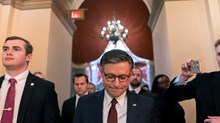
As his poll numbers continue to climb dramatically with Republicans, John McCain has been extending an olive branch to evangelicals in the party. But evidence is mixed over whether he can win their support.
In the first six Republican matchups, the Arizona senator has had not seen the major successes among evangelical voters that have boosted rivals Mitt Romney and Mike Huckabee.
Among Republicans who identified themselves as evangelical or born again, Huckabee won Iowa with 46 percent over Romney (19%) and McCain (10%). The New Hampshire evangelical vote was split between Huckabee (28%), McCain (28%), and Romney (27%). In Michigan, Nevada, and South Carolina, McCain fell behind Huckabee, and in Nevada even Ron Paul gathered more votes (13%) than McCain (9%) did. But despite his strong overall showing in Florida, McCain (30%) barely overtook Huckabee (29%) and Romney (29%) among evangelicals.
A September 2007 Pew Forum survey showed that 36 percent of evangelicals are reluctant to vote for Romney because of his Mormon faith, and some are concerned about his "flip flopping" on issues like abortion. Still, McCain has not been able to attract many evangelical votes from Romney as his overall poll numbers have climbed.
Many journalists attribute McCain's lackluster support to a comment he made during the 2000 election, when he described Pat Robertson and the late Jerry Falwell as "agents of intolerance." But Wheaton College political science professor Amy Black says that comment would not significantly hurt him among evangelicals eight years later. However, she says, other issues from the 2000 campaign may be limiting his appeal.
"Many voters will remember McCain as the more liberal option from 2000," Black told Christianity Today. "They're looking for a social conservative and an economic conservative. McCain does not have a strong consistent record on both of those in a way that the Christian conservatives want. He's not a liberal, but he's just more moderate." McCain led campaign finance rules that frustrated some evangelical leaders who felt it restricted their involvement in politics. He also supported stem-cell research and looser immigration rules, and he opposed large tax cuts and a marriage amendment.
McCain's campaign rode a roller coaster last year. A Pew Forum poll taken in April 2007 showed Rudy Giuliani leading among evangelicals with 27 percent, while McCain closely trailed with 23 percent. But McCain nearly dropped off the radar screen last fall. A September ABC poll showed McCain gaining 13 percent among evangelicals, trailing behind former candidates Rudy Giuliani (23 percent) and Fred Thompson (22 percent). Romney gained eight percent and Huckabee was not listed in the poll.
Two former aides hired to lead religious outreach were fired in April 2007 during a campaign staff reshuffling. The staffers complained of McCain's lack of effort to connect with voters on religious terms, says Furman University political science professor Jim Guth. "They universally reported a contempt toward conservative Protestants and traditionalist Catholics," Guth said.
Marlene Elwell, one of the fired staffers and an activist who directed Michigan's 2004 marriage amendment campaign, told reporters that others in the campaign ignored her and wanted to collect church directories against her objections. "The way we were being treated, it was as if we had leprosy," she told reporter Dan Gilgoff. Elwell endorsed Romney on January 14.
At least one conservative leader is adamant in his views of McCain. James Dobson, founder of Focus on the Family, told Dallas Christian radio KCBI that he "would not vote for John McCain under any circumstances." But scholars like John Green of the Pew Forum on Religion & Public Life are not sure leaders will actually matter when it comes to voting day.
"The most interesting thing about John McCain in the primaries is that he's getting a big share of the evangelical vote, yet there hasn't been much enthusiasm from evangelical leaders," Green said. "Trying to pigeonhole evangelical voters by looking at a few leaders is probably a big mistake."
If McCain wins the Republican nomination, Michael Cromartie, vice president of the Ethics and Public Policy Center, says McCain may lose many evangelical voters to Democratic Senator Barack Obama, whose campaign has done significantly more religious outreach than McCain's, and who regularly talks about faith on the campaign trail. "[McCain] doesn't have the ability like Bill Clinton and George Bush to use the language of redemption and forgiveness, and is theologically a little tone deaf," Cromartie said. But Cromartie thinks McCain would have an easier time against Obama's primary opponent. "The most motivating words for religious conservatives will be 'President Hillary Clinton.'"
Although McCain hasn't garnered overwhelming evangelical support in states that have already voted, he may have some hope on Super Tuesday and afterward. A January Pew Forum survey found that McCain has 25 percent of conservative evangelical support, between Huckabee's 33 percent and Romney's 12 percent.
Huckabee's national poll numbers have been dropping over the last month, and he has not won a primary or caucus since Iowa. His opponents are better financed, and Huckabee has not gained much support among non-evangelicals. Exit polls show many Huckabee supporters listed McCain as their second choice, which Green says is likely because Huckabee and McCain are socially conservative but economically moderate.
But there may be good, if bittersweet, news for Huckabee: Pundits and journalists, like the Washington Post's Chris Cillizza, are speculating he could be McCain's choice as a running mate, and might deliver the evangelical support McCain has been missing.
Copyright © 2008 Christianity Today. Click for reprint information.
Related Elsewhere:
News coverage of McCain's surge and evangelical voters includes:
McCain's Critics on Right Look Again | Senator John McCain has long aroused almost unanimous opposition from the leaders of the right. That, however, was before he emerged this week as the party's front-runner. (The New York Times)
If Huckabee goes, who will evangelicals back? | The Baptist preacher goes up against two better-financed, better-known and better-placed rivals in 21 states for the Republican U.S. presidential nomination, and pundits give him next to no chance. (Reuters)
In GOP Primaries: Three Victors, Three Constituencies | Romney Gains Among Non-Evangelical Conservatives (Pew Forum survey)
McCain reaching out to Christian conservative base | McCain talks about his faith (McClatchy newspapers)
Other Christianity Today articles on campaign 2008 are available in our full-coverage section.







Support Our Work
Subscribe to CT for less than $4.25/month