Sunday morning, May 18, 1980, my children were leaving the little Presbyterian church in College Place, Washington, where they had been attending a program. They looked up at the sky, and a verse they had read in the Bible leapt to their minds. Jesus said that in the last days, the sun would be darkened, and the moon would not give its light. The sky was so preternaturally dark that my girls thought that the end of the world was upon us. They joined hands and ran the several blocks to our home.
What had happened was the deadliest and most economically destructive volcanic event in U.S. history. Mount St. Helens had blown its dome, killing 57 people and destroying 250 homes, 47 bridges, 15 miles of railway, and 185 miles of highway. The ash cloud darkened our skies, and the nasty stuff settled on our houses and yards and cars, making it impossible to drive without clogging the air intakes and harming the engines.
It was tricky to cope with the event for the next few weeks, but the damage near our home was minor compared with what people in western Washington had to deal with. But for my little girls—for just a moment—it was the end of the world.
Christians have consistently been end-of-the-world people, with at least one eye on matters related to eschatology or "last things"—final judgment, the second coming of Christ, death and the resurrection of the dead, the renewal of Creation, and the coming of God's rule in its fullest and most visible expression. Yet contemporary realities have forced Christians to explore what it means to be an anticipatory people with a strong orientation to these last things when facing environmental degradation, and perhaps even environmental disaster.
Too Future-Minded to be of Present Good?
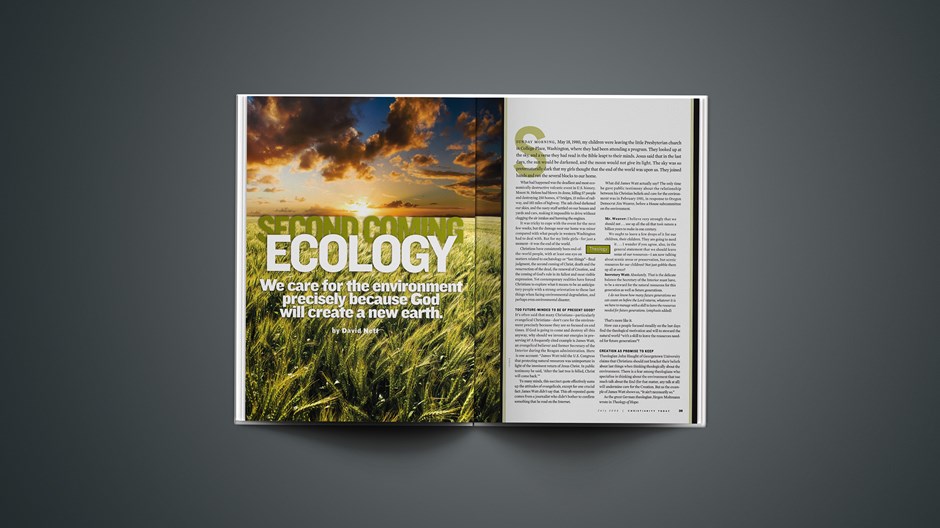
It's often said that many Christians—particularly evangelical Christians—don't care for the environment precisely because they are so focused on end times. If God is going to come and destroy all this anyway, why should we invest our energies in preserving it? A frequently cited example is James Watt, an evangelical believer and former Secretary of the Interior during the Reagan administration. Here is one account: "James Watt told the U.S. Congress that protecting natural resources was unimportant in light of the imminent return of Jesus Christ. In public testimony he said, 'After the last tree is felled, Christ will come back.'"
To many minds, this succinct quote effectively sums up the attitudes of evangelicals, except for one crucial fact: James Watt didn't say that. This oft-repeated quote comes from a journalist who didn't bother to confirm something that he read on the Internet.
What did James Watt actually say? The only time he gave public testimony about the relationship between his Christian beliefs and care for the environment was in February 1981, in response to Oregon Democrat Jim Weaver, before a House subcommittee on the environment.
Mr. Weaver: I believe very strongly that we should not … use up all the oil that took nature a billion years to make in one century.
We ought to leave a few drops of it for our children, their children. They are going to need it … I wonder if you agree, also, in the general statement that we should leave some of our resources—I am now talking about scenic areas or preservation, but scenic resources for our children? Not just gobble them up all at once?
Secretary Watt: Absolutely. That is the delicate balance the Secretary of the Interior must have, to be a steward for the natural resources for this generation as well as future generations.
I do not know how many future generations we can count on before the Lord returns, whatever it is we have to manage with a skill to leave the resources needed for future generations. (emphasis added)
That's more like it.
How can a people focused steadily on the last days find the theological motivation and will to steward the natural world "with a skill to leave the resources needed for future generations"?
Creation as Promise to Keep
Theologian John Haught of Georgetown University claims that Christians should not bracket their beliefs about last things when thinking theologically about the environment. There is a fear among theologians who specialize in thinking about the environment that too much talk about the End (for that matter, any talk at all) will undermine care for the Creation. But as the example of James Watt shows us, "It ain't necessarily so."
As the great German theologian Jürgen Moltmann wrote in Theology of Hope:
From first to last, and not merely in the epilogue, Christianity is eschatology, is hope, forward looking and forward moving, and therefore also revolutionizing and transforming the present. The eschatological is not one element of Christianity, but it is the medium of Christian faith as such, the key in which everything in it is set, the glow that suffuses everything here in the dawn of an expected new day. … Hence eschatology cannot really be only a part of Christian doctrine. Rather, the eschatological outlook is characteristic of all Christian proclamation, of every Christian existence and of the whole Church. There is therefore only one real problem in Christian theology … : the problem of the future.
Article continues below
Haught says we need to think of our doctrine of last things in terms of promise. Of course, the biblical doctrine is a mix of promise and threat, of renewal and destruction, of victory for good and judgment for evil. But the promise of God's kingdom is fundamentally good news, and as a promise it carries within it some importance for the present.
Perhaps an analogy would help illuminate the dynamics of promise. If a young man gives a young woman an engagement ring, this pledge is a carrier of promise, but it is not the wedding band itself—just as the engagement is not the wedding. Similarly, our present existence is like the engagement, and the fullness of the kingdom is like the wedding. Our present environment is God's gift to us. It is not all that it will be when the "wedding" comes, but it is extremely valuable—just like the engagement ring.
I don't think any young woman favorably inclined to her suitor has ever said, "Well forget that, it's only an engagement ring. What I wanted was a wedding ring." No, you don't dis an engagement ring.
Or think of a teenager eager to learn to drive, who has just acquired a learner's permit. The learner's permit is not a driver's license. But it is what it is—a bearer of promise. What young man getting his learner's permit doesn't beam with joy? While it's not a driver's license, no teen disrespects a permit.
So an orientation toward that which is to come helps us think in terms of promise and fulfillment. And while promise isn't fulfillment, it is something precious.
Keeping the End in Mind
Framing a discussion of the natural world eschatologically also leads toward other lines of thought we should consider:
First, knowing that the Creation as we have it is promise and not fulfillment means that we will recognize its limits and conserve it. Nature as we know it is bountiful, but not unbounded. As we have been repeatedly reminded, there are limits to fossil fuels. Even the fuels for nuclear power are seriously limited. These facts should not surprise us. The Creation is a limited thing, a provisional thing.
Christians with an eschatological vision do not want to despoil the earth of its resources. Part of being human is learning to live (and consume) within limits. It is liberal Christianity, at least in its classic form with its unbounded optimism about human resourcefulness and technological prowess, that should be readjusting. Christians operating with the End in mind should always have limits in view, but like everyone else in North America, Christians have by and large been co-opted by consumer culture. It is now up to us to live with a theology of limits.
Article continues below
Similarly, seeing Creation as promise prevents us from treating it as mere raw material. If the gift of Creation were simply a commodity, then we could consume it the way we consume a gift box of chocolates. But because it carries promise, it must be conserved until the time of fulfillment.
Second, knowing that Creation is God's promise helps us realize that the Creation is not an ultimate value. The theologians who don't pay attention to this fact end up sliding off into one of any number of views that simply get the world wrong: pantheism, nature mysticism, deep ecology, or re-paganization.
While it is important to reject the mechanical materialism of the 17th century (the philosophy that paved the way for industrialization), there is no reason to revert to nature idolatry, paganism, shamanism, or animism. We need to be sure that the core ecological insight—of the complex, weblike interrelatedness of all things animate and inanimate—guides us to a more sophisticated scientific outlook, not an anti-technological mysticism. The technological revolutions that accompanied the rise of capitalism did in fact make life a lot better for many people. They brought health, nutrition, and leisure to the masses for the first time in history. So we are careful to treat nature as a relative good rather than something to be worshiped.
Similarly, seeing nature through eschatological eyes helps us rise above natural cycles. In the ancient world, the pagan view of history was tied to the cycles of fertility and the seasons. The seasonal flooding of the Nile, the early and later rainy seasons in Palestine—these things dominated the pagan view of life. But the Jewish and Christian views were historical. Biblical religion celebrated God's abundance in the annual agricultural cycles. But the more important festivals celebrated historical events: the liberation from slavery in Egypt and the giving of the Torah. This prepared them to understand God and his actions in the framework of world history. What the superpowers of the day—Egypt, Babylon, Persia, Greece, and Rome—did was of significance to God and God's people. And for Christians, what happened at the Cross became the center point of history.
Article continues below
Eschatology is one form of biblical historical consciousness. It helps us see the cosmos in the context of time and history. Such a historical view is a religious perspective that empowers people to take significant action, and not be bound to insignificance by the cycles of time.
Third, an eschatological frame helps us take account of the big picture of salvation. Evangelical forms of Christianity—most notably its pietist and revivalist strands—have tended to focus on the personal experience of present salvation. And there are good historical reasons for that. Think of Luther's struggle for a sense of acceptance with a wrathful God. Or think of John Wesley's famous experience of having his heart strangely warmed when he heard the preface to Luther's Commentary on the Epistle to the Romans read at Aldersgate Chapel: "An assurance was given me that He had taken away my sins, even mine, and saved me from the law of sin and death."
But as the apostle Paul contemplates the end of all things in his epistle to the church in Rome, he talks not just about individuals awaiting their redemption, but about the whole Creation as well.
The creation was subjected to frustration, not by its own choice, but by the will of the one who subjected it, in hope that the creation itself will be liberated from its bondage to decay and brought into the glorious freedom of the children of God. We know that the whole creation has been groaning as in the pains of childbirth right up to the present time. Not only so, but we ourselves, who have the firstfruits of the Spirit, groan inwardly as we wait eagerly for our adoption as sons, the redemption of our bodies. For in this hope we were saved.
Rom. 8:20-24
Christ didn't come to save just you or just me—though his ultimate sacrifice assures us of our individual worth. He came to save Adam's fallen race by becoming the Second Adam, the head of a new humanity that will someday inhabit a new and improved version of the Eden that Adam and Eve were forced to leave. When we remember that a restored humanity in a restored Eden is the crowning vision of Scripture, we come to see ourselves and our responsibilities in a bigger, broader landscape.
That broader landscape will encourage us to engage with the "groanings" of Creation as we are now able to hear them.
Fourth, an eschatological perspective helps us save nature for God's sake, not just for our own benefit. Care for the natural world is not just about a cost-benefit analysis for human welfare, though that must always be done. But if God has a plan for this natural world, has a bright future for it, we do not always need to see the benefit for ourselves before acting to preserve the natural order. It should be enough for us that this is part of God's vision for the future and a carrier of his promises.
Article continues below
Fifth, and finally, an eschatological perspective can help us deepen our relationship to all people and all things. As Christians, we are called to love our neighbors as ourselves, and Jesus defined "neighbor" in extremely broad terms. I find it difficult to love and serve as broadly as Jesus calls me to. In the global community that communication technology and multinational businesses have brought about, I can know about, and feel concern about, needs that I can never hope to address. Geographical and cultural distance can be a real source of frustration when I hear that genocide is going on in one place or starvation in another. Aside from e-mailing my congressional representative and donating a few dollars to disaster response and relief work, it is hard to know how to relate.
There are limitations on my present existence that will no longer exist in the kingdom of God. Yet for now, despite limits of money, time, and energy, as well as cultural, ethnic, and linguistic barriers, relate I must.
The eschatological vision portrays a global community that is no longer divided by tribal and ethnic barriers. Both the Hebrew prophets and the Book of Revelation portray a new humanity drawn from every tribe and nation, language group and people. That vision causes me to care just as much about what rising sea levels do to impoverished people in Bangladesh as about what they do to affluent people living on the isle of Manhattan. That vision causes me to care just as much about what happens when sea erosion causes buildings to collapse on the Alaskan island of Shishmaref as it does when rich people's houses in Malibu slide into the ocean.
Seeing through eschatological eyes pushes me in the direction of relating to desperate people who are at a distance, because God has promised some day to bring them close. When I was growing up, eschatology meant "end times"—that is, my church focused on the timing and manner of final events.
But Jesus and the apostles played down the time element and even the manner of the End. Instead, they emphasized the inbreaking of God's rule and the way our ability to see his rule helps to transform the present.
Article continues below
If we are given that ability to see God at work, bringing the present into contact with the End, we cannot be indifferent to the way things are. We cannot be deaf to the groanings of Creation. And we can treasure every gift God gives us as a sign of his promises.
David Neff is editor in chief of Christianity Today.

















 While we pray for peace, we need moral clarity about this war.
 We’ve got little information on Jesus’ appearance and personality. But that’s the way God designed it.españolFrançais
 After lobbying from fellow Southern Baptists and Christians affected by the war, the House speaker moves a package forward.






