As a denomination, there are a couple surefire ways to get your name in the headlines. You can bow to popular wisdom on a major doctrinal issue, as the Episcopal Church did in 2003 by electing an openly homosexual man as bishop. Or you can weigh in against practices near and dear to some of your fellow Christians, as the Southern Baptist Convention did two years ago.
If you want to make sure no one covers your denominational meeting, here's what you do: Revise your statement of faith before certain issues become disputed in your churches. And yet here I am writing about the Evangelical Free Church of America's newly revised statement of faith. Why? Because the time to fix your doctrine is when it isn't broke.
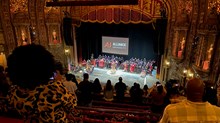
By and large, the EFCA has been insulated from the evangelical world's recent debates over open theism, the Atonement, justification, and inerrancy. That's not to say the EFCA has avoided the debates. Faculty at the EFCA seminary, Trinity Evangelical Divinity School (TEDS), have actively engaged each of these controversial topics. But the newer interpretations have not gained traction among the denomination's 1,300 churches. Still, it's clear EFCA leaders had these debates in mind when they adopted a new statement of faith on June 26.
The first article says God has "limitless knowledge and sovereign power." Thus, the EFCA takes a stand against open theism, which claims that God granted humans complete free will, so he can't know the future precisely. This first article was shifted ahead of an article on the Bible, which led off the last statement of faith, adopted in 1950, when the EFCA was formed by merger. The move should not be interpreted as de-emphasizing inerrancy. Indeed, the 2008 revision strengthens the EFCA's commitment to inerrancy by taking a cue from the 1978 Chicago Statement. The Bible, "without error in the original writings," is to be "believed in all that it teaches, obeyed in all that it requires, and trusted in all that it promises." The EFCA statement also says the Bible is the "ultimate authority by which every realm of human knowledge and endeavor should be judged."
It is no surprise the EFCA would take a strong stance on inerrancy. The late TEDS luminaries and CT editors Kenneth Kantzer and Carl F. H. Henry helped draft the Chicago Statement. But the move is still significant, since every tenured TEDS professor must sign the EFCA statement of faith. Another bastion of inerrancy, Westminster Theological Seminary, recently suspended Peter Enns on suspicion that his understanding of inerrancy was at odds with the Westminster Confession.
Like other doctrinal statements of the era, the EFCA's 1950 draft did not elaborate much on any point. For example, it says the "shed blood of Jesus Christ and his resurrection provide the only ground for justification." But with the definition of justification now up for grabs, the new statement says, "The true church comprises all who have been justified by God's grace through faith alone in Christ alone." Regarding the Atonement, the 1950 statement says that Jesus "died on the cross, a sacrifice for our sins according to the Scriptures." Someone who rejects substitutionary Atonement, who sees Jesus primarily as a model of sacrificial service, could sign the earlier statement. Not so with the 2008 version. It reads, "We believe that Jesus Christ, as our representative and substitute, shed his blood on the cross as the perfect, all-sufficient sacrifice for our sins."
EFCA leaders often cite as their unofficial motto, "In essentials, unity. In non-essentials, charity. In all things, Jesus Christ." If that's the case, they must see substitutionary Atonement and justification by faith alone as gospel essentials.
But the document may be equally notable for what it does not say. There is an article about the Holy Spirit, but it says nothing about certain gifts of the Spirit, such as prophecy or speaking in tongues. It says the Lord Jesus mandated baptism as one of two ordinances, along with the Lord's Supper. But it does not specify the mode or timing of baptism. Very few EFCA pastors baptize infants, but the denomination allows this option, said Greg Strand, the EFCA's director of biblical theology and credentialing. He said the EFCA historically accommodated refugee Methodists and Presbyterians who still wanted to baptize their infants.
Unlike Baptist denominations, adult baptism by immersion is not a requirement for membership in the EFCA. This practice dates back to the EFCA's roots in the Scandinavian free churches that split with the Lutheran state churches. The free churches recoiled against requiring anything but a profession of faith in Jesus Christ for membership. But the EFCA's openness on baptismal modes has led churches to de-emphasize baptism altogether, Strand said. The 1950 statement says only that water baptism and the Lord's Supper are "not to be regarded as means of salvation."
"The ordinances became a matter of indifference," Strand said. "That's a weakness. And that's what we attempted to redress in article seven in our new statement of faith." The 2008 statement says the ordinances "confirm and nourish the believer." David Neff, editor in chief of Christianity Today media group, observes the new tone of the document, which also states the ordinances "visibly and tangibly express the gospel."
Strand and many other leaders relented on one proposed change. They worried they could not garner support from the required 67 percent of delegates to the EFCA national leadership conference. The proposal would have dropped premillennialism from the statement of faith. Objections to the change recall an earlier era during the early and mid-20th century, when dispensationalism became closely associated with historic Protestant orthodoxy in America. Strand said some delegates argued that opening the door to other end-times views would undermine inerrancy and put the denomination on a slippery slope to liberalism.
Concerns about promoting a social gospel were raised about the article on Christian living, Strand said. But the surviving article reminds Christians that "God's justifying grace must not be separated from his sanctifying power and purpose." It goes on to say that God commands Christians to live out their faith with "compassion toward the poor and justice for the oppressed."
"One of the big issues the evangelical church needs to address today is the both/and of orthodoxy and orthopraxy," Strand said. "That is why we've been intentional about including both in a statement of faith."
By being intentional about revising the statement of faith before it breaks down, EFCA leaders just might save themselves the trouble of fixing it later.
Collin Hansen is a CT editor at large, master of divinity student at TEDS, and author of Young, Restless, Reformed: A Journalist's Journey with the New Calvinists.
Copyright © 2008 Christianity Today. Click for reprint information.
Related Elsewhere:
Previous Theology in the News columns are available on our site.







Support Our Work
Subscribe to CT for less than $4.25/month