In the pantheon of Fourth of July Will Smith blockbusters, Hancock, directed by Peter Berg, will rank significantly higher than Men in Black 2 but far lower than the granddaddy of them all, Independence Day. In other words: It isn't horrible, but it's far from classic. Actually, it does pretty much everything it should do for what it is: explosions, romance, laughs, heroes, villains, and gobs of patriotism.
The name of the film is actually one of the least patriotic things about it. It's simply the surname our hero stumbled upon. Go figure. But I'll be darned if the film as a whole is not something President George W. Bush will gleefully enjoy.
Will Smith as a superhero with … issues
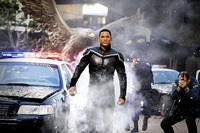
Now I do not know Peter Berg's politics, but it is interesting that the films he's directed have thrown the unusually conservative bone to red state America. Friday Night Lights celebrates Texas football, The Kingdom glories in killing vicious terrorists, and Hancock—stretch though it may be—seems to be an apologetic for President Bush. The film is all about a good-at-heart guy with super powers (played by Smith) who tries to do good things but often leaves a messy trail of destruction in his wake.
To put the kibosh on a highway chase, Hancock inflicts $9 million in damages on the city of Los Angeles; in rescuing a beached whale, he destroys a sailing yacht. And so on. Naturally, the people get angry and are not thankful in the least—repaying Hancock's clumsy heroics with jeers and protests. They are not tolerant of heroism when there is a cost involved, just like the many Americans clamoring for an exit in Iraq. Is Hancock some personification of Bush? Probably not, but it's a thought.
First and foremost, though, Hancock is a popcorn superhero movie. The plot is fairly standard, though unlike most superhero movies there is no laborious "how did he get to be this way" prologue. We are thrown into the middle of what has apparently been a long and rocky relationship between Hancock and the denizens of Los Angeles, and the back story comes out only in the film's third act.
Hancock is always leaving destruction in his wake
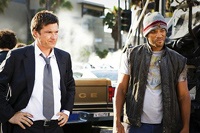
In the meantime we get to watch the fantastic Jason Bateman take Hancock under his wing and perform a much-needed PR makeover on the celebrity superhero. He teaches Hancock to be a little nicer, less destructive, and to smile more. Eventually Bateman's character, Ray, convinces Hancock to spend some time in prison (there has been a warrant out for Hancock's arrest since his latest do-good debacle) to make the public miss him. Sure enough, it works. But just when it looks like Hancock will sail happily into a Santa Monica sunset, a major twist throws his life for a new loop.
The twist comes about an hour into the film, and it has to do with the third major character: Ray's girlfriend Mary (Charlize Theron). It's pretty clear from the first moments of the film that Charlize holds some dark, crucial secret. She's always looking nervous and emotional when Hancock is present, or even when she sees him on TV. Without revealing anything else, I'll just say that the "twist" changes the tenor of the film in a big way, becoming more like X-Men than Iron Man (if that makes sense—and it will, if you see the movie).
Charlize Theron as Mary
Some people will like the surprising direction the film goes in its final act, but I definitely think the first half of Hancock is better. The plot becomes a little too complicated for its own good, with a lot of expository talking about things that would be much more interesting (and comprehensible) to see. It also becomes much less funny and more melodramatic in the end, though there are a handful of truly touching moments.
On the technical level, Hancock does everything it needs to do, though nothing more. There aren't the dazzling suits of Iron Man or the impressive attention to detail of a Batman Begins. Berg's visual style can be hit and miss, and he sometimes feels like the lost brother of Tony Scott or Jerry Bruckheimer (360-degree shots! Montage sequences!), but for a summer blockbuster like this, the excess is tolerable.
Jason Bateman plays Hancock's image consultant
In terms of themes, Hancock deals with standard superhero fare: reluctant heroism, the burden of power, fate vs. choice, etc. There are also some nice commentaries on altruism: doing good deeds even when you get nothing for it, or "giving back" because it is trendy and good PR. A lot of these themes have potential, but as with a lot of Hancock, they never quite hit their stride or connect like they should.
But most of Hancock's faults can be forgiven in light of the film's major upside: Will Smith. He proved he can carry a movie on his own with last year's I Am Legend, and Hancock succeeds mostly because of him. Playing his second pseudo-homeless person in two years (the first was in The Pursuit of Happyness), Smith mixes his trademark comic delivery, impressive action star bravado, and everyman appeal to create a hero who is quintessentially American: flawed, frayed, but always sacrificing for the sake of others.
Talk About It
Discussion starters
Do you see any parallels between the way Hancock is treated by the public and the current political scene in America?
Article continues below
What parallels do you see between Hancock and Ray in the way they approach altruism?
What does the film have to say about sacrifice?
Late in the film, Mary says, "Fate doesn't account for everything. We have a choice." Is her statement justified by film's end?
The Family Corner
For parents to consider
Hancock is rated PG-13 for sci-fi action and violence and language. It contains its fair share of obscenities, and there are also a few sex jokes, including a prison gag that offers a not-so-subtle reference to prison rape. There is a lot of violence, but very little blood. Overall this is a film that families with older children could enjoy together, with caution, though its value is mostly that of popcorn escapism and doesn't offer much in the way of thematic discussion fodder.
Leader explains why the movement is seeing its biggest membership bump in 30 years and its mission for the years ahead.
Interview by James Thompson
Hancock
1 of 4
Will Smith as a superhero with … issuesHancock is always leaving destruction in his wakeCharlize Theron as MaryJason Bateman plays Hancock's image consultant
















 While we pray for peace, we need moral clarity about this war.
 As my doubts about his teachings grew, so did a secret fascination with Jesus.
 Leader explains why the movement is seeing its biggest membership bump in 30 years and its mission for the years ahead.