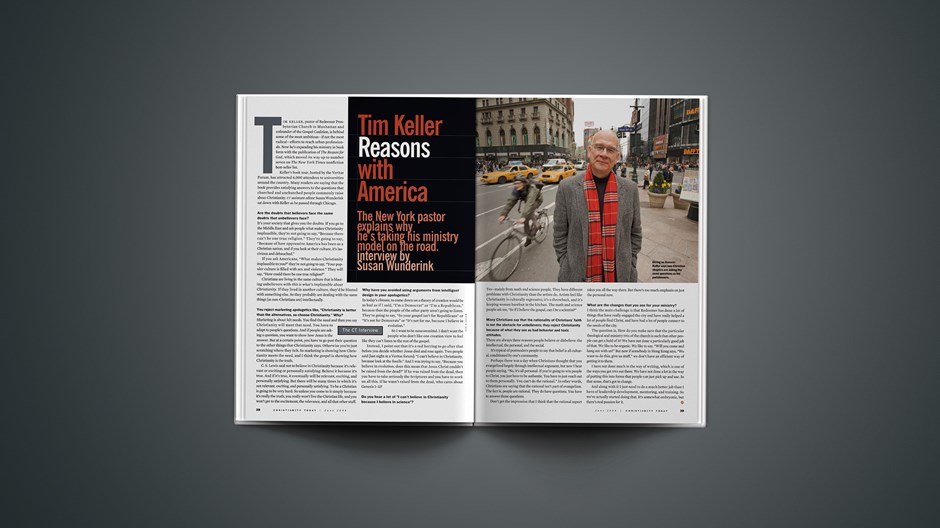
Tim Keller, pastor of Redeemer Presbyterian Church in Manhattan and cofounder of the Gospel Coalition, is behind some of the most ambitious — if not the most radical — efforts to reach urban professionals. Now he's expanding his ministry in book form, with the publication of The Reason for God, which moved its way up to number seven on The New York Times nonfiction bestseller list.
Keller's book tour, hosted by the Veritas Forum, has attracted 6,000 attendees to universities around the country. Many readers are saying that the book provides satisfying answers to the questions that churched and unchurched people commonly raise about Christianity. CT assistant editor Susan Wunderink sat down with Keller as he passed through Chicago.
Are the doubts that believers face the same as the doubts that unbelievers face?
It's your society that gives you the doubts. If you go to the Middle East and ask people what makes Christianity implausible, they're not going to say, "Because there can't be one true religion." They're going to say, "Because of how oppressive America has been as a Christian nation, and if you look at their culture, it's lascivious and debauched."
If you ask Americans, "What makes Christianity implausible to you?" they're not going to say, "Your popular culture is filled with sex and violence." They will say, "How could there be one true religion?"
Christians are living in the same culture that is blasting them with this is what's implausible about Christianity. If they lived in another culture, they'd be blasted with something else. So they probably are dealing with the same things [as non-Christians are] intellectually.
But my guess is the personal issues are different. If they came from a very homogenous, insular Christian community and they go to college and their roommate, who they think is wonderful, is Hindu, and they really feel like all Christians would be better than all Hindus, then they're confused.
I do think a lot of Christians — because they don't understand the grace narrative — get out into the world and find it very tough to navigate. I think it's because they don't understand the gospel, not because they can't answer all the theological questions.
You reject marketing apologetics like, "Christianity is better than the alternatives, so choose Christianity." Why?
Marketing is about felt needs. You find the need and then you say Christianity will meet that need. You have to adapt to people's questions. And if people are asking a question, you want to show how Jesus is the answer. But at a certain point, you have to go past their question to the other things that Christianity says. Otherwise you're just scratching where they itch. So marketing is showing how Christianity meets the need, and I think the gospel is showing how Christianity is the truth.
C. S. Lewis says somewhere not to believe in Christianity because it's relevant or exciting or personally satisfying. Believe it because it's true. And if it's true, it eventually will be relevant, exciting, and personally satisfying. But there will be many times when it's not relevant, exciting, and personally satisfying. To be a Christian is going to be very, very hard. So unless you come to it simply because it's really the truth, you really won't live the Christian life, and you won't get to the excitement and to the relevance and all that other stuff.
Why have you avoided using arguments from intelligent design in your apologetics?
James Boice was a great preacher at Tenth Presbyterian Church in Philadelphia years ago. When he preached on Genesis 1, he talked about young-earth creationism, theistic evolution, and progressive creationism. He went through the gap theory (that there were essentially two creations on either side of the gap in Genesis 1:2). He went through all the various theories that evangelical Christians with a high view of Scripture have come to. He showed the strengths and weaknesses of every one.
Nobody does that anymore. Nobody says different Christians might come down in different places here and still have a high view of Scripture. Instead, they identify their take as the wise one, and say everyone else is selling out or something.
In today's climate, to come down on a theory of creation would be as bad as if I said, "I'm a Democrat" or "I'm a Republican," because then the people of the other party aren't going to listen. They're going to say, "So your gospel isn't for Republicans," or "It's not for Democrats," or "It's not for me, because I believe in evolution."
So I want to be noncommittal. I don't want the people who don't like one creation view to feel like now they can't listen to the rest of the gospel.
Instead, I point out that it's a red herring to go after that before you decide whether Jesus died and rose again. Two people said [last night at a Veritas forum]: "I can't believe in Christianity, because look at the fossils." And I was trying to say, "Because you believe in evolution does this mean that Jesus Christ couldn't be raised from the dead?" One said, "No, that has nothing to do with it." If he was raised from the dead, then you have to take seriously the Scripture and you have to work on all this. If he wasn't raised from the dead, who cares about Genesis 1–11?
Article continues below
Do you hear a lot of "I can't believe in Christianity because I believe in science"?
Yes — mainly from math and science people. They have different problems with Christianity than the artists do. Artists feel like Christianity is culturally regressive; it's a throwback, and it's keeping women barefoot in the kitchen. The math and science people ask me, "So if I believe the gospel, can I be a scientist?"
The recent Pew study talked about changing patterns of belief in America. Has that affected your apologetics ministry?
The Pew study showed that the moderate middle has atrophied — people who are kind of Christian. They now take Christianity metaphorically. They believe the Resurrection is a wonderful symbol. That group has just been shrinking, and secularism and orthodoxy are growing. So we have a polarized society — which is what I try to say in the first chapter of the book. So it only confirmed the book.
One reason for this is because I think there's been a backlash. Evangelicalism has been so identified with conservative Republican values that a lot of people who might be more moderate have decided they are not religious. I've seen that happen in New York. They're moderate or liberal politically, and they feel like orthodox Christianity is so identified with conservative Republican politics that they have actually distanced themselves from the faith.
Many Christians say that the rationality of Christians' faith is not the obstacle for unbelievers; they reject Christianity because of what they see as bad behavior and toxic attitudes.
There are always three reasons people believe or disbelieve: the intellectual, the personal, and the social.
It's typical of postmodern people to say belief is all cultural, conditioned by your community.
Perhaps there was a day in which Christians thought that you evangelized largely through intellectual argument, but now I hear people saying, "No, it's all personal. If you're going to win people to Christ you just have to be authentic. You have to just reach out to them personally. You can't do the rational." In other words, Christians are saying the rational isn't part of evangelism. The fact is, people are rational. They do have questions. You have to answer those questions.
Article continues below
Don't get the impression that I think that the rational aspect takes you all the way there. But there's too much emphasis on just the personal now.
Maybe you know I'm a 57-year-old man. You'd say, "Of course you'd say that." But I'm knee deep in 20-somethings. So it's not like I don't know how people are today.
What are the changes that you see for your ministry?
I think the main challenge is Redeemer has done a lot of things that have really engaged the city and have really helped a lot of people find Christ, and have had a lot of people connect to the needs of the city.
The question is, How do you make sure that not only the particular theological and ministry DNA of the church is such that other people can get ahold of it? We have not done a particularly good job of that. We like to be organic. We like to say, "Will you come and hang out with us?" But now if somebody in Hong Kong says, "We want to do this. Give us stuff," we don't have an efficient way of getting it to them. I have not done much in the way of writing, which is one of the ways you get DNA out there. We have not done a lot in the way of putting this into forms that people can just pick up and use. In that sense, that's got to change.
And along with it, I just need to do a much better job than I have of leadership development, mentoring, and training. So we've actually started doing that. It's somewhat embryonic, but there's a real passion for it.
The Reason for God is available from ChristianBook.com and other retailers. The book's website has MP3s from Keller's talks while on tour, a reader's guide, and other resources.
New York's New Hope | From inner-city gardens, to fine-art exhibitions, to political activism, street-smart churches are changing the culture of America's largest and most dynamic city. (December 1, 2004)
















 While we pray for peace, we need moral clarity about this war.
 We’ve got little information on Jesus’ appearance and personality. But that’s the way God designed it.españolFrançais
 Beyoncé’s right. Whether listening to Cowboy Carter or reading theology, diversity is a good thing.






