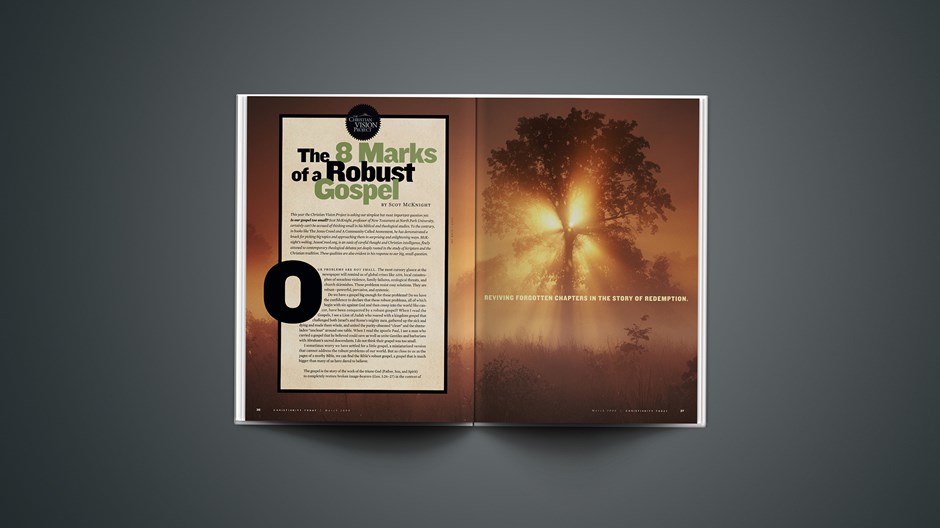
This year the Christian Vision Project is asking our simplest but most important question yet: Is our gospel too small? Scot McKnight, professor of New Testament at North Park University, certainly can't be accused of thinking small in his biblical and theological studies. To the contrary, in books like The Jesus Creed and A Community Called Atonement, he has demonstrated a knack for picking big topics and approaching them in surprising and enlightening ways. McKnight's weblog, JesusCreed.org, is an oasis of careful thought and Christian intelligence, finely attuned to contemporary theological debates yet deeply rooted in the study of Scripture and the Christian tradition. These qualities are also evident in his response to our big, small question.
Our problems are not small. The most cursory glance at the newspaper will remind us of global crises like AIDS, local catastrophes of senseless violence, family failures, ecological threats, and church skirmishes. These problems resist easy solutions. They are robust—powerful, pervasive, and systemic.
Do we have a gospel big enough for these problems? Do we have the confidence to declare that these robust problems, all of which begin with sin against God and then creep into the world like cancer, have been conquered by a robust gospel? When I read the Gospels, I see a Lion of Judah who roared with a kingdom gospel that challenged both Israel's and Rome's mighty men, gathered up the sick and dying and made them whole, and united the purity-obsessed "clean" and the shame-laden "unclean" around one table. When I read the apostle Paul, I see a man who carried a gospel that he believed could save as well as unite Gentiles and barbarians with Abraham's sacred descendants. I do not think their gospel was too small.
I sometimes worry we have settled for a little gospel, a miniaturized version that cannot address the robust problems of our world. But as close to us as the pages of a nearby Bible, we can find the Bible's robust gospel, a gospel that is much bigger than many of us have dared to believe:
The gospel is the story of the work of the triune God (Father, Son, and Spirit) to completely restore broken image-bearers (Gen. 1:26–27) in the context of the community of faith (Israel, Kingdom, and Church) through the life, death, and resurrection of Jesus Christ and the gift of the Pentecostal Spirit, to union with God and communion with others for the good of the world.
The gospel may be bigger than this description, but it is certainly not smaller. And as we declare this robust gospel in the face of our real, robust problems, we will rediscover just how different it is from the small gospel we sometimes have believed and proclaimed.
1. The robust gospel is a story. Jesus didn't drop out of the heavens one snowy night in Bethlehem to a world hushed for Advent. Instead, Jesus' birth came in the midst of a story with a beginning, a problem, and a lengthy history. When Jesus stood up to announce the "gospel of the kingdom" (Matt. 4:23), the first thing his hearers would have focused on was not the word gospel but the word kingdom—the climax of Israel's story and its yearning for the eternal messianic reign. Gospel-preaching for Jesus had the same hope and vision one finds in Mary's Magnificat (Luke 1:46–55), Zechariah's Benedictus (1:68–79), Simeon's Nunc dimittis (2:29–32), and John the Baptist's summons to a new way of life (3:10–14)—namely, the fulfillment of the whole story's hope, the kingdom of God. This is why Paul defines gospel after its first mention in Romans 1:1 with this: "which he promised beforehand through his prophets, the gospel concerning his Son, who was descended from David" (NRSV). To preach the gospel and to believe the gospel is to offer and enter into a story.
2. The robust gospel places transactions in the context of persons. When the gospel is reduced to a legal transaction shifting our guilt to Christ and Christ's righteousness to us, the gospel focuses too narrowly on a transaction and becomes too impersonal. We dare not deny transaction or what's called double imputation, but the gospel is more than the transactions of imputation. The robust gospel of the Bible is personal—it is about God the Father, God the Son, and God the Spirit. It is about you and me as persons encountering that personal, three-personed God.
Indeed, more often than not in the New Testament, the gospel is linked explicitly to a person. It is the "gospel of Christ" or the "gospel of God." Jesus calls people to lose their life "for my sake" and, to say the same thing differently, "for the sake of the gospel" (Mark 8:35; 10:29). Paul preached the "gospel of God" (1 Thess. 2:9) and the "gospel of Christ" (3:2) and "the glorious gospel of the blessed God" (1 Tim. 1:11). Paul tells us that the gospel is the glorious power of God's Spirit to transform broken image-bearers into the glory of God that can be seen in the face of the perfect image-bearer, Jesus Christ (2 Cor. 3:18–4:6). In our proclamation, too, the focus of the gospel must be on God as person and our encountering that personal God in the face of Jesus Christ through the power of the Spirit.
Article continues below
3. The robust gospel deals with a robust problem. Genesis 1–3 teaches us that humans are made in God's image and likeness. These image-bearers were in utter union with God, at home with themselves, in communion with one another, and in harmony with the world around them. When Eve, with her husband in tow, chose to eat of the wrong tree, the image was cracked in each of those four directions: God-alienation, self-shame, other-blame, and Eden-expulsion. Sin results not only in alienation from God, which is paramount, but also in shame of the self, blame and antagonism toward others, and banishment from the world as God made it to be.
The proportions of the biblical problem are not small; the problems are so robust that a robust gospel is needed. The rest of the Bible, from Genesis 4 to Revelation 22, is about these cracked image-bearers being restored to union with God, freed from shame, placed in communion with others, and offered to the world. Any gospel that does not expand the "problem" of Genesis 3 to these cosmic dimensions is not robust enough.
4. A robust gospel has a grand vision. The little gospel promises me personal salvation and eternal life. But the robust gospel doesn't stop there. It also promises a new society and a new creation. When Jesus stood up to read Isaiah 61 in the synagogue at Nazareth, then sat down and declared that this prophetic vision was now coming to pass through him, there was more than personal redemption at work. God's kingdom, the society where God's will is established and lived, was now officially at work in his followers. That society was overturning the injustices and exclusions of the empire and establishing an inclusive and just alternative. We find this in Jesus' opening words (Luke 4:18–19), the Beatitudes (6:20–26), and in his response to John (Mark 7:22–23). This vision for a just society led to the radical practices of generosity and hospitality in the Jerusalem churches (Acts 2:42–47). Any gospel that is not announcing a new society at work in the world, what the apostle Paul called the church, is simply not a robust gospel.
5. A robust gospel includes the life of Jesus as well as his resurrection, and the gift of the Spirit alongside Good Friday. Paul said he preached "Christ crucified," but the crucified Christ Paul preached was an empty-cross Christ and an empty-grave Christ. That same gospel of Christ crucified was rooted in an incarnate life. And that same Christ crucified, after his 40 days of appearances and ascension, sent the Holy Spirit at Pentecost in order to empower his followers to become the church as a new creation.
Article continues below
If our only problem is individual guilt, the solution can be reduced to Good Friday. But as we acknowledge our problem in its true biblical proportions, we need more than Good Friday: we need Christmas as Incarnation, Good Friday as Substitution and Paradigm and the stripping of systemic powers from their illegitimate thrones, Easter as New Creation, and Pentecost as Empowerment. The robust gospel incorporates us into the life of Jesus Christ, into his death with us, for us, and instead of us, into the Resurrection that justifies and creates new life, and the Pentecostal Spirit that empowers us to live together, as image-bearers of God, in such a way that we glow with the glory of the blessed God.
6. A robust gospel demands not only faith but everything. Inherent in the robust, biblical view of the gospel is a view of faith that involves repentance, trust, surrender, commitment, and obedience. Paul warns of those who do not "obey the gospel of our Lord Jesus Christ" (2 Thess. 1:8). Paul can say that his intent in preaching the gospel is to bring about the "obedience of faith" (Rom. 1:5). Jesus' gospel can be found in Mark 1:14–15: "Now after John was arrested, Jesus came to Galilee, proclaiming the good news of God, and saying, 'The time is fulfilled, and the kingdom of God has come near; repent, and believe in the good news.' " And he called his disciples to surrender themselves to him in self-denial so they could follow him (Mark 8:34–38). A robust gospel summons each of us to respond in repentance, trust, surrender, commitment, and obedience. Indeed, whole-hearted response to God is what the Jesus Creed, the double commandment to love God and to love others, is all about (Mark 12:29–31). The robust gospel calls for a robust response of a robust person.
7. A robust gospel includes the robust Spirit of God. How often do we hear about the Spirit of God in our gospel preaching? To our shame, the Spirit has been defined out of the gospel. But notice these words from the New Testament's most notorious gospeler, Paul: "For I will not venture to speak of anything except what Christ has accomplished through me to win obedience from the Gentiles, by word and deed, by the power of signs and wonders, by the power of the Spirit of God, so that from Jerusalem and as far around as Illyricum I have fully proclaimed the good news of Christ" (Rom. 15:18–19). For Paul, the gospel, the power of God unto salvation (1:16), was also the "power of the Spirit of God." Again, "In him you also, when you had heard the word of truth, the gospel of your salvation, and had believed in him, were marked with the seal of the promised Holy Spirit; this is the pledge of our inheritance toward redemption as God's own people, to the praise of his glory" (Eph. 1:13–14). Jesus, too, said, "But if it is by the Spirit of God that I cast out demons, then the kingdom of God has come to you" (Matt. 12:28). The gospel is animated by God's powerful Spirit, and its result is Spirit-empowerment for new living.
Article continues below
8. A robust gospel emerges from and leads others to the church. The little gospel creates individuals who volunteer to attend church on the basis of their preferences in worship, friendships, sermons, and programs. The robust gospel knows that God's work, from the very beginning, has revolved around three words: Israel, Kingdom, and Church. Again, the words of Paul make this abundantly clear: "In former generations this mystery was not made known to humankind, as it has now been revealed to his holy apostles and prophets by the Spirit: that is, the Gentiles have become fellow heirs, members of the same body, and sharers in the promise in Christ Jesus through the gospel" (Eph. 3:5–6). The mystery of the gospel is that Gentiles have become fellow heirs with Jews in the promise of Christ Jesus. The gospel's intent, in fact its substance, is the creation of God's new society with Jesus on the throne. The robust gospel emerges out of the church with good news and calls others into that same church.
For 13 years I have been teaching a survey of the Bible at North Park University. I eventually learned that we cannot skip from Genesis 3 to either John 3 or Romans 3. We cannot skip from the Fall to the Cross. God chose, instead of sending his Son to redeem Adam and Eve in Genesis 4, to wait. And what God did between the time of Adam and Eve and Jesus Christ was to work redemption in the form of community. The Old Testament is about Israel; the New Testament is about Jesus and the church. The Bible is about God's people, the community of faith. The church is not an institution that provides benefits for individual Christians so they can carry on their personal relationship with God until that church can no longer provide what they need. Instead, the church is the focus of God's redemptive work on earth in the present age.
Article continues below
So "joining the church" isn't an option for Christians. How often do we preach entering into the community of faith, the church, as inherent to what the gospel work of God is all about? The little gospel gives the new believer the choice about the local church; the robust biblical gospel offers the new believer the church along with its Lord. Because ultimately, only a redeemed community is robust enough to do justice to the problems we confront—and the gospel we proclaim.
My physician tells me that the way I live during this decade will shape the way I live in the next decade. Likewise, the way we preach the gospel in this decade will shape the church of the next. A more robust gospel now will mean a more robust church for the next generation.
Related Elsewhere:
Previous Christian Vision Project themes were culture in 2006 and mission in 2007. Articles include:
Singing in the Chains | To be saved means more than we might think. (January 31, 2008)
The Lima Bean Gospel | The Good News is so much bigger than we make it out to be. (January 8, 2008)
The Dread Cancer of Stinginess | When it comes to missions giving, donor dependency may not be the greatest problem. (October 2, 2007)
Powering Down | World Vision India head Jayakumar Christian on how the poor become movers and shakers, and movers and shakers become poor. (August 31, 2007)
Liberate My People | Theologian and educator Ruth Padilla DeBorst says true Christian mission addresses issues of power and poverty. (August 8, 2007)
From Tower-Dwellers to Travelers | Ugandan-born theologian Emmanuel Katongole offers a new paradigm for missions. (July 3, 2007)
Have something to add about this? See something we missed? Share your feedback here.
Our digital archives are a work in progress. Let us know if corrections need to be made.















 While we pray for peace, we need moral clarity about this war.
 As my doubts about his teachings grew, so did a secret fascination with Jesus.
 Eastern Orthodox poet Scott Cairns reflects on his new collection, his journey of faith, and poetry’s capacity to apprehend inexhaustible realities.






