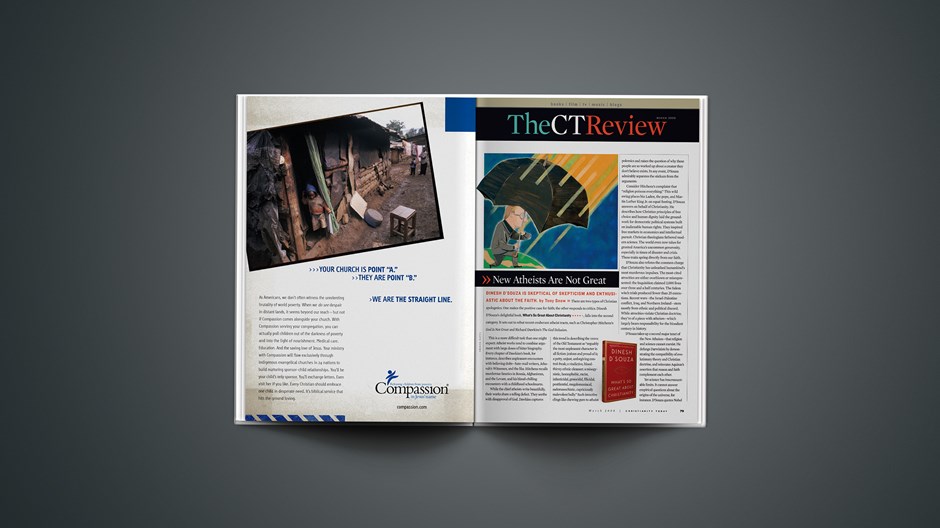
Dinesh D'Souza is skeptical of skepticism and enthusiastic about the faith. by Tony Snow » There are two types of Christian apologetics. One makes the positive case for faith; the other responds to critics. Dinesh D'Souza's delightful book, What's So Great About Christianity, falls into the second category. It sets out to rebut recent exuberant atheist tracts, such as Christopher Hitchens's God Is Not Great and Richard Dawkins's The God Delusion.
This is a more difficult task than one might expect: Atheist works tend to combine argument with large doses of bitter biography. Every chapter of Dawkins's book, for instance, describes unpleasant encounters with believing dolts—hate-mail writers, Jehovah's Witnesses, and the like. Hitchens recalls murderous fanatics in Bosnia, Afghanistan, and the Levant, and his blood-chilling encounters with a childhood schoolmarm.
While the chief atheists write beautifully, their works share a telling defect. They seethe with disapproval of God. Dawkins captures this trend in describing the YHWH of the Old Testament as "arguably the most unpleasant character in all fiction: jealous and proud of it; a petty, unjust, unforgiving control-freak; a vindictive, bloodthirsty ethnic cleanser; a misogynistic, homophobic, racist, infanticidal, genocidal, filicidal, pestilential, megalomaniacal, sadomasochistic, capriciously malevolent bully." Such invective clings like chewing gum to atheist polemics and raises the question of why these people are so worked up about a creator they don't believe exists. In any event, D'Souza admirably separates the stickum from the arguments.
Consider Hitchens's complaint that "religion poisons everything." This wild swing places bin Laden, the pope, and Martin Luther King Jr. on equal footing. D'Souza answers on behalf of Christianity. He describes how Christian principles of free choice and human dignity laid the groundwork for democratic political systems built on inalienable human rights. They inspired free markets in economics and intellectual pursuit. Christian theologians fathered modern science. The world even now takes for granted America's uncommon generosity, especially in times of disaster and crisis. These traits spring directly from our faith.
D'Souza also refutes the common charge that Christianity has unleashed humankind's most murderous impulses. The most-cited atrocities are either overblown or misrepresented: the Inquisition claimed 2,000 lives over three and a half centuries. The Salem witch trials produced fewer than 25 executions. Recent wars—the Israel-Palestine conflict, Iraq, and Northern Ireland—stem mostly from ethnic and political discord. While atrocities violate Christian doctrine, they're of a piece with atheism—which largely bears responsibility for the bloodiest century in history.
D'Souza takes up a second major tenet of the New Atheism—that religion and science cannot coexist. He defangs Darwinists by demonstrating the compatibility of evolutionary theory and Christian doctrine, and reiterates Aquinas's assertion that reason and faith complement each other.
Yet science has insurmountable limits. It cannot answer empirical questions about the origins of the universe, for instance. D'Souza quotes Nobel laureate Arno Penzias and astronomer Robert Jastrow to the effect that the Big Bang leads us back to a moment when everything began—and delivers us not to the doorstep of atheism but theology.
Dawkins's shrill dissent is telling. He dismisses as "infantile" the arguments for God's existence offered by Aquinas and Anselm: "The very idea that grand conclusions could follow from such logomatist trickery offends me aesthetically." This is an odd claim, considering it appears in the midst of a "logomatist" polemic. It also dodges the big question: If reason can explain everything, why can't it explain where things come from?
Ethics produces an even greater quandary. Moral laws have changed less over the millennia than the recognized laws of physics and mathematics. The ethical principles that undergird the Ten Commandments' prohibitions against stealing and murder are recognized by people in New York, New Guinea, Timbuktu, and even bin Laden's cave, while scientific theory has undergone numerous revolutions—and will continue to do so.
So what explains the uniformity of moral laws? As former atheist Antony Flew notes in There Is a God, musings about the origin of life and virtue lead directly to God. So when atheists invoke natural law standards, they embrace the Creator they most wish to deny.
On the broader issue of faith and reason, D'Souza states the obvious: "Religious faith is not in opposition to reason. The purpose of faith is to discover truths that are of the highest importance to us through purely natural means." He quotes philosopher Ludwig Wittgenstein: "[E]ven if all possible scientific questions are answered, the problems of life still have not been touched at all." Darwinists may be able to describe how older bees, wasps, ants, and termites help their younger siblings, but they can't explain why Raoul Wallenberg became a martyr for captive Jews.
Article continues below
Atheism fails as a creed because it lacks humanity. It destroys the wall of sanctity that defends the weak from the strong. It spawned history's most savage movements—from the French Terror to the Stalinist purges. None of the atheistic alternatives has survived because reason just doesn't make a satisfying god.
This leads us to perhaps the strongest argument against atheism, which D'Souza makes only indirectly—the argument from experience. Atheism cannot reach our hearts. A rigorous atheist cannot console in a time of grief, cannot explain love, cannot sigh in happy wonder at life's endless surprises. He can only utter, "What is, is."
Christianity, in contrast, offers the divine "I Am"—God, speaking through Scripture, saying what he means and meaning what he says. In the person of Jesus Christ, he taught. He ministered. He saved. He chased away the moneychangers and wept at the news of Lazarus's death. He lived so boldly that he had to be killed—yet did not stay in the tomb.
No other religion dares claim that God walked among us as fully human. None describes the Lord as a servant rather than overlord. None contemplates an Almighty who humbly offers the bread and cup of love or gives his children complete freedom to grasp his outstretched hand or slap it away.
Every child has felt a shiver of God as night closes and the world grows quiet. Adults, amid the bustle and din, know he's there. When trouble comes, we whisper his name. We cannot see, hear, or yet walk with him. But from time to time we experience a presence that defies description. The God of love is also the God of surprise. Atheists deny something profoundly obvious, something deeply unforgettable, that's woven into our souls.
This explains D'Souza's opening assertion that "God is back. … Christianity is winning and secularism is losing. … God is the future and atheism is on its way out." Atheists may be selling books, but they're not making converts. Christianity is, especially in places and congregations that take Scripture seriously—and joyously.
D'Souza calls atheists cowards. Not quite: They're like the man who perishes in a fire because he refuses to believe the net below will hold. What's So Great About Christianity performs a wonderful and overdue service. It engages atheists exhaustively and carefully, exposing atheism more as a bundle of sentiments than a coherent doctrine.
Tony Snow, former press secretary for President George W. Bush.
















 While we pray for peace, we need moral clarity about this war.
 As my doubts about his teachings grew, so did a secret fascination with Jesus.
 Eastern Orthodox poet Scott Cairns reflects on his new collection, his journey of faith, and poetry’s capacity to apprehend inexhaustible realities.






