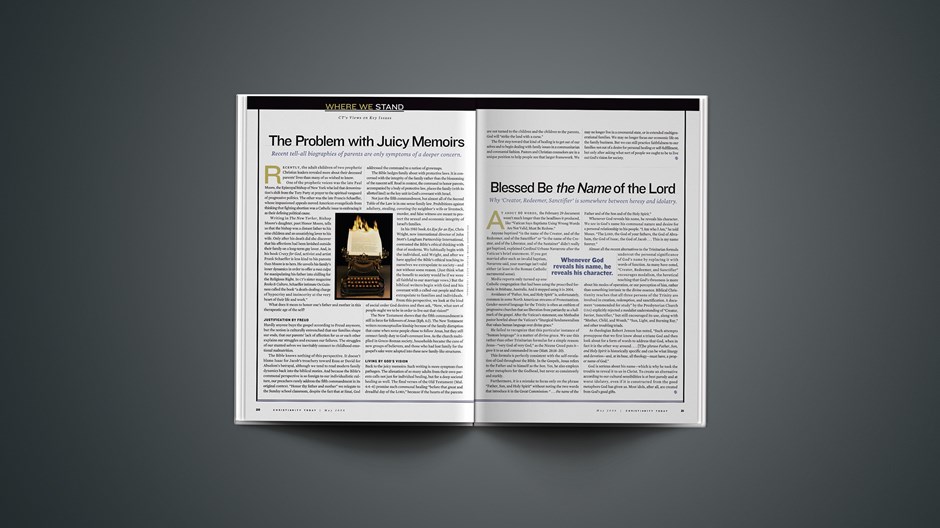
Recently, the adult children of two prophetic Christian leaders revealed more about their deceased parents' lives than many of us wished to know. One of the prophetic voices was the late Paul Moore, the Episcopal bishop of New York who led that denomination's shift from the Tory Party at prayer to the spiritual vanguard of progressive politics. The other was the late Francis Schaeffer, whose impassioned appeals moved American evangelicals from thinking that fighting abortion was a Catholic issue to embracing it as their defining political cause.
Writing in The New Yorker, Bishop Moore's daughter, poet Honor Moore, tells us that the bishop was a distant father to his nine children and an unsatisfying lover to his wife. Only after his death did she discover that his affections had been lavished outside their family on a long-term gay lover. And, in his book Crazy for God, activist and artist Frank Schaeffer is less kind to his parents than Moore is to hers. He unveils his family's inner dynamics in order to offer a mea culpa for manipulating his father into shilling for the Religious Right. In CT's sister magazine Books & Culture, Schaeffer intimate Os Guinness called the book "a death-dealing charge of hypocrisy and insincerity at the very heart of their life and work."
What does it mean to honor one's father and mother in this therapeutic age of the self?
Justification by Freud
Hardly anyone buys the gospel according to Freud anymore, but the notion is culturally entrenched that our families shape our ends, that our parents' lack of affection for us or each other explains our struggles and excuses our failures. The struggles of our stunted selves we inevitably connect to childhood emotional malnutrition.
The Bible knows nothing of this perspective. It doesn't blame Isaac for Jacob's treachery toward Esau or David for Absalom's betrayal, although we tend to read modern family dynamics back into the biblical stories. And because the Bible's communal perspective is so foreign to our individualistic culture, our preachers rarely address the fifth commandment in its original context. "Honor thy father and mother" we relegate to the Sunday school classroom, despite the fact that at Sinai, God addressed the command to a nation of grownups.
The Bible hedges family about with protective laws. It is concerned with the integrity of the family rather than the blossoming of the nascent self. Read in context, the command to honor parents, accompanied by a body of protective law, places the family (with its allotted land) as the key unit in God's covenant with Israel.
Not just the fifth commandment, but almost all of the Second Table of the Law is in one sense family law. Prohibitions against adultery, stealing, coveting thy neighbor's wife or livestock, murder, and false witness are meant to protect the sexual and economic integrity of Israel's families.
In his 1983 book An Eye for an Eye, Chris Wright, now international director of John Stott's Langham Partnership International, contrasted the Bible's ethical thinking with that of moderns. We habitually begin with the individual, said Wright, and after we have applied the Bible's ethical teaching to ourselves we extrapolate to society—and not without some reason. (Just think what the benefit to society would be if we were all faithful to our marriage vows.) But the biblical writers begin with God and his covenant with a called-out people and then extrapolate to families and individuals. From this perspective, we look at the kind of social order God desires and then ask, "Now, what sort of people ought we to be in order to live out that vision?"
The New Testament shows that the fifth commandment is still in force for followers of Jesus (Eph. 6:2). The New Testament writers reconceptualize kinship because of the family disruption that came when some people chose to follow Jesus, but they still connect family duty to God's covenant love. As the church multiplied in Greco-Roman society, households became the core of new groups of believers, and those who had lost family for the gospel's sake were adopted into these new family-like structures.
Living by God's Vision
Back to the juicy memoirs: Such writing is more symptom than pathogen. The alienation of so many adults from their own parents calls not just for individual healing, but for a deep societal healing as well. The final verses of the Old Testament (Mal. 4:4-6) promise such communal healing "before that great and dreadful day of the Lord," because if the hearts of the parents are not turned to the children and the children to the parents, God will "strike the land with a curse."
The first step toward that kind of healing is to get out of our selves and to begin dealing with family issues in a communitarian and covenantal fashion. Pastors and Christian counselors are in a unique position to help people see that larger framework. We may no longer live in a covenantal state, or in extended multigenerational families. We may no longer focus our economic life on the family business. But we can still practice faithfulness to our families not out of a desire for personal healing or self-fulfillment, but only after asking what sort of people we ought to be to live out God's vision for society.
















 While we pray for peace, we need moral clarity about this war.
 We’ve got little information on Jesus’ appearance and personality. But that’s the way God designed it.españolFrançais
 Christian artists work at the intersection of music and climate change.






