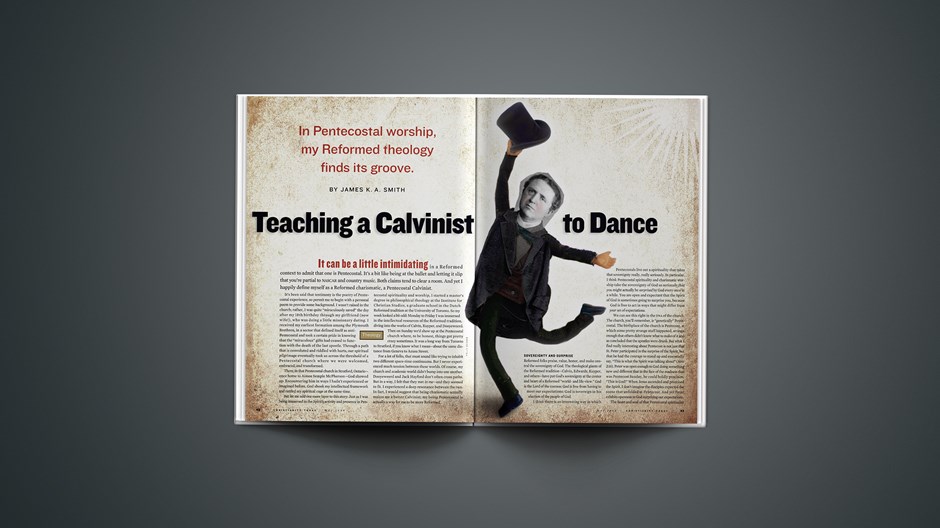
It can be a little intimidating in a Reformed context to admit that one is Pentecostal. It's a bit like being at the ballet and letting it slip that you're partial to NASCAR and country music. Both claims tend to clear a room. And yet I happily define myself as a Reformed charismatic, a Pentecostal Calvinist.
It's been said that testimony is the poetry of Pentecostal experience, so permit me to begin with a personal poem to provide some background. I wasn't raised in the church; rather, I was quite "miraculously saved" the day after my 18th birthday through my girlfriend (now wife!), who was doing a little missionary dating. I received my earliest formation among the Plymouth Brethren, in a sector that defined itself as anti-Pentecostal and took a certain pride in knowing that the "miraculous" gifts had ceased to function with the death of the last apostle. Through a path that is convoluted and riddled with hurts, our spiritual pilgrimage eventually took us across the threshold of a Pentecostal church where we were welcomed, embraced, and transformed.
There, in that Pentecostal church in Stratford, Ontario—once home to Aimee Semple McPherson—God showed up. Encountering him in ways I hadn't experienced or imagined before, God shook my intellectual framework and rattled my spiritual cage at the same time.
But let me add one more layer to this story: Just as I was being immersed in the Spirit's activity and presence in Pentecostal spirituality and worship, I started a master's degree in philosophical theology at the Institute for Christian Studies, a graduate school in the Dutch Reformed tradition at the University of Toronto. So my week looked a bit odd: Monday to Friday I was immersed in the intellectual resources of the Reformed tradition, diving into the works of Calvin, Kuyper, and Dooyeweerd.
Then on Sunday we'd show up at the Pentecostal church where, to be honest, things got pretty crazy sometimes. It was a long way from Toronto to Stratford, if you know what I mean—about the same distance from Geneva to Azusa Street.
For a lot of folks, that must sound like trying to inhabit two different space-time continuums. But I never experienced much tension between these worlds. Of course, my church and academic world didn't bump into one another. Dooyeweerd and Jack Hayford don't often cross paths. But in a way, I felt that they met in me—and they seemed to fit. I experienced a deep resonance between the two. In fact, I would suggest that being charismatic actually makes me a better Calvinist; my being Pentecostal is actually a way for me to be more Reformed.
Reformed folks praise, value, honor, and make central the sovereignty of God. The theological giants of the Reformed tradition—Calvin, Edwards, Kuyper, and others—have put God's sovereignty at the center and heart of a Reformed "world- and life-view." God is the Lord of the cosmos; God is free from having to meet our expectations; God is sovereign in his election of the people of God.
I think there is an interesting way in which Pentecostals live out a spirituality that takes that sovereignty really, really seriously. In particular, I think Pentecostal spirituality and charismatic worship take the sovereignty of God so seriously that you might actually be surprised by God every once in a while. You are open and expectant that the Spirit of God is sometimes going to surprise you, because God is free to act in ways that might differ from your set of expectations.
We can see this right in the DNA of the church. The church, you'll remember, is "genetically" Pentecostal. The birthplace of the church is Pentecost, at which some pretty strange stuff happened, strange enough that others didn't know what to make of it and so concluded that the apostles were drunk. But what I find really interesting about Pentecost is not just that St. Peter participated in the surprise of the Spirit, but that he had the courage to stand up and essentially say, "This is what the Spirit was talking about" (Acts 2:16). Peter was open enough to God doing something new and different that in the face of the madness that was Pentecost Sunday, he could boldly proclaim, "This is God!" When Jesus ascended and promised the Spirit, I don't imagine the disciples expected the scene that unfolded at Pentecost. And yet Peter exhibits openness to God surprising our expectations.
The heart and soul of that Pentecostal spirituality is not the manifestations, but rather the courage and openness to see God in those unexpected manifestations, and to say, "This is what the Spirit promised."
That means acknowledging God's sovereignty in worship in ways that have to be learned. I think most Reformed folk have learned habits of worship that effectively constrain the sovereignty of God by adopting highly defined and narrow expectations of the Spirit's operations. I long for a kind of "Pentecostalized" Reformed spirituality that expects the sovereign Lord to show up in ways that might surprise us. If we take our Reformed convictions about God's sovereignty seriously, then we can, with Peter, be boldly open to the Spirit's surprise. We need not immediately kick back in fear at what might sometimes appear to be the madness of Pentecost, but can have the courage to say the Spirit is at work.
Article continues below
I think that's exactly the sensibility embodied by Jonathan Edwards, America's greatest theologian. While presenting labyrinthine theological sermons in monotone from his pulpit, the Puritan preacher witnessed strange manifestations, convulsing bodies, and shouts and yelps among his congregants. But Edwards the Reformed theologian was discerning enough not to write this off, but to say, "There's something of the Spirit in this." In Pentecostal spirituality, the Calvinist conviction about the sovereignty of God is extended to worship in a way that makes us open to and even expectant of the sovereign Lord surprising us.
The Goodness of Embodiment
Reformed folk, particularly in the Dutch tradition of Kuyper and Dooyeweerd, often emphasize the "goodness of creation"— that God created a material universe that he pronounced "very good" (Gen. 1:31). And although it is fallen, God is redeeming this world, not redeeming us out of it. An important piece of that affirmation is the goodness of embodiment—the goodness of the stuff we bump into, the bodies we inhabit.
But that's precisely why I've always found it a bit strange that Reformed worship so often treats human beings as if we're brains-on-a-stick. All week long we talk about how good creation is, how good embodiment is. But then we have habits of worship that merely deposit great ideas in our heads, making us rather cerebral disciples. Despite all our talk about the goodness of creation and embodiment, in Reformed worship the body doesn't show up that much.
Pentecostals, on the other hand, embody their spirituality. I would argue that Pentecostal worship is the extension of the Reformed intuition about the goodness of creation and the goodness of embodiment. We can see this in just a few examples.
First, Pentecostals believe in healing—and they don't mean only "spiritual" healing. They think physical healing is part of what the Cross accomplished. God doesn't want to just save your soul; God also cares about your body. The Pentecostal emphasis on the healing of the body is an affirmation of the goodness of embodiment.
Second, Pentecostals use their whole bodies in worship. Pentecostal worship can get a little messy; indeed, sometimes there are bodies everywhere! I can still remember the first time I ever raised my hands in worship—there in that Pentecostal church in Stratford. Tentatively and awkwardly raising your arms, hands trembling, you feel like an idiot—and, of course, that's precisely the point. To be in a position with hands outstretched, or prostrate on the floor, is to be in a position of vulnerability and humility. And that can be an especially powerful spiritual discipline for Reformed Christians, who are probably prone to a certain staid confidence in our intellectual prowess and doctrinal precision. I thank God for those practices of embodied humiliation that are part and parcel of Pentecostal worship; they were exactly the counterweight I needed as a young Reformed philosopher. But they were also fleshing out the theories I was absorbing.
Article continues below
There is a third sense in which Pentecostals enact the Reformed affirmation of embodiment: It's in touch. When Pentecostals pray for one another, we touch one another. We lay hands on our sister or brother. Pentecostal worship always involves dedicated periods of prayer—"altar time"—that bring together the people of God with hands clasped, embraced in prayer, laying hands in hope. Faith, hope, and love are channeled and charged when the community expresses itself in that kind of touch.
Because Pentecostals live out the Reformed affirmation of both the sovereignty of God and the goodness of embodiment, I don't experience much tension between these core aspects of Reformed identity and Pentecostal spirituality.
The explosion of the Spirit's work in world Christianity reminds us that the church's DNA is Pentecostal. It is important for Reformed Christians to not be scared of that, and in fact, to see in it an invitation of the Spirit to live out the Reformed intuitions we talk about all the time.
James K. A. Smith teaches philosophy at Calvin College in Grand Rapids, Michigan. His book Thinking in Tongues: Elements of a Pentecostal Worldview will be published next year by Eerdmans.
Smith wrote "Thinking in Tongues" for the April 2008 issue of First Things, but that article is available online only for subscribers. He will publish Thinking in Tongues: Elements of a Pentecostal Worldview with Eerdmans later this year.
In the Journal of Pentecostal Theology, Amos Yong and Smith have been discussing Smith's attempts to synthesize not just Pentecostalism and the Dutch Reformed tradition, but also those two movements with the Radical Orthodoxy movements. Unfortunately, only the abstracts of the discussion are available for free online.
Earlier articles by Smith include:
Replacing Rallies with Revivals | In criticizing the Religious Right, Greg Boyd resurrects pietistic withdrawal. A review of The Myth of a Christian Nation. (Oct. 5, 2006)
















 While we pray for peace, we need moral clarity about this war.
 We’ve got little information on Jesus’ appearance and personality. But that’s the way God designed it.españolFrançais
 The Grammy-winning artist was found dead at her home in Nashville at age 47.






