Why'd you change this? Why did you leave out that? How come you didn't…
Andrew Adamson has heard all those questions, and then some. When you're trying to adapt some of the best-loved children's books of all time into big-screen movies, there will be plenty of naysayers and nitpickers, and Adamson fully expected it.
Already an acclaimed director for the first two Shrek films, Adamson stepped into a whole 'nother world, literally and figuratively, when he took on the first two Narnia films—2005's The Lion, The Witch, and The Wardrobe, and the sequel Prince Caspian, which opens in theaters May 16.
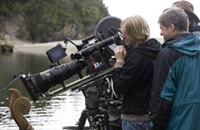
The director sizes up a scene
We recently chatted by phone with the 41-year-old director, who was working on final edits and polishing up special effects in a London studio. His wife and daughters (Isabelle, 4½, and Sylvie, 2½) were living with him in London—sort of a home between homes for the New Zealand natives. After living in Los Angeles for more than a decade (making the Shrek and then the Narnia movies), Adamson will take a break after this one, moving back to his home country for some R&R and extended time with his family.
And he'll pass the Narnia torch on to Michael Apted, the veteran British director behind such films as Amazing Grace and James Bond's The World Is Not Enough. Apted is directing The Voyage of the Dawn Treader, slated for a 2010 release—and Adamson, who will stay on as a producer, assures fans that the franchise is in good hands.
The Lion, The Witch, and The Wardrobe was one of the top 30 movies of all time internationally. What kind of pressure does that put on you?
No additional weight that wasn't already there with this property. The beloved nature of the book—and how much import I place on staying true to it—has already put a load on me, and I feel it. Certainly following up a successful film, you feel like you have to live up to expectations. But to some degree, I went through that with Shrek, where the first one was a bit under the radar, and the second one, you had a lot more people watching you, and you didn't want to disappoint them.
With TheLion, The Witch, and The Wardrobe, so many fans of the book already had high expectations. And that's something you're very conscious of when making a film—and it's hard. There's always an adaptation process. Things do change from book to screen, and you ask, "Did I make the right changes?" The other thing I do is refer to my memory—I zero in on the things I remember from reading the book as a child. Those are the things it's important to be true to.
That reminds me: Before Lion/Witch, you said you had a memory of the book from childhood, but it wasn't an accurate memory. You had remembered this massive battle scene, but it really covers just a few pages. So why the epic battle?
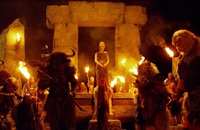
Some of the horrible creatures at the Stone Table scene from 'LWW'
That's the wonder of the way C. S. Lewis writes. He leaves a lot to your imagination. One cue to that is the scene just before Aslan's death, with all of the horrible creatures around the Stone Table. He lists some of the creatures and then says something along the lines of, And some creatures even more horrible, but I can't tell you or your parents won't let you read this book.
Douglas Gresham [Lewis's stepson and a producer/consultant on the films] told us he doesn't think Caspian is as good a book as Lion/Witch, but you've ended up with a better movie. Would you say that's accurate?
Hard for me to say. Definitely the adaptation was more difficult in Prince Caspian, because the story of Lion/Witch was already very cinematic with sort of a five-act structure. In Prince Caspian a lot of the story is told in retrospect, with Trumpkin telling the kids what happened when they were gone. So I restructured it to make it more linear. It's a challenge, but sometimes the limitations you face actually create more interesting solutions. And that's what I think makes this movie feel like a bigger movie, a more complex and interesting movie.
Narnia devotees are going to nitpick your every single decision. Would you say that Doug Gresham is the biggest nitpicker of all?
He is a nitpicker, but it's very rare that we have bumped heads on anything because we both have the desire to be true to the books. But there were times in the first film we did come to blows (laughing)—no, come to conflict, I should say—with things like Susan [Pevensie, one of the children in the books]. This was where C. S. Lewis had a feeling about women's role in the world that differed a lot from mine—particularly with Susan getting to use her bow.
Adamson on the Caspian set
You're talking about the part in Lion/Witch where Father Christmas tells Susan and Lucy they are not to use their weapons in battle, but only in great need?
Yeah. I always thought it was such a negative message to send to young girls and women to say, "Here's a bow and arrow. But I really should have given you a butter knife and a plate, because all you do is get to make sandwiches." To me, it's like why is he giving her a bow and arrow and then saying you have to rely on your brothers to defend you? This is where Doug and I got into it a little bit. I said maybe that was C. S. Lewis's point of view at the time, but times have changed and it's certainly not my view at this time. I've got two young daughters, and I don't want that message to go to my daughters.
Article continues below
But Andrew, you didn't try to contemporize other parts of the movie. You kept the setting in World War II, with London being bombed at the beginning. So why did you feel like you had to contemporize this part of the story?
Well, I think Lewis's view of women changed when he met Joy—Doug's mother. I think he sort of cast women down in the earlier books, but when you look at The Horse and His Boy, it has a strong female character. Doug's mother was a strong woman. Doug said, "I don't really know if that's true. I'm trying to remember if he wrote The Horse and His Boy after he met my mother." I went, "Doug, the book is dedicated to you."
Based on that argument, you reached the agreement that Susan would indeed be in battles?
Yes, we did. And Doug accepted. Well, I don't know whether he just relinquished or accepted. But she's in battle in both of them, and she really does well with this one.
Moving on to the title character—why is a 26-year-old [Ben Barnes] playing the role of a 13-year-old?
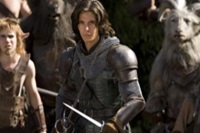
Ben Barnes as Prince Caspian
Caspian is not 13 in the story. I've made him more about Peter's age, 17-18. [Some Narnia fans support this, because the book Prince Caspian says Peter saw Caspian as "a boy about his own age."] Ben doesn't look like he's 26; he doesn't look a day over 20. But I think we were lucky to find someone with really good acting experience. He understood an element of Caspian's character that not everyone got, and he was great in the auditions. Charming. He's a genuinely sweet young man.
Do you tire of all of the nitpicking questions from the diehard fans, including me?
It's a mixed blessing. You get positive things, and you get the negative too. But it's inevitable, and you can't tackle something like this without accepting that it's going to happen—and you're not going to make everyone happy. Even if I stayed true to the book word for word, I don't believe I could make a movie that would make every fan happy. I talked to [Lord of the Rings director] Peter Jackson about this, and asked, "How true did you stay to the books?" And he said, "I'm getting credit for staying true to the books, but I changed a lot." He said you can change stuff, as long as it's good.
Article continues below
Christian readers are among the most devoted Narnia fans, and Lewis is revered in evangelical circles. Do you feel any sort of responsibility to the Christian audience?
I feel my responsibility to C. S. Lewis's fans is just being true to the books, and letting people take from it what they will. What you take from it depends on your belief, and how much interpretation you place upon it. I think by staying true to the book, I'm staying true to what any fan gets from the book.
Before Lion/Witch, a USA Today story referred to you as the son of "associate missionaries" in Papua New Guinea. Can you tell me more about that?
It's a difficult thing to get into. I'm sort of in the public eye, and I don't think it's fair to drag my family into it. So I don't talk about it a lot. But yes, we did move to Papua New Guinea when I was 11. My father worked at the university there, and my parents were involved in the church there as well.
Living in Papua New Guinea is an important part of my story in another way. When I tried to understand the Narnia stories from a kid's point of view, I realized that the Pevensie kids were going through something I'd gone through. I went to this country when I was 11, and Papua New Guinea has changed significantly since then. When I was there, I'd ride my cycle all around, a huge amount of freedom. Now there's a lot of violence and corruption. Basically, the place that I grew up in doesn't exist anymore, and for me, there's a sense of loss. I realized that's something the kids go through in returning to Narnia [in Prince Caspian]. They try to go back to a place they spent 15 years in, and now the place they knew is gone. And ultimately at the end of the story, for the older Pevensies, they have to let go.
It's something we all go through in our passage from childhood to adulthood, when we realize we can't go back to the innocence of our childhood. We can't get back to the house being as big as we thought it was when we grew up. And at some point you have to say I accept that—and move on and become an adult. To me, that was the heart of this story from Peter and Susan's point of view. And my own experience provided this sort of bittersweet, nostalgic framework for that.
How many years were you in Papua New Guinea?
From 11 till I was 18. So I still consider it kind of my home, because those years are so formative.
And then you moved back to Auckland at 18?
Yes, and I was there till I was about 24, and then moved to San Francisco. And I've lived between San Francisco and Los Angeles for the last 15-16 years. And now I'm in the process of moving back to New Zealand.
Article continues below
Would it be accurate to call your parents Christian missionaries?
Yes, it would be accurate. You're still going down that road, aren't you?
I'm just interested to know a little more about your background. I won't ask you a bunch of family questions; I know you want to protect that?
I appreciate that. And just to clarify: My parents weren't sent to Papua New Guinea by the church, as typical missionaries are sent. My father went to Papua New Guinea to work at the university, and while there, my parents were involved with the church, doing some of the work of the church.
What can you tell me about your own spiritual formation and journey?
I can't, because I've decided not to use these films as a platform or springboard for my own beliefs. I was very much expressing C. S. Lewis's story and allowing people to take from it whatever they took from the book.
Michael Apted will soon be taking the Narnia torch from you to direct Voyage of the Dawn Treader. What are your thoughts on that?
Obviously, he's a tremendous filmmaker [Apted directed Amazing Grace, The World Is Not Enough, and the Up documentaries]. But mainly for me, it was watching him with the children who play the Pevensie kids. One of the main reasons I did this film after the previous one is because of my responsibility to the children. I felt like I dragged them from their normal British lives and dragged them all around the world, and I felt a responsibility to all four of them.
Was that partly because you became a father in the meantime?
It was, and I kind of became a father to this makeshift family. I felt like the four kids formed a family and then allowed me to be part of it.
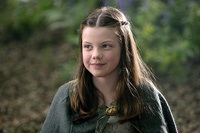
Georgie Henley as Lucy
I remember working with Georgie [Henley, who plays Lucy] in the scene where she was watching Aslan die. I needed her to cry in the scene, but we were shooting it on a blue screen stage, and it was very hard to get the emotion because she wasn't looking at anything. So I hid [off camera] and talked her through various things. I brought up the sequel Prince Caspian, and she asked if I was going to do it. I said, "Aw, I don't know if I will," and I was deliberately being really sad about it, and sure enough it got her quite emotional. She came up to me later and said, "You know when you said you weren't doing the sequel? You were only saying that to make me cry. You're going to do it, aren't you?" And with this innocent little face with teary eyes looking up at me, I was like "Of course I'll do it, Georgie." How could I not do it?
Article continues below
How hard is it going to be to step away from this franchise?
Oh, terrible separation anxiety. But luckily, I'm not stepping away entirely. I'll stay on as a producer on Dawn Treader and still be there for the kids if they need me.
What will that producer role look like?
I think it will look like being on a beach and just getting a phone call every now and again! I don't entirely know yet. I'm helping to get script into shape, helping to be true to the book—to keep the tone, the characters, to stay as true with those as possible. I feel like it's important for me to keep a fairly firm hand in that way. That being said, I don't want to step on Michael Apted's toes in any way, but it's important to make sure we continue in the way we started, that we don't sort of go off in a different direction and suddenly disappoint a whole audience that we've so far satisfied.
I imagine you're looking forward to spending more time with your wife and kids?
Yes, a lot. I haven't had a real break since the first Shrek, and I've been promising my wife I would have one since then. So I think if I want to keep my family, I'd better have one!
Sounds like you owe your wife a nice dinner and a vacation?
I think I owe her a nice long series of dinners and several vacations! On this film, I've been a lot stricter about my family time. With the first film, I had a lot harder time balancing family time to work time. But on this film, several times I've said to myself, At the end of a day it's a movie, and my kids are my kids. The movie will get made, but I'm not missing out on this thing with my kids.
Anything else you want to say that we didn't cover?
I think your readership is very happy in general with what I did with the last film, and will feel similarly about this film. But I think you can also take Doug Gresham's word for that, because he is really coming into it as much as an audience member as a producer.
We showed it to an audience for a first time recently, and it went very well. Doug had this huge smile on his face, because it was the first time he'd seen the film intact. You never know how somebody that's grown up with this—that loves every word of the book—is going to react. So that was a huge reassurance to me.
NIL deals in college athletics present new challenges—and opportunities—for colleges and students.
Emily Belz
The Weight of Story
1 of 5
The director sizes up a sceneSome of the horrible creatures at the Stone Table scene from 'LWW'Adamson on the Caspian setBen Barnes as Prince CaspianGeorgie Henley as Lucy













 While we pray for peace, we need moral clarity about this war.
 A Christian reconciliation group in Israel and Palestine warned that war would come. Now the war threatens their relevance.españolالعربيةFrançaisрусскийУкраїнська
 NIL deals in college athletics present new challenges—and opportunities—for colleges and students.