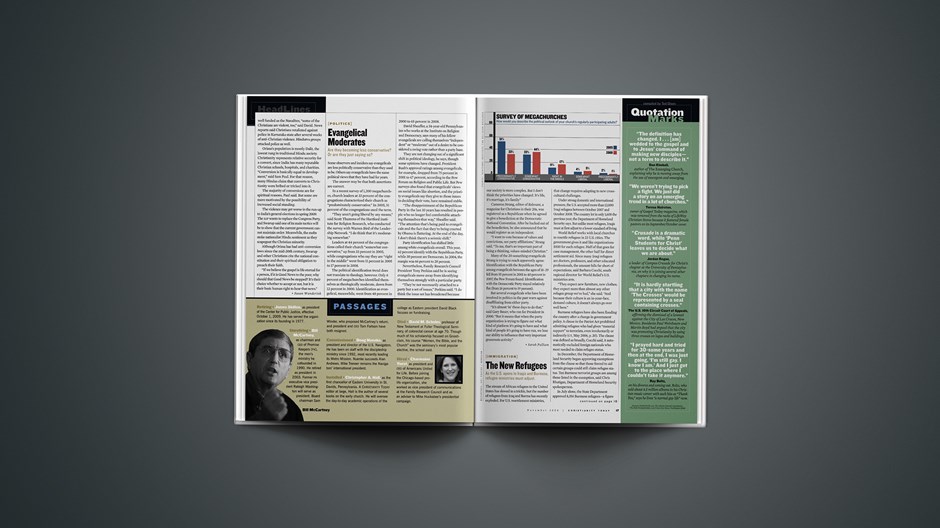
The stream of African refugees to the United States has slowed to a trickle, but the number of refugees from Iraq and Burma has recently exploded. For U.S. resettlement ministries, that change requires adapting to new crosscultural challenges.
Under strong domestic and international pressure, the U.S. accepted more than 12,000 Iraqi refugees between October 2007 and October 2008. The country let in only 1,608 the previous year, the Department of Homeland Security says. But unlike most refugees, Iraqis must at first adjust to a lower standard of living.
World Relief works with local churches to resettle refugees in 23 U.S. cities. The government gives it and like organizations $850 for each refugee. Half of that goes for case management, the other half for direct settlement aid. Since many Iraqi refugees are doctors, professors, and other educated professionals, the amount falls far short of expectations, said Barbara Cocchi, south regional director for World Relief's U.S. ministries arm.
"They expect new furniture, new clothes; they expect more than almost any other refugee group we've had," she said. "And because their culture is an in-your-face, demand culture, it doesn't always go over well here."
Burmese refugees have also been flooding the country after a change in government policy. A clause in the Patriot Act prohibited admitting refugees who had given "material support" to terrorists, even involuntarily or indirectly. The clause was defined so broadly, Cocchi said, it automatically excluded foreign nationals who most needed to claim refugee status.
In December, the Department of Homeland Security began approving exemptions from the clause so that those forced to aid certain groups could still claim refugee status. Ten Burmese terrorist groups are among those listed in the exemption, said Chris Rhatigan, Department of Homeland Security spokesperson.
In July alone, the State Department approved 8,356 Burmese refugees—a figure equivalent to 60 percent of all Burmese refugees accepted in 2007. But the process isn't running smoothly, said Jenny Hwang, director of advocacy for World Relief's refugee program.
"It's supremely slow going," she said. "The way the administration is handling this issue is on a case-by-case basis, and they're not acting fast enough."
Still, the gates are opening to Iraqi and Burmese refugees just as they are closing to Africans. The primary refugee population in the 1990s, Africans are arriving less frequently, largely due to a temporary halt in the State Department's family reunification program.
The Priority Three program allows refugees from certain countries (mainly in East Africa) an interview with the Department of State if a relative in the U.S. can prove a family relationship. The department halted the program this spring after DNA testing on African applicants showed that about 80 percent of applicants had no biological relationship with American residents.
It is unlikely that all of the cases deemed fraudulent were intentionally so, said Carleen Miller, executive director of Exodus Refugee International. Africans' and Americans' views of family can differ dramatically, she said.
"A friend or somebody who's been close in the village has been a family member but may not be related by blood," Miller said. "They see them as family because they're very community-oriented people."
The program suspension means fewer African refugees are entering the country, and for the near future, the Department of State is shifting its refugee focus to Asian and Middle Eastern countries.
"When Somali Bantus were coming in three to four years ago, that was a major shift," Hwang said. "In a few years, once we get through the Burmese, it may be another population. It just depends on the political situation."















 While we pray for peace, we need moral clarity about this war.
 A Christian reconciliation group in Israel and Palestine warned that war would come. Now the war threatens their relevance.العربيةFrançais
 We must always be people of the Word, but we’ll have to reimagine deep engagement with Scripture.






