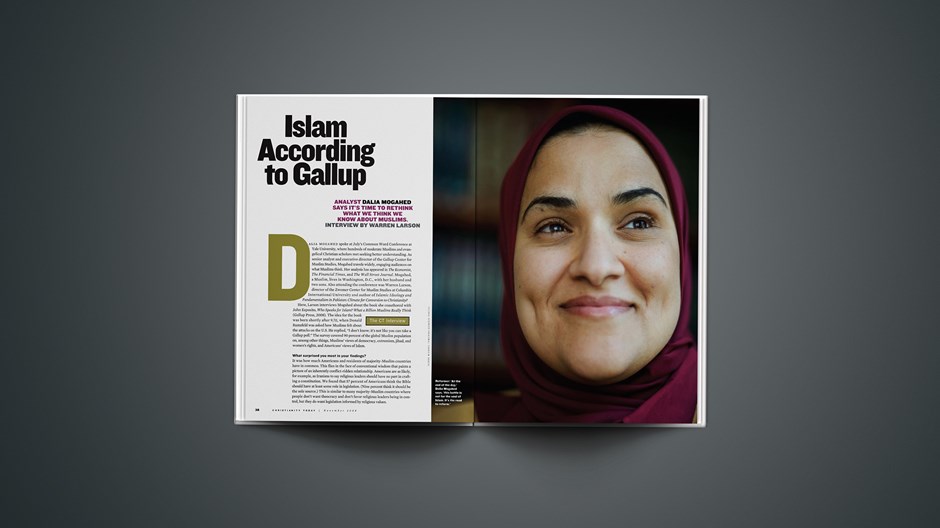
Dalia Mogahed spoke at July's Common Word Conference at Yale University, where hundreds of moderate Muslims and evangelical Christian scholars met seeking better understanding. As senior analyst and executive director of the Gallup Center for Muslim Studies, Mogahed travels widely, engaging audiences on what Muslims think. Her analysis has appeared in The Economist, The Financial Times, and The Wall Street Journal. Mogahed, a Muslim, lives in Washington, D.C., with her husband and two sons. Also attending the conference was Warren Larson, director of the Zwemer Center for Muslim Studies at Columbia International University and author of Islamic Ideology and Fundamentalism in Pakistan: Climate for Conversion to Christianity?
Here, Larson interviews Mogahed about the book she coauthored with John Esposito, Who Speaks For Islam? What a Billion Muslims Really Think (Gallup Press, 2008). The idea for the book was born shortly after 9/11, when Donald Rumsfeld was asked how Muslims felt about the attacks on the U.S. He replied, "I don't know; it's not like you can take a Gallup poll." The survey covered 90 percent of the global Muslim population on, among other things, Muslims' views of democracy, extremism, jihad, and women's rights, and Americans' views of Islam.
What surprised you most in your findings?
It was how much Americans and residents of majority-Muslim countries have in common. This flies in the face of conventional wisdom that paints a picture of an inherently conflict-ridden relationship. Americans are as likely, for example, as Iranians to say religious leaders should have no part in crafting a constitution. We found that 57 percent of Americans think the Bible should have at least some role in legislation. (Nine percent think it should be the sole source.) This is similar to many majority-Muslim countries where people don't want theocracy and don't favor religious leaders being in control, but they do want legislation informed by religious values.
What do Muslim women say about Shari'ah [Islamic law]?
Muslim women and men, surprisingly, hold similar views about Shari'ah. In Jordan, most Muslim women and men say it should play a role in legislation. Muslim women want and think they deserve equal rights: the right to vote without interference from their families, the right to work at any job they are qualified for, and even the right to serve in senior levels of government. In short, Muslim women don't regard Shari'ah as impeding their rights; they may in fact see it as a road to progress.
Didn't Ontario's government recently disallow Islamic law because Muslim women opposed it?
In the absence of representative survey research, we cannot make that assessment. The government was actually led to believe Muslim women didn't want it, but we can't be sure. Often a vocal, well-organized minority speaks for everyone and claims that it's the opinion of the majority. For example, a Washington Post article claimed Iraqi women were outraged and against Islamic law. Our research in Iraq shows 83 percent of Iraqi women say they do not want a division between state and religion, and most want religious leaders to take a part in family law.
What stereotypes does your book challenge?
[One is that] Muslims allegedly reject democratic values, when in fact they admire them and wish they had more of those values implemented in their own governments. A second popular stereotype is that the conflict between the Muslim world and the West is about a clash of values, a rejection of modernity. What Americans admire about themselves—democracy, technology, ingenuity—is what Muslims admire most about America.
Your book says that 7 percent, or 91 million, of 1.3 billion Muslims worldwide think the 9/11 attacks were "completely" justified, leaving 93 percent as moderates. Ninety-one million is a big number, but other studies put Islamic extremism at an even higher level.
We must define extremism. If it's the number of people actually involved in violence, the number is much less than 7 percent. Analysts estimate thousands, not millions. If it's about people who sympathize with extremists, we must define what it means to sympathize. But our goal was not to quantify percentages of so-called extremists, but to understand the fringe element and how they differ from mainstream Muslims.
Do you question a Sunday Telegraph report in 2006, for example, that claimed the percentage of UK Muslims who were "radical" jumped from 15 percent in 2001 to 43 percent in 2006?
If we use the same measuring stick on the American public, we find that a whopping 31 percent are extremists. The University of Maryland surveyed [Americans on] the justifiability of attacks on civilians, and nearly one-third said "sometimes." That kind of definition might be good for newspaper headlines, but it does not give the information needed to understand the fringe element.
What do most Muslims think about apostates?
Apostates are not very popular in any religion, so [Muslims] definitely view leaving Islam as a terrible idea. On the other hand, in any faith community, it's not something people think should be handled violently. Our study shows it is dangerous to call other Muslims apostates. An important declaration several years ago by a group of prominent scholars, the Amman Message, defined what it means to call someone else an apostate and how theologically incorrect it is to use such terms against fellow Muslims.
Article continues below
Don't all four schools of Sunni Islamic law suggest that a Muslim who leaves Islam and embraces Christianity, for example, should be executed?
We have to look at modern interpretations, because Islamic law is a vibrant, ever-changing set of interpretations. Fiqh, or human interpretation of Shari'ah, maps changes with time and place. Look, for example, at Sheikh Ali Jumu'a, grand mufti of Egypt, whose interpretation of apostasy laws is not to take drastic measures. In the past, apostasy was seen as treason because citizenship in one group was defined by faith, and when people left one faith, they had to work against their community. One's faith today is no longer seen in the same context, because the nation-state has been completely transformed.
How do you respond to conventional wisdom that says the Qur'an espouses violence?
First, [violent] verses have a historical context and must be understood and interpreted in a specific way. Second, if the Qur'an espouses violence, then we should have a greater percentage of Muslims involved in violence. Violence is usually politically, not religiously, motivated. Third, terrorist sympathizers or the "cheering section"—the 7 percent who are politically radicalized—are no more religious than mainstream Muslims who abhor violence and say it is morally unjustified. Muslims are as likely as Americans to denounce attacks on civilians. Finally, people defending their position on 9/11—the 7 percent who think it's completely justified—do so because of political and geopolitical perceptions, not theology. Not one referred to the Qur'an. Their responses could have come from an atheist. They see the U.S. as an imperialist power trying to control the world. Those who condemned 9/11 quoted Qur'anic verses that forbid killing innocent people. So moral objection to terrorism is competing with political rage, and people can go either way.
In Who Speaks for Islam? you suggest that the domestic terrorist Timothy McVeigh was a Christian. Why?
I refer to his writings. Another example is the Ku Klux Klan. When people hold a certain ideology, whether rooted in religion or some political thought, they [can] become radicalized, and that radicalization takes on symbolic language. When environmentalists become radicalized, they become environmental terrorists. When animal-rights activists become radicalized, they become animal-rights terrorists. Similarly, Muslim rhetoric takes on the symbols of the dominant social medium they are in. Timothy McVeigh's radical ideas, reflected in his writings, carry symbols of Christianity. Throughout history the KKK claimed to be sincere Christians. The religious ideology they hold is not the root of their radicalization, but it will necessarily be the context in which their ideas manifest.
Article continues below
How should evangelicals respond to what seems to be the spread of extremist Islam globally?
Evangelicals should respond the way everyone should respond. Understanding the cause of the problem is important. The data clearly show it is driven not by religious extremism but by extreme political ideology. Second, as a human family, look at the extremists as an outside group, rather than as an outgrowth of religion. This builds bridges between people of different faiths all fighting a common enemy. Let's not forget that Muslims are the primary victims of violent extremism. People in majority-Muslim countries, unlike Americans, say their greatest fear is terrorism. Third, evangelicals should help empower those trying to make positive change peacefully. At the end of the day, this battle is not for the soul of Islam. It's the road to reform.
The grievances terrorists champion are strategically chosen and ones the vast majority agree with. Others try to address these same issues peacefully. To the extent these people are effective, terrorists are seen as ineffective and their methods as barbaric. Finally, evangelicals should vocally and unequivocally denounce anti-Muslim hate speech. When prominent Christian leaders make degrading statements about Islam, it feeds [Osama] bin Laden's claim of an American "crusade" against Islam and Muslims. Hateful statements against what Muslims hold most dear are a gift to bin Laden and a slap to mainstream Muslims who fear and reject his methods and therefore should be seen as allies, not enemies, in the fight against violent extremism.















 While we pray for peace, we need moral clarity about this war.
 We’ve got little information on Jesus’ appearance and personality. But that’s the way God designed it.españolFrançais
 After lobbying from fellow Southern Baptists and Christians affected by the war, the House speaker moves a package forward.






