The filmmakers behind Milk couldn't have asked for better timing for their release. A tightly composed tale of Harvey Milk's contribution to the gay movement (he was the first openly gay man to be elected to public office in the U.S.), Milk portrays the early and explosive days of grassroots activism for homosexual rights on the streets of San Francisco. Thirty years later, the movement is taking to the streets again in California, protesting the recently passed Proposition 8, which amends the state Constitution to restrict the definition of marriage to a union between a man and a woman.
The film is more of an homage and biopic than a political call to arms, but certainly it will be embraced as a galvanizing piece of agit-prop by the already incensed gay community. Its openly gay filmmakers, including director Gus Van Sant and screenwriter Dustin Lance Black, undoubtedly mean it to be more than just popcorn escapism.
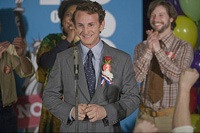
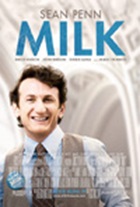
Sean Penn as Harvey Milk
The film follows Milk (Sean Penn) from his early '70s arrival in San Francisco, where he set up shop (literally: a camera shop) in the city's Castro District, which quickly became a haven to which homosexuals migrated. Gays owned the shops, rented the apartments, and lived peacefully. But the police hated them, and occasionally got abusive. Milk quickly became the organizing voice ("the mayor of Castro Street") who could funnel his community's anger into activism. Following the 1977 repeal of gay rights legislation in Florida (which singer Anita Bryant famously campaigned for), there were riots in the Castro district. Milk got up with a megaphone and put a positive spin on it, speaking with Obama-esque language of hope. "We've gotta give hope to gay teenagers across America!"
The film efficiently documents Milk's political ascendancy, mounting numerous failed campaigns before finally winning the post of city supervisor in 1977, on a coalition of union support, women, seniors, gays and minority voters. An interesting and crucial section of the film concerns the subsequent battle over California's Proposition 6 in 1978, which would ban gays from teaching in public schools. These scenes—which, like the film at large, skillfully employ the use of archival footage—play like some sort of weird déjà vu, given the rhetoric that accompanied this fall's vicious fight over Prop 8 (with conservatives arguing that the failure of Prop 8 would result in homosexuality being taught in public schools). Milk's side was victorious in the fight against Prop 6, which is what ultimately led to his untimely demise. Shortly after the homosexuals' victory in the November 1978 elections, Milk was shot to death by a disturbed fellow politician, Dan White (Josh Brolin).
We know from the film's outset that Milk is a doomed figure. The film opens with Milk recording an "only in the event of my death by assassination" message in which he admits the very real possibility that he will be targeted for his gay activism. "In San Francisco, we have broken the dam of major prejudice in this country," we hear him say, followed by archival footage of Dianne Feinstein (then head of San Francisco's board of supervisors) announcing on November 27, 1978 that "Both Mayor Moscone and Supervisor Harvey Milk have been shot and killed."
The movie begins and ends with Milk's death, though, unlike Gus Van Sant's "death trilogy" (2002's Gerry, 2003's Elephant, and 2005's Last Days) and most recent film, Paranoid Park (2008), Milk is not a film about death. Rather, it is a film that champions life—as framed by mortality—when it is lived to the fullest, with action and activism and love and laughter at its core. Indeed, for all the film's gravitas, it is unusually cheerful—though tempered by the uncertain (and always outnumbered) position of being a minority fighting an uphill battle.
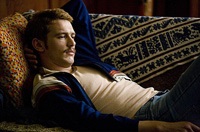
James Franco as Scott Smith
The paradoxes of life and death, hope and despair are epitomized in the figure of Milk, as portrayed by the brilliant Sean Penn, who (with the help of a prosthetic nose) looks, acts and speaks just like the real man, imbuing his character with a cheery flamboyance but also a world weariness and deep-seated unease. There is a sense that Milk is never completely comfortable in his skin, yet he embraces it and runs recklessly forward, never looking back. Armed with a megaphone and trademark catchphrases ("I'm Harvey Milk and I'm here to recruit you!"), Milk was a dynamic speaker and lightning rod to the gay community. It's easy to see why he became the first gay elected official and, sadly, easy to see why people hated him enough to kill him.
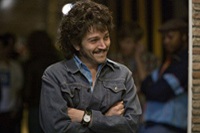
Penn is the marquee acting performance here, but the talented actors who fill out the supporting cast should also be noted. Playing Milk's various lovers/activist staffers is a who's who of young Hollywood stars—including James Franco, Emile Hirsch, and Diego Luna, all of whom are straight. They fill the roles well, though they tend to over-emphasize gay stereotypes; Luna, in particular, plays it a little too flamboyant, but Franco comes across very sympathetically and played-down.
Article continues below
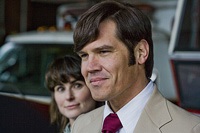
Josh Brolin as Dan White
Fresh off his turn as George W. Bush in Oliver Stone's W, Josh Brolin delivers an impressively subtle performance as Milk's awkward political foil/friend and ultimate assassin. White, a pasty, blue-collar, homophobic Catholic, has some serious psychological issues of which Brolin and Van Sant wisely provide only a glimpse. He could have easily been turned into the typical "crazy Christian villain" stereotype, but Van Sant shows restraint by insisting on a fair portrayal.
As compelling as the acting and story are, Milk's chief fault is—ironically—its conventionality. Perhaps because Van Sant has proven himself to be one of America's most creative, visionary directors (with almost high art tendencies—see Paranoid Park), the straightforward style he employs here is somewhat of a disappointment. Here and there we see splashes of color or operatic flourishes (as in a scene of Milk attending a performance of Puccini's Tosca), but by and large it is noticeably uninteresting from a stylistic point of view. Everything is well-crafted—from Danny Elfman's score to Harris Savides' cinematography—but it is all a little too safe. Van Sant is back in Finding Forrester mode here.
In any case, Milk achieves what it sets out to do, telling an inspiring tale of one man's quest to legitimize his identity, to give hope to his community. I'm not sure how well it'll play outside of big cities, or if it will sway any opinions on hot-button political issues, but it gives a valiant, empathetic go of it.
Talk About It
Discussion starters
Does this film make you more or less sympathetic to the gay fight for rights?
There are some "Christian" characters in the film who argue against homosexuality in rude, demeaning ways. How can Christians articulate disapproval of that lifestyle in a loving and charitable way?
As a Christian, how would you engage a person like Harvey Milk if you could meet him today?
The Family Corner
For parents to consider
Milk is rated R for language, some sexual content and brief violence. It is a film about homosexual activism, and as such, there are a lot of gay characters and activities. There are numerous scenes of men kissing or in bed together, though there is no explicit sex. There is a scene of suicide by hanging, and a few brief scenes of gun violence. There is a fair share of offensive language and sexual innuendos as well. Though the film is not gratuitous or exploitative, it is inappropriate for children, and only for mature and discerning adults.













 While we pray for peace, we need moral clarity about this war.
 We’ve got little information on Jesus’ appearance and personality. But that’s the way God designed it.españolFrançais
 Leader explains why the movement is seeing its biggest membership bump in 30 years and its mission for the years ahead.