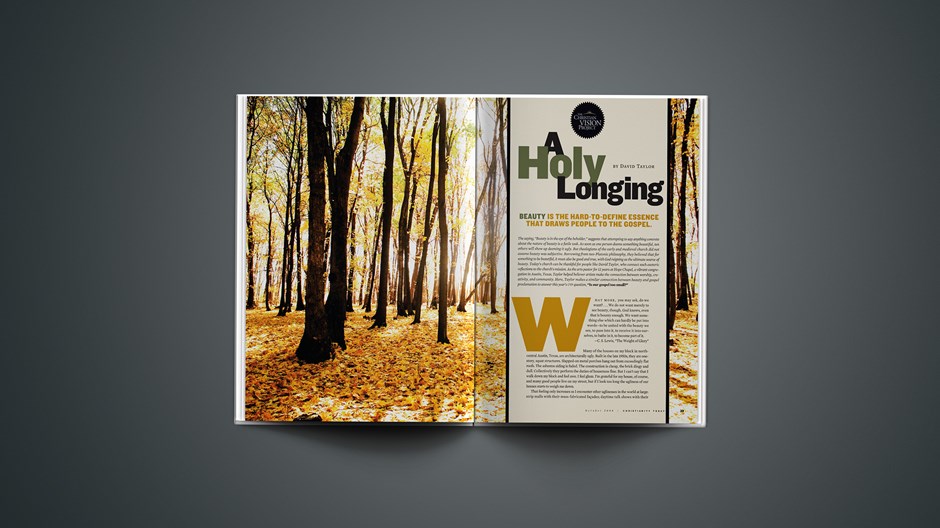
The saying, "Beauty is in the eye of the beholder," suggests that attempting to say anything concrete about the nature of beauty is a futile task. As soon as one person deems something beautiful, ten others will show up deeming it ugly. But theologians of the early and medieval church did not assume beauty was subjective. Borrowing from neo-Platonic philosophy, they believed that for something to be beautiful, it must also be good and true, with God reigning as the ultimate source of beauty. Today's church can be thankful for people like David Taylor, who connect such esoteric reflections to the church's mission. As the arts pastor for 12 years at Hope Chapel, a vibrant congregation in Austin, Texas, Taylor helped believer artists make the connection between worship, creativity, and community. Here, Taylor makes a similar connection between beauty and gospel proclamation to answer this year's CVP question, "Is our gospel too small?"
What more, you may ask, do we want? … We do not want merely to see beauty, though, God knows, even that is bounty enough. We want something else which can hardly be put into words—to be united with the beauty we see, to pass into it, to receive it into ourselves, to bathe in it, to become part of it. —C. S. Lewis, "The Weight of Glory"
Many of the houses on my block in north-central Austin, Texas, are architecturally ugly. Built in the late 1950s, they are one-story, squat structures. Slapped-on metal porches hang out from exceedingly flat roofs. The asbestos siding is faded. The construction is cheap, the brick dingy and dull. Collectively they perform the duties of houseness fine. But I can't say that I walk down my block and feel awe. I feel glum. I'm grateful for my house, of course, and many good people live on my street, but if I look too long the ugliness of our houses starts to weigh me down.
That feeling only increases as I encounter other uglinesses in the world at large: strip malls with their mass-fabricated façades; daytime talk shows with their voyeuristic gossip; relentless visual noise that drains and distracts us; racism; self-indulgent behavior; wastefulness; barely utilitarian church buildings; and "faith" movies that ignore every biblical notion of sanctification.
And the ability to make ugliness abound, whether material or moral, is in us all, sinners great and small. The effect of all this ugliness upon us is no small thing, either. Like a dementor in Harry Potter's Azkaban, it sucks the life out of us. Ugliness makes our souls sick, leaving us dissipated and eventually deformed. Ugliness is one of the three anti-fruits of human rebellion, alongside falsehood and evil.
So what will rescue us from all this ugliness? God, of course. But what about God gives us hope in the midst of so much ugliness? A fundamental attribute of God: that he is beautiful. He is a beauty-full, beauty-making God who invites us to participate in his work of expanding beauty upon the earth.
The Beauty of God
Consider the ordinary dictionary meaning of beauty—"The quality that gives pleasure to the mind or senses and is associated with such properties as harmony of form or color, excellence of artistry, truthfulness, and originality."
Then consider this God.
Our God makes beautiful material stuff. He fashions the carnival-colored, wacky-jumping flat lizard of South Africa and the severe environment of the Gobi desert in Mongolia. He constructs the extravagant diversity of life in the Amazon rainforest. He invents homier things such as the capacity to savor tea and toast.
Our Creator commissions a multifaceted work of literature: the Bible. In it, we find the comforting poetry of Psalm 23. There is the Apocalypse, teeming with strange symbols that inspire fear and awe. In the Gospels Jesus' parables deploy allusive turns of phrase. There is no sentimentalism in the laments of Jeremiah, no slick or sloppy writing in Paul's letters.
There is also, preeminently, the beauty of God's self-sacrificing love—of Father, Son, and Holy Spirit. At the cross the beauty of God is mangled, smelly, dirty, misunderstood, "banged with terror," to quote one modern poet. It makes us weep. And it is good. And how it makes us yearn to be loved and love like such a God.
What we see in this Trinitarian God is his ability to make beauty shine forth from all kinds of lovely and messy, magnificent and broken things—things from which we expect beauty to be absent. The doubt-filled book of Job? That freakish quartet of singing beasts cruising around the eternal throne? These are beautiful? Yes, these things, directed by the hand of God, are beautiful.
I submit, then, that when we present a gospel that ignores or devalues beauty, we not only present a small gospel, but also a distorted gospel, because it misrepresents our God.
The God whom we preach can end up not looking like the Word made radiant flesh, but like the Word who belongs to a Mensa club. He has the answers, all of which are true, but no real presence. He is the Right Idea who looks nothing like the resplendent, technicolor Son of Man—"hair a blizzard of white, voice a cataract, face a perigee sun"—whose beauty captivated the heart of St. John. Likewise, instead of the Good Shepherd whom Mary of Bethany leisurely beheld, we can easily find ourselves following a worker-of-the-month carpenter, a driven good-doer who gets plenty accomplished for the kingdom, but who looks like a far cry from the transfigured Glory whom the early church fathers called the "everlasting desire of nations."
Article continues below
We certainly must continue to declare Jesus as the Good Way and the True Truth. But he is not these alone. Jesus is also a Desirable Beauty, one who attracts us by the beauty of his person and works. And he has placed a deep longing in all humans for beauty. When you and I welcome the in-forming, re-forming presence of beauty into our gospel—our evangelism and social action, our worship and work, our praying and playing—we allow beauty to do something that only it can do: generate longing, a longing that is satisfied supremely in the Source of all created beauties, Jesus Christ. And this is very good news.
To be sure, beauty has its subjective dimension. I like a good mocha coffee. My wife prefers a good black tea. My architect friend Margaret favors the clean lines of modern architecture over the ornate gothic architecture I'll take any day. There are the nonbelievers who fail to see the "beauty" of the crucifixion. In no way, then, can we make simplistic statements about what is beautiful. Still, there are at least three fundamental qualities that suggest the basic nature of beauty. Let me explain.
The Mechanics of Beauty
When we say of something, "That is beautiful," what dynamics are at work? Three interrelated qualities: unity, complexity, and richness, all of which, when working together, evoke longing. Take a Mercedes Benz engine, a fine mechanical work of art.
First, all the parts of a Mercedes engine hold together, are excellently integrated—unified. Nothing is wasted, nothing missing. Second, the engine exhibits a complexity of action. Many things, electrical, chemical, and mechanical, are happening at the same time to produce wondrous functions. And third, the engine provokes, for Benz-lovers at least, poetic outbursts: "What a gorgeous engine! It's perfect!" While philosophers might call this "radiance" or "richness," car enthusiasts would call this ecstasy, for they sense that something "more than" is going on.
Article continues below
That "more than" is the pull of beauty, something we have all surely sensed at some point. I have sensed it in singer-songwriter Sufjan Stevens's melancholy "Sister Winter"; in the richly textured storytelling of Dostoyevsky's Crime and Punishment; and in both happy and dark subject matter such as P. L. Travers's Mary Poppins and Michelangelo's The Last Judgment.
All these works are beautiful, though never merely subjectively. For in every case they reveal the objective pattern of unity, complexity, and richness, which collectively evoke longing. Differently for each of us, they stir an ache in our hearts. The longing for what? For starters, the longing for joy, for order, and for more beauty.
Joy Anyone who has been on this planet long enough knows that joy and good food frequently go hand in hand. And by "good," we don't just mean good nutritionally—we mean good beautifully.
Consider the 1996 movie Big Night, the bittersweet tale of two Italian-American brothers trying desperately to keep their restaurant in operation. One brother, Primo, is shy and hopelessly impractical, but also a gastronomic genius, and he fancies a local florist, Ann. In one scene, Ann wanders into Primo's kitchen, where he is fussing over a sauce. He looks up to see her and invites her to taste it. The taste of the sauce is so exquisite that Ann can do nothing but exclaim repeatedly: "Oh my God!" Primo takes her exclamation and turns it into a keen insight: "'Oh my God' is right, see? Now you know. To eat good food is to be close to God." Then he quips: "The knowledge of God is the bread of angels. I'm never sure what that means, but it is true!" Here Ann breaks into laughter.
This scene reminds us of an essential connection between beauty (Primo's finely crafted multicourse meal), joy (the merrymaking that ensues throughout the meal), and God (to whom the exclamations of delight are directed). The knowledge he talks about may not be saving knowledge, but it is part and parcel of God's revelation of himself to his world. What a great gift we can offer our neighbors when our acts of beauty, such as a finely made meal, lead to sweet, true joy.
Order Insofar as beauty is marked by unity, when we make something beautifully we offer to others a vision of unity, or order. Such a vision can minister to the souls of people torn by fragmented schedules and broken relationships.
Article continues below
At Hope Chapel, we hang at the beginning of Advent two 9-foot-high, 6-foot-wide banners that feature the archangels Michael and Gabriel. They make for fierce, strange creatures, vibrantly colored in reds, purples, oranges, yellows, and greens. Angular in form, they hover protectively over the congregation. At the base of the banners, the colors brighten to hint that dawn approaches with the coming good news. Once a year, the banners act to "reorder" our sense of time, to reorient us to the time of Emmanuel. What time is it at Advent? It is the time that God has come; that he is here defending us and speaking now; that he will one day make whole all that is damaged around us and in us.
The order of spiritual time represented in the banners nourishes us frazzled, occasionally faint of heart congregants. The angels' visual reminder puts us at rest: all shall be well, the Lord is near. Surely we need that reminder at least once a year.
More Beauty But beauty is actually much wilder than simply evoking in us a desire to have more "units" of beauty. No, we want, as C. S. Lewis keenly observed, to pass into beauty. In other words, we want to bathe in Mozart's music. We want to become a part of the Swiss Alps. We want to receive our spouse into ourselves. We want not merely to behold the Bread of Life; we want to eat it, and in so doing, find ourselves truly known.
Psalm 27:4 states, "One thing I ask of the Lord, this is what I seek … all the days of my life, to gaze upon the beauty of the Lord, and to seek him in his temple."
All the days of my life. That's a long time and quite an exceptional desire. But I don't think the psalm-ist intends to exaggerate. He has encountered the Source of all beauties. How can he not want this beauty forever? God has redeemed us so that we may worship him never-endingly as the glorious, tri-personal Source of beauty. God has also purposed to transform all of creation's brokenness, as theologian Jeremy Begbie reminds us, "into something of infinitely expanding, superabundant beauty." This too is good news.
Messengers of a Greater Beauty
My street is not without signs of beauty. One family grows tall vines in its front yard that yield luscious red tomatoes. Every March, Texas Mountain Laurels grace us with sweet grape-scented flowers. Human doings. God doings. These signs gladden my heart. They beckon me away from the ugliness in my own heart.
Article continues below
We evangelicals uphold the true and the good of our gospel, and rightly so. But there is also a great work to be had in expanding beauty upon the earth. To place beauty in the lives of our neighbors is to place a forestalling effect in their hearts against the downward drag of sin into ugliness, both moral and material.
Sometimes our beauty-making works will be an indirect witness to God, as with Mel Gibson's movie Braveheart and its depiction of self-sacrificing love. Sometimes our works will be very direct testaments: Gibson's Passion of the Christ is just that. But always, the effect of beauty upon us will be the same—to evoke longing for the Source of all beauties. Our privilege as those who walk with Jesus is to be able to say to our neighbors, with the Holy Spirit's guidance: "That longing you feel in your heart for something greater than yourself? That is a longing for God himself. He truly can satisfy your deepest desires."
To do this work does not mean we neglect the true proclamation of God or the practical love of our neighbor. It means we infuse all things with the presence of beauty—our discipleship and our public parks, our grocery stores and our popular novels, our meal-makings and mission projects—knowing that we are doing gospel work, proclaiming the full revelation of God.
My final prayer is this: that you and I would become, in all we say and do, messengers of a Greater Beauty, living signposts of that First Brightness, holy irritations against all that is ugly, so that at least once throughout the course of our neighbors' day, they will, with God's grace, long for him and perhaps even find him—the everlasting desire of all nations.
















 While we pray for peace, we need moral clarity about this war.
 We’ve got little information on Jesus’ appearance and personality. But that’s the way God designed it.españolFrançais
 Christian artists work at the intersection of music and climate change.






