If cultivating and creating are so central to our biblical vocation, why have they been put aside?
The disenfranchisement of conservative Christians from cultural power at the dawn of the 20th century elicited strong reaction. Just two generations after evangelical Protestants had been intimately involved in building almost every major post-Civil War cultural institution, they either were kicked out or left voluntarily. People who wanted to hold on to theologically conservative beliefs thought you couldn't do that and participate fully in mainstream culture. We've spent a century working our way back from the fallout of that.
Last century we also saw the rise of mass consumption as a way of life in America. When you look at newspapers from 100 years ago the principle word used to refer to Americans in general was citizen. Now the word USA Today uses most often to refer to all of us is consumers. And if we want to talk about people in their civic role we don't usually call them citizens but voters. Think about how different those words are, how much thinner a word voter is than citizen. It's not just Christians but Americans in general who have adopted a posture of waiting passively for cultural offerings. We think it's our job simply to figure out what we like and buy it.
Finally, being an effective cultivator and creator requires certain disciplines—cultivating a certain awareness and willingness to work at things in the world. Consumer culture has made it easy to get along in many spheres without learning basic skills, whether it's how to keep the garden growing or how to cook. Although technology gives us an amazing sense of power and infinite capacity, it does so by taking over all these things that our parents and grandparents knew how to do. But there is a backlash. People are starting to realize that we've lost some capacities that we don't want to lose.
Your book returns us to a much older story—the biblical story—and shows where humans stand in that greater, ancient narrative.
One of the things that has hindered evangelical cultural creativity has been a nostalgia for the nineteenth century when we were dominant culturally in a way that we will probably never be again. Ancient Israel is a much better place to start because it was so small, always beleaguered, always overwhelmed by empires around them, and yet they sustained this incredible, world-changing culture. That's a much more instructive picture than hoping that we can reclaim the kind of cultural control that evangelicals briefly had at one point in American history.
You challenge the use of the word culture as an abstraction. Why is it so important to understand that all culture making begins locally?
This is one of the things I care about most in the book. We get paralyzed by thinking of culture as one monolithic, huge thing out there, when in fact the larger the scale the less anyone can claim to shape it. Much that's of paramount importance in culture happens only on a local scale. While my neighborhood is affected by forces that stretch all the way up to global levels, there are many things about my neighborhood that can only be cultivated locally. No government agency can do it. No Hollywood movie can affect it. It's up to me and my neighbors. And that's a very significant portion of the culture that I'm responsible for. If I spend all my time preoccupied with grand, global scales of society I'm likely not to be responsible in the one place where I could probably make a difference.
Culture making at even the largest scale happens in these small concentric circles. Any given person can only participate in a few sets of circles, but there are some spots that only you can fill. This frees us from having to concern ourselves only about a handful of powerful people who allegedly get to shape culture. It is true that some people get to green-light Hollywood movies. I don't get to do that. Probably most of our readers don't get to do that. But there are many things I can do that those people cannot do that make a cultural difference.
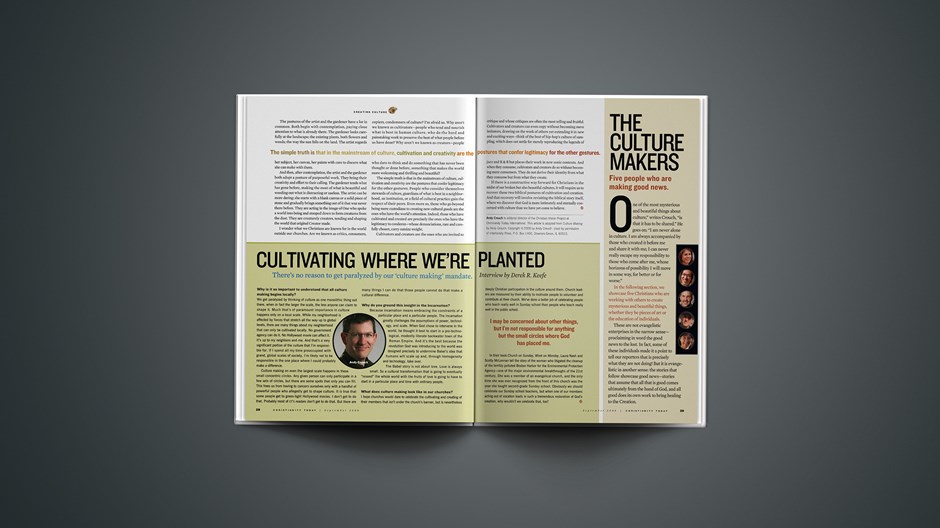
One of our neighbors cultivates and creates things in our local school that, if President Bush came to visit our school, he couldn't do. He could make a splash for a day. He might help push through a law that affects our school. But on a day-to-day basis, our neighbor has a greater ability to shape what life is like for a bunch of children, teachers, and staff than the President of the United States or the head of the Department of Education. To me that's very freeing. I may be concerned about other things, but I'm not responsible for anything but the small concentric circles where God has placed me.
And "family is culture at its smallest and most powerful." Might this be a good word for people who read your book's title and say, "Culture making oh, I'm not artistic, I'm not a creative type. What's my place in this?"?
Yes. When I started writing the book I was working with Ivy League students. So I was initially thinking I needed to write a book for people who are culturally creative. But this emphasis on family emerged as vitally important. It's not that we should focus on one to the exclusion of the other, because we're called to be in all spheres and scales of culture.
Article continues below
But the further along I went the more I appreciated the importance of the local and the small. It was very important to me that those who may not be paid to do any culture making—maybe someone at home with their kids or homeschooling—would realize they are doing significant cultural creating. Emphasis on the family has sometimes signaled a retreat from culture, but there are ways to make the life of your family a culturally creative enterprise.
You remind us that as a culture maker even the Word was constrained—and freed—by the limits and particularities of the culture in which he was made flesh.
Yes, incarnation means embracing the constraints of a particular place, a particular people, and it is radically good news that the salvation of the whole world could begin that small. The Incarnation greatly challenges the assumptions of power, technology, and scale. When God chose to intervene in the world, he thought it best to start was in a pre-technological, modestly literate, backwater of the Roman Empire. And it's the best because the revolution God was introducing to the world was designed precisely to undermine Babel's idea that humans will scale up, and through homogeneity and technology, we'd take over.
The Babel story's not about love. Love is always small. So a cultural transformation that is going to eventually reseed the whole world with the fruits of love is going to have to start in a particular place and time with just ordinary people. And yet that doesn't take anything away from its capacity to become a world changing movement, which it did and is and ultimately will fully be.
Near the end of your book you write that we are called to create culture "at the intersection of grace and cross." What do you mean?
The idea of the intersection of grace and cross helpfully brings together two things that mark the Christian calling.
One is that life is a gift. To the extent that what we're called to do in culture is distinctively Christian, it should have the mark of abundance that Jesus' own life had. It's not a matter of finding the thing that is hardest for us and least beneficial and deciding that must be the loving thing to do. Where is it that when you work in this arena, when you cultivate in this field, fruit comes up that you never expected? To me that's the sign that God's at work in the world. And it's not just linear. It's not that I put in a unit of input and get a unit of output. Our culture making should have this quality of grace.
Article continues below
Now, we could stop there, but that could lead us, if we're people of privilege, to do stuff that's easy. While I believe that culture making should be marked by grace, it also needs to participate in the distinct way that Christ was present in the world, which is suffering in the broken places. So it's not quite enough to say, "Do what you love." No, do what takes you to that intersection where you experience abundance and yet also find yourself wrestling ever more deeply with the brokenness of the world because of sin and its effects. Vocation is the place where paradoxically both are true, which is what Hebrews says was the case even with the cross for Jesus, "Who for the sake of the joy set before him endured the cross." You can almost always identify a step toward grace as a step toward the cross.
How might asking whether we're creating and cultivating things that have a chance of "furnishing the New Jerusalem" shape our culture making efforts?
We sometimes make it too easy for ourselves by thinking that if we just do things that are explicitly Christian that's somehow satisfactory—that a Christian label makes a cultural item good. One of the temptations of pretty much Christian anything—I mean Christian as an adjective followed by any noun—is that you can fool yourself into thinking you're doing good work when you're just doing it in a very small pool with low standards. I'm not sure that everything with a Christian label on it has the qualities of excellence that we can imagine the kings of the earth bringing into the New Jerusalem as their best offering (cf. Rev 21:24). So it's a demanding standard in that we can't just baptize our feeble, unreflective, uncultivated efforts and assume that they're good enough for God.
On the other hand, we might also have anxiety about doing things that don't seem to have an immediate evangelistic purpose or measurable effect in the currency of the kingdom. And yet much of culture is just not set up to have an instantaneous impact. It's actually set up to preserve and bring out the best of the created world and what others have cultivated from it. This question is liberating because is frees me from short-term urgencies—whether of an evangelistic nature, a pious nature, or a business quarter-by-quarter nature.
Article continues below
One of the undercurrents of the book is this hearty yes to the goodness of creation and culture. How do we greet the world in its goodness without bypassing the church? What does culture making look like in our churches?
I certainly hope this book does not cause people to say less than a hearty yes to the church, because I love the church. One thing thinking in terms of culture making can do is make us more aware of ways that our churches themselves are collections of cultural goods and cultural efforts and the humanness of these enterprises and their good and bad qualities. Communities of faith are also areas of culture that deserve to be tended, and that, like all culture, can be transcendently wonderful and also very broken and dysfunctional.
The biggest risk for a church comes when it begins to exist for itself and only celebrates or recognizes cultural activities that serve its immediate tangible mission. I hope churches would dare to celebrate the cultivating and creating of their members that isn't under the church's banner, but is nevertheless deeply Christian participation in the culture around them that is shaped by life in worship, study, and prayer together.
Churches sometimes fail partly because church leaders are measured by their ability to motivate people to volunteer and contribute at their church. We've done a better job of celebrating people who teach really well in Sunday school than people who teach really well in the public school.
In their book Church on Sunday, Work on Monday Laura Nash and Scotty McLennan tell the story of the woman who litigated the clean up of the terribly polluted Boston Harbor for the Environmental Protection Association—one of the major environmental breakthroughs of the twenty-first century. She was a member of an evangelical church, and the only time she was ever recognized from the front of this church was the year that she taught second grade Sunday school. Obviously we should celebrate our Sunday school teachers, but when one of our members acting out of vocation leads in such a tremendous restoration of God's creation, why wouldn't we celebrate that, too? And if our churches celebrated that more there would be a less of a sense of saying "yes" to the one, "no" to the other.
Celebrating what people are doing out beyond church walls feels like a risk for pastors, but I think that fear is unfounded.















 While we pray for peace, we need moral clarity about this war.
 As my doubts about his teachings grew, so did a secret fascination with Jesus.
 After lobbying from fellow Southern Baptists and Christians affected by the war, the House speaker moves a package forward.






