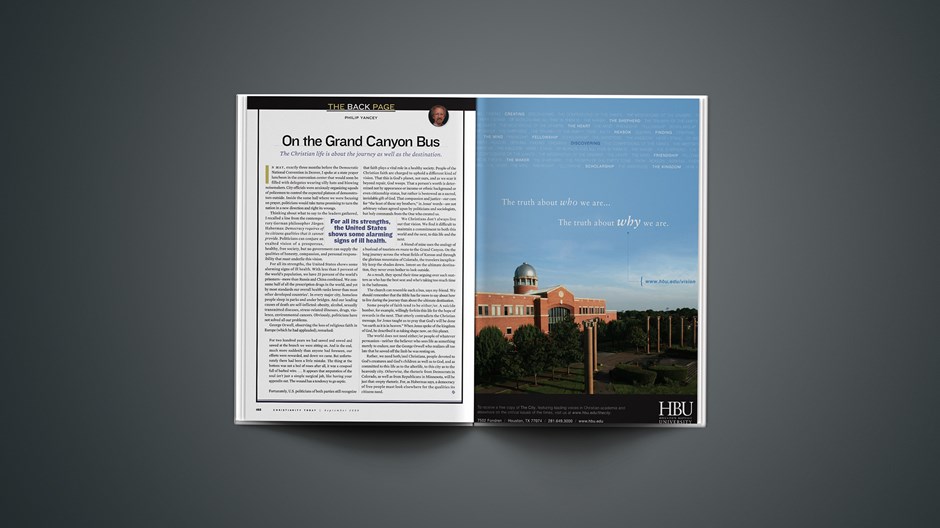
In may, exactly three months before the Democratic National Convention in Denver, I spoke at a state prayer luncheon in the convention center that would soon be filled with delegates wearing silly hats and blowing noisemakers. City officials were anxiously organizing squads of policemen to control the expected platoon of demonstrators outside. Inside the same hall where we were focusing on prayer, politicians would take turns promising to turn the nation in a new direction and right its wrongs.
Thinking about what to say to the leaders gathered, I recalled a line from the contemporary German philosopher Jürgen Habermas: Democracy requires of its citizens qualities that it cannot provide. Politicians can conjure an exalted vision of a prosperous, healthy, free society, but no government can supply the qualities of honesty, compassion, and personal responsibility that must underlie this vision.
For all its strengths, the United States shows some alarming signs of ill health. With less than 5 percent of the world's population, we have 25 percent of the world's prisoners—more than Russia and China combined. We consume half of all the prescription drugs in the world, and yet by most standards our overall health ranks lower than most other developed countries'. In every major city, homeless people sleep in parks and under bridges. And our leading causes of death are self-inflicted: obesity, alcohol, sexually transmitted diseases, stress-related illnesses, drugs, violence, environmental cancers. Obviously, politicians have not solved all our problems.
George Orwell, observing the loss of religious faith in Europe (which he had applauded), remarked:
For two hundred years we had sawed and sawed and sawed at the branch we were sitting on. And in the end, much more suddenly than anyone had foreseen, our efforts were rewarded, and down we came. But unfortunately there had been a little mistake. The thing at the bottom was not a bed of roses after all, it was a cesspool full of barbed wire. … It appears that amputation of the soul isn't just a simple surgical job, like having your appendix out. The wound has a tendency to go septic.
Fortunately, U.S. politicians of both parties still recognize that faith plays a vital role in a healthy society. People of the Christian faith are charged to uphold a different kind of vision. That this is God's planet, not ours, and as we scar it beyond repair, God weeps. That a person's worth is determined not by appearance or income or ethnic background or even citizenship status, but rather is bestowed as a sacred, inviolable gift of God. That compassion and justice—our care for "the least of these my brothers," in Jesus' words—are not arbitrary values agreed upon by politicians and sociologists, but holy commands from the One who created us.
We Christians don't always live out that vision. We find it difficult to maintain a commitment to both this world and the next, to this life and the next.
A friend of mine uses the analogy of a busload of tourists en route to the Grand Canyon. On the long journey across the wheat fields of Kansas and through the glorious mountains of Colorado, the travelers inexplicably keep the shades down. Intent on the ultimate destination, they never even bother to look outside.
As a result, they spend their time arguing over such matters as who has the best seat and who's taking too much time in the bathroom.
The church can resemble such a bus, says my friend. We should remember that the Bible has far more to say about how to live during the journey than about the ultimate destination.
Some people of faith tend to be either/or. A suicide bomber, for example, willingly forfeits this life for the hope of rewards in the next. That utterly contradicts the Christian message, for Jesus taught us to pray that God's will be done "on earth as it is in heaven." When Jesus spoke of the kingdom of God, he described it as taking shape now, on this planet.
The world does not need either/or people of whatever persuasion—neither the believer who sees life as something merely to endure, nor the George Orwell who realizes all too late that he sawed off the limb he was resting on.
Rather, we need both/and Christians, people devoted to God's creatures and God's children as well as to God, and as committed to this life as to the afterlife, to this city as to the heavenly city. Otherwise, the rhetoric from Democrats in Colorado, as well as from Republicans in Minnesota, will be just that: empty rhetoric. For, as Habermas says, a democracy of free people must look elsewhere for the qualities its citizens need.
Philip Yancey is editor at large of Christianity Today and cochair of the editorial board for Books and Culture. Yancey's most recent book is What Good Is God?: In Search of a Faith That Matters. His other books include Prayer (2006), Rumors of Another World (2003), Reaching for the Invisible God (2000), The Bible Jesus Read (1999), What's So Amazing About Grace? (1998), The Jesus I Never Knew (1995), Where is God When It Hurts (1990), and many others. His Christianity Today column ran from 1985 to 2009.















 While we pray for peace, we need moral clarity about this war.
 As my doubts about his teachings grew, so did a secret fascination with Jesus.
 Christians can disciple each other toward action, prayer, and hope.






