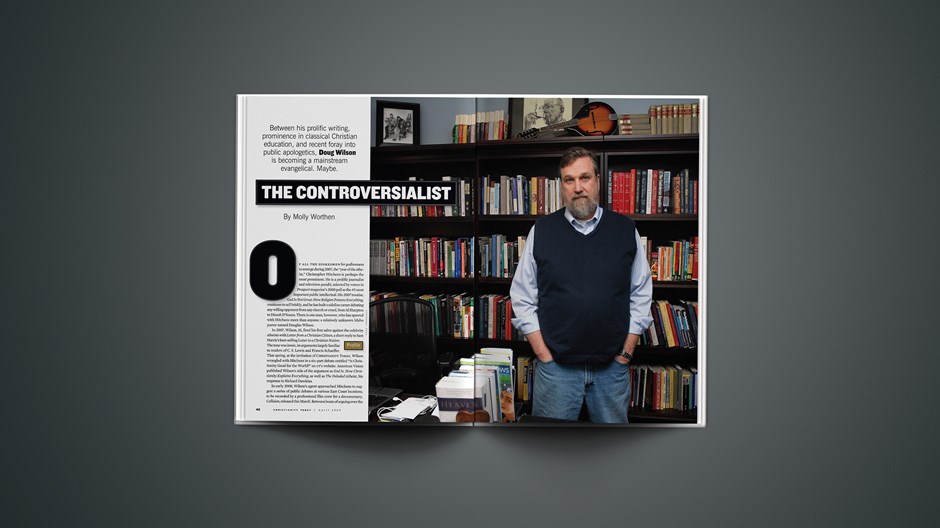
Between his prolific writing, prominence in classical Christian education, and recent foray into public apologetics, Doug Wilson is becoming a mainstream evangelical. Maybe.
Of all the spokesmen for godlessness to emerge during 2007, the "year of the atheist," Christopher Hitchens is perhaps the most prominent. He is a prolific journalist and television pundit, selected by voters in Prospect magazine's 2008 poll as the #5 most important public intellectual. His 2007 treatise, God Is Not Great: How Religion Poisons Everything, continues to sell briskly, and he has built a sideline career debating any willing opponent from any church or creed, from Al Sharpton to Dinesh D'Souza. There is one man, however, who has sparred with Hitchens more than anyone: a relatively unknown Idaho pastor named Douglas Wilson.
In 2007, Wilson, 55, fired his first salvo against the celebrity atheists with Letter from a Christian Citizen, a short reply to Sam Harris's best-selling Letter to a Christian Nation. The tone was irenic, its arguments largely familiar to readers of C. S. Lewis and Francis Schaeffer. That spring, at the invitation of Christianity Today, Wilson wrangled with Hitchens in a six-part debate entitled "Is Christianity Good for the World?" on CT's website. American Vision published Wilson's side of the argument as God Is. How Christianity Explains Everything, as well as The Deluded Atheist, his response to Richard Dawkins.
In early 2008, Wilson's agent approached Hitchens to suggest a series of public debates at various East Coast locations, to be recorded by a professional film crew for a documentary, Collision, released this March. Between bouts of arguing over the morality of substitutionary atonement or the possibility of rational thought in a universe without God, the cameramen caught Hitchens in a revealing offstage moment. One asked him what he knew about Wilson. "He has a ministry on the Washington-Idaho border, I believe," Hitchens said. "I don't know of what Christian denomination he precisely describes himself … I try not to do too much homework on people."
Who is this self-appointed defender of the faith? Until last year, those who had heard of Doug Wilson most likely knew him in his other roles: pastor provocateur in a liberal university town; polarizing leader in the classical Christian education movement; nonconforming Calvinist who has made so many enemies in Reformed circles that no denomination will have him. These people would be surprised at—and skeptical of—the new, "mainstream" Wilson who purports to debate atheists on behalf of all Christians. "Given my temperament, my conservatism, the radicalism of some of my views … sectarianism is going to be my temptation, not bonhomie ecumenicity," Wilson says. He seems an unlikely spokesman for the average American evangelical. Yet in a strange way, his career has prepared him to be just that.
Doug's father, Jim Wilson, a career evangelist, moved his family to Moscow, Idaho, in 1971. Home to the University of Idaho and just across the state border from Washington State University, the sleepy town seemed the perfect base from which to convert new Christians, particularly students. While his father proselytized through his network of Christian bookstores, Doug helped found a Baptist-leaning, "hippie, Jesus People church," as his younger brother Evan puts it, planted by the Evangelical Free Church.
When they weren't strumming the guitar or preaching, both brothers were discerning their own theology. They met with friends one morning a week to debate ideas in Evan's living room, calling themselves the Drones, after the idle gentlemen's club in P. G. Wodehouse's novels. Then, "through a series of unfortunate events … my brother got interested in Calvinist theology," says Evan, 54, a soft-spoken man with a graying beard and a penchant for fiddling with his pipe. Evan embraced a form of openness theology, arguing that God could not know or absolutely control the future.
"That uncertainty appalled me," says Doug. "But as an Arminian, I had no way of answering it. Evan was being more consistent with his free-will premises than I was being with mine." In a fraught period that Evan calls "The Great Unpleasantness," Doug became a postmillennial Calvinist, drifted away from the Drones, and asked Evan to resign from all teaching roles in their church.
In Doug's words, he "fell down the Reformational stairs," and his church began attracting "refugee Presbyterians" in the late 1980s. Yet no Reformed denomination would welcome his church, a Baptist-Presbyterian "mutt," or certain ideas Wilson held about the covenant and the sacraments. In 1995, his church was one of three that cofounded a new denomination, the Confederation of Reformed Evangelical Churches.
Wilson's congregation, Christ Church, was growing so rapidly that he didn't have time to escape to seminary (save for one summer at Regent College in Vancouver), and did his best to study independently. His studies covered Scripture and the church fathers, but also led him further off the beaten track, to Christian Reconstructionism.
Article continues below
Christian Reconstructionists are controversial, to put it mildly. The brainchild of Rousas John Rushdoony, an Armenian-American pastor and disciple of Presbyterian theologian Cornelius Van Til, Christian Reconstructionism's core is the application of every jot and tittle of Mosaic Law to modern Christian life, and a postmillennialism that borders on a call for outright theocracy.
Wilson says he rejects the Reconstructionists' political tactics and distances himself from the label, claiming that his view of Old Testament law is more subtle than theirs. But when I asked what he thought of the death penalty for homosexual acts suggested in Leviticus 20:13, he did not shy away from the theonomic hard line that disturbs many Christians. "You can't apply Scripture woodenly," he says. "You might exile some homosexuals, depending on the circumstances and the age of the victim. There are circumstances where I'd be in favor of execution for adultery. … I'm not proposing legislation. All I'm doing is refusing to apologize for certain parts of the Bible."
Instead of political activism, Wilson aims for grassroots cultural change. He worries less about the next election than about the next generation of Christians—particularly their education, which has concerned him since his eldest daughter approached school age. An encounter with Dorothy Sayers's influential essay "The Lost Tools of Learning" convinced him to revive the medieval pedagogical model, the Trivium, and build a curriculum focused on Greek, Latin, Hebrew, and the Western canon. Wilson founded Logos School in Moscow in 1981. "We knew we didn't want to be a reactionary fundamentalist academy in a truncated way, and didn't want to be just a private prep school," he says. "So our slogan was 'a classical, Christ-centered education.' "
Wilson became one of the founding fathers of the classical Christian education movement. The response to his 1991 book, Recovering the Lost Tools of Learning, was so overwhelming that he founded the Association of Classical and Christian Schools to provide information and host conferences for parents and teachers. In 1994, as his daughter was finishing high school, Wilson founded New St. Andrews College in Moscow (NSA), the first four-year college dedicated to the classical Christian curriculum. (All three of his children are Logos and NSA graduates.)
Culture Wars at Home
Wilson and his colleagues at NSA have not abandoned the notion of "culture war." They have merely reinvented it. The college catalog lists "cultural leadership" as a central expectation for students. "For the faithful, wars shall never cease," runs the school's motto, a phrase from Cotton Mather's Magnalia Christi Americana. The faculty adheres to a narrow version of Reformed Protestantism, and the student handbook warns against "doctrinal errors" "such as Arianism, Socinianism, Pelagianism, Skepticism, Feminism." At the same time, all read books by non-Christian authors, from Plato to Karl Marx and Margaret Sanger. "NSA is good at introducing other ideas and taking them seriously," says Robin Harris, a recent graduate. "It doesn't quarantine our brand of Christianity as right belief, but teaches everything through the eyes of faith." The students are not surprised that Wilson has sallied forth to take on the world's leading atheists—that is part of NSA's mission.
Article continues below
While classical Christian education has become an international movement in the last 15 years—encompassing hundreds of private schools and some of the most popular homeschool curricula—not everyone has championed Wilson as their leader. Christians who don't share his theology have formed rival national organizations. All parties stress mutual admiration, but an undercurrent of tension persists. "We started as an alternative classical Christian movement to Wilson's," says Gene Veith, who helped found the Society for Classical Learning in the mid-1990s. "One of the frustrating things for me is that people sometimes associate the movement with Doug Wilson, so some people are sort of afraid of it."
For a more diplomatic conservative Christian, Moscow might be an ideal place to hone the art of dialogue and coexistence with people unlike oneself. Main Street features a Tibetan Buddhist meditation center and yoga studio that offers classes in ecstatic dance; the Moscow Food Co-op, with its wheatgrass smoothie bar and weekly sales on "tofu scrambler pockets," is just a few blocks away. In the 2008 election, though John McCain won the state of Idaho, Barack Obama took Moscow handily.
Over the past two decades, Wilson's church has expanded to include more than 1,000 members and sprouted a sister church, schools, a minister training program, a publishing house, and a bimonthly magazine on Reformed theology, Credenda/Agenda. Several families have moved to Moscow to join Christ Church and enroll their children in Logos or NSA: Francis and Donna Foucachon, for example, moved there from France to enroll their sons in the college. "We came because of our appreciation of this incredible school, and Doug Wilson. What Wilson preaches is closer to continental Presbyterianism than anything else I've seen in America," says Francis, an ordained minister in the Presbyterian Church in America who runs a restaurant downtown. Even critics acknowledge that Wilson has built an empire, and has sold his particular brand of education successfully. "People moved to town so their kids could have this experience," says Rose Huskey, a local resident and longtime critic of Wilson. "They are persuaded by his theology and charisma."
Article continues below
Though their numbers are not immense, the families that have moved to participate in Wilson's vision have contributed to the impression that "the character of the town is changing," says Peter Leithart, professor and dean of graduate studies at NSA. The college's 2002 purchase of a landmark building downtown set off a flurry of zoning complaints. The "intoleristas," as Wilson has nicknamed his most vocal opponents, have done all they can to block the college's expansion.
Rather than try to mollify their critics, Wilson's colleagues paid them back in kind by filing tongue-in-cheek counter-complaints with the city against zoning violations by local liberal establishments, or staging practical jokes that mocked Moscow's left-wing constituency. "They are deliberately antagonistic," says one local critic, Keely Emerine-Mix. "What's important is not just proclaiming Christ, but emulating him. I see none of that in Christ Church."
On April Fools' Day a few years ago, a Christ Church ministerial candidate obtained letterhead from the University of Idaho English department and, with the help of a student working at Kinko's, sent out hundreds of faxes announcing a "Topless and Proud" lecture series featuring feminist lecturers speaking on topics like "Breasts as Embodied Intuitions." The fliers were absurd, but apparently they hit close to home. The university was flooded with curious phone calls. "We were beleaguered, under siege, and in our responses we've tried to maintain a sense of humor," says Wilson. "The besetting sin of conservatives is that they are shrill. They write letters to the editor with a fisted crayon. That's why [their] message is not heard."
In A Serrated Edge, one of his many short books published by his church's press, Wilson defends his satirical tactics as "Trinitarian skylarking." Citing examples of satire throughout the Bible, he calls on Christians to quit playing nice and join him in subverting modern evangelicalism's "axis of treacle" (the Christian Booksellers Association, Wheaton College, Thomas Kinkade, Jerry B. Jenkins, and this magazine). Wilson is nearly as critical of American evangelical culture as are the celebrity atheists he debates.
Article continues below
In his quest to mock modern-day cows of Bashan, however, critics say Wilson has sometimes gone too far. His local opponents will not soon forget the fall of 2003, when a pamphlet that Wilson co-wrote years earlier came to their attention. The aim of Southern Slavery: As It Was, authored with Louisiana pastor Steve Wilkins, was to compel Christians to acknowledge God's sanction of slavery as it is biblically portrayed. Wilson and Wilkins argued that if Christians admit that the Bible's treatment of slavery may be outdated, it's only a short way down the slippery slope of relativism toward relinquishing the Bible's teaching on homosexuality and other hot issues. "If we respond to the 'embarrassing parts' of Scripture by saying, 'That was then, this is now,' we will quickly discover that liberals can play that game more effectively than conservatives," they wrote.
The pamphlet, and a conference that Wilson hosted in summer 2004, provoked a storm of protest from local university students and residents. Scholars challenged its claims that slavery in the South "was a relationship based upon mutual affection and confidence," and revealed that the booklet had been partially plagiarized. The Southern Poverty Law Center, an Alabama nonprofit, called it a "repulsive apologia for slavery."
Although he believes that "the South was right on all the essential constitutional and cultural issues surrounding the war," Wilson has repeatedly declared that he is no neo-Confederate. He prefers the label paleo-Confederate.
"You're not going to scare me away from the word Confederate like you just said 'Boo!' " Wilson says. "I would define a neo-Confederate as someone who thinks we are still fighting that war. Instead, I would say we're fighting in a long war, and that [the Civil War] was one battle that we lost."
Wilson says his "long war" is not on behalf of white supremacy, though his criticisms of government-enforced desegregation echo those of neo-secessionist groups like the League of the South. Rather, Wilson seeks to revive the memory—however rose-tinted—of eras in Western history when faith and reason seemed at one, when family, church, and the organic "community of Christians" that T. S. Eliot describes in Christianity and Culture were more powerful than the state. When Wilson says that the mission of NSA is to "save civilization," this is his meaning.
Article continues below
A Would-Be Prophet Goes Mainstream
Wilson is the first to acknowledge that his views are not those of the evangelical mainstream—and that is fine by him. No true prophet, after all, can afford too much mainstream appeal, and Wilson has gone out of his way to alienate people. "I knew that if something started in Moscow—a movement of the Holy Spirit—it would be about three weeks before the suits and haircuts arrived, shrink-wrapped the whole thing, and took it on the road, because that's what evangelicals do," he says. "I decided that if fire fell on Moscow, as upon Elijah's altar, I wanted it to fall on an altar doused with water. I made a point of adopting certain unmarketable positions. I'm a televangelist with a blacked-out tooth—so if something happens, it's God's work."
Yet Wilson's statements about theonomy and race relations are not merely contrarian tactics—they are his firm beliefs. In his recent replies to atheists, he has left these beliefs in the background because the apologetic task at hand requires him to do so. It appears that Wilson wouldn't mind becoming the evangelical answer to Hitchens: a public intellectual whose iconoclastic wit and best-selling books could prove to the wider world that evangelicals can drink beer in a pub, crack jokes, and defend their worldview against all comers.
In his first major bid for a national audience, Wilson left behind his paleo-Confederatism and Reformed doctrinal debates in favor of a good-natured, if sometimes pedantic, exposition of classic arguments in favor of Christianity. "There are people who may not like my take on the Westminster Confession, but they see me debating Hitchens, and nine out of ten will be rooting for me," he says.
At the same time, once mainstream evangelicals learn more of Wilson's beliefs, they may refuse to let him speak on their behalf. "Hitchens is arguing not with a 'heavyweight,' " said one online commenter on the CT debate, "but a scoundrel."
In a culture as diverse as American evangelicalism, no spokesman could ever represent the views of all believers. It is worth recalling that C. S. Lewis, English-speaking Christians' most beloved apologist, was almost as far from the American evangelical mainstream as Wilson is—albeit on the Anglican, myth-minded, pipe-smoking end of the spectrum. Apologetics is an art very different from systematic theology or pastoral teaching. Mere Christianity, however, can never be severed from the more specific questions about doctrine and human life that follow, and an apologist's opinion on them matters more than his well-placed dig at the village atheist—even if it is a very clever dig against a global village atheist.
Article continues below
Lately, the flow of atheist bestsellers has waned. With President Obama's election, Wilson says that secular liberals "might back off their sense of panic" and lose interest in attacking Christianity. Yet between his prolific publishing, prominence in private Christian education, and taste for the difficult questions that evangelicals often avoid, Wilson is becoming someone who even those minding their own business in the noncontroversial "mainstream" cannot afford to ignore.
Molly Worthen's last Christianity Today piece was about L'Abri after Francis Schaeffer.
For more information on Doug Wilson, visit his blog.
Christopher Hitchens and Douglas Wilson began to debate on Christianity Today's website in 2007. Their first debate was "Is Christianity Good for the World." His son Nate Wilson also wrote about more debates in 2008.
Christianity Today also has a special section on atheism.
Have something to add about this? See something we missed? Share your feedback here.
Our digital archives are a work in progress. Let us know if corrections need to be made.
















 While we pray for peace, we need moral clarity about this war.
 As my doubts about his teachings grew, so did a secret fascination with Jesus.
 After lobbying from fellow Southern Baptists and Christians affected by the war, the House speaker moves a package forward.






