When he was 13 months old, my son Gabriel had his first life-threatening asthma attack. As my mom and I put finishing touches on dresses and party favors for my upcoming wedding, Gabe grew listless, and his breathing increasingly labored. Throughout that busy day, we blindly took turns calling the doctor and soothing Gabe with home remedies. By nightfall, we were in a hospital emergency room being introduced to the miracles that can be wrought with adrenaline and oral steroids. Gabriel spent the next five days, including the wedding day, recovering in an oxygen tent.
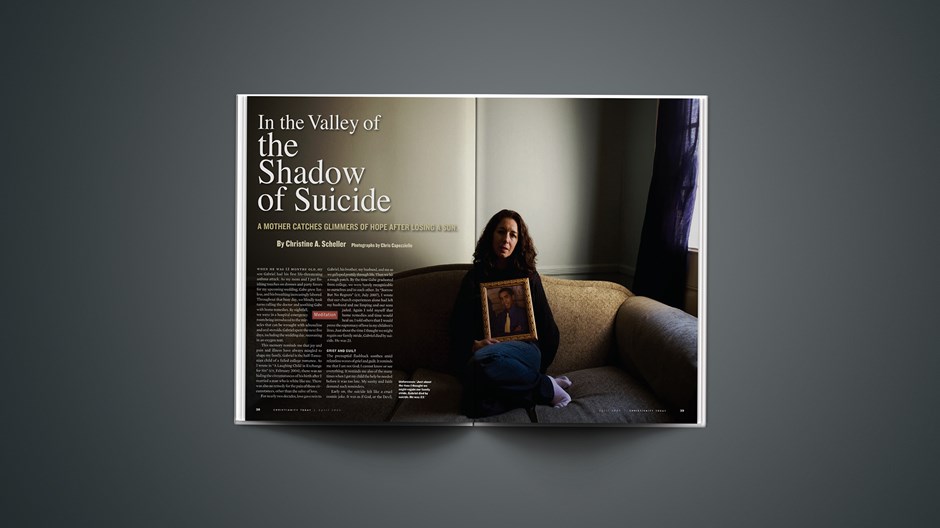
This memory reminds me that joy and pain and illness have always mingled to shape my family. Gabriel is the half-Tanzanian child of a failed college romance. As I wrote in "A Laughing Child in Exchange for Sin" (CT, February 2004), there was no hiding the circumstances of his birth after I married a man who is white like me. There was also no remedy for the pain of those circumstances, other than the salve of love.
For nearly two decades, love gave rein to Gabriel, his brother, my husband, and me as we galloped prettily through life. Then we hit a rough patch. By the time Gabe graduated from college, we were barely recognizable to ourselves and to each other. In "Sorrow But No Regrets" (CT, July 2007), I wrote that our church experiences alone had left my husband and me limping and our sons jaded. Again I told myself that home remedies and time would heal us; I told others that I would prove the supremacy of love in my children's lives. Just about the time I thought we might regain our family stride, Gabriel died by suicide. He was 23.
Grief and Guilt
The prenuptial flashback soothes amid relentless waves of grief and guilt. It reminds me that I am not God; I cannot know or see everything. It reminds me also of the many times when I got my child the help he needed before it was too late. My sanity and faith demand such reminders.
Early on, the suicide felt like a cruel cosmic joke. It was as if God, or the Devil, or some Job-like combination thereof, was mocking and toying with us. Had my husband and I not been devoted, if imperfect, parents? And what kind of awful irony was it that our boy with the sunny disposition, the one whose story embodied the pro-life message, would take his own life? Would his legacy be reduced to symbols of social stigma instead, in birth and in death? Had I not the previous day submitted a story about the Psychiatry and Spirituality Forum at the University of California-Irvine to a news outlet, my interest having been piqued by parental concern? I had even blogged about a forum lecture on suicide prevention. Surely I should have recognized the warning signs.
And yet I did not see what only God and Gabriel knew—that he was in such anguish, he saw no way out save death. All it took was a few final triggers, a good deal of alcohol (as is the case in many suicides), and easy access to means.
In a diabolic twist, those who exhibit the most pronounced warning signs of suicide tend to choose less lethal means, while those who act on impulse generally display fewer symptoms and employ deadly means—like firearms or jumping from a precipice. Less than 10 percent of suicide attempt survivors go on to take their own lives. For more than 90 percent, the crisis passes.
Shortly after the police came and went the night of Gabriel's death, I called not a pastor or a friend but Aaron Kheriaty, the psychiatrist who directs the Psychiatry and Spirituality Forum. He patiently assured us that Gabriel's death was not our fault, and gently but firmly insisted that the death would never make sense: suicide is inherently an irrational act. Kheriaty was a safe person to invite into our moment of horror, unlike some pastors who later described the suicide as an "unwise choice" and simple spiritual failure.
Kheriaty also spoke at Gabriel's funeral. His (recorded) homily produced a framework for my grief and provides rest for my mind amid ongoing battles with self-doubt.
We survivors replay final conversations with the deceased in our minds—like the one Gabriel had with a friend days before he died in which he made passing reference to the means he would employ. Or the one I had with him before he walked out the door that evening: "Gabe, honey," I had said. "What's going on? Your eyes look dead." He had simply shrugged, and I let him go.
It's possible that Gabriel was suffering from bipolar disorder. In An Unquiet Mind: A Memoir of Moods and Madness, Kay Redfield Jamison, Johns Hopkins University professor of psychiatry, describes her experience:
A floridly psychotic mania was followed, inevitably, by a long and lacerating, black, suicidal depression; it lasted more than a year and a half. From the time I woke up in the morning until the time I went to bed at night, I was unbearably miserable and seemingly incapable of any kind of joy or enthusiasm. Everything—every thought, word, movement—was an effort. Everything that once was sparkling was now flat. … The wretched, convoluted, and pathetically confused mass of gray worked only well enough to torment me with a dreary litany of my inadequacies and shortcomings in character, and to taunt me with the total, desperate hopelessness of it all … . Death and its kin were constant companions.
Article continues below
Gabe's written descriptions of himself and his depression are markedly similar to Jamison's, yet this inner reality was largely invisible to others.
Kheriaty explained, "For reasons that are quite beyond our comprehension, God allowed Gabriel to suffer a terrible illness [three, in fact: asthma, neurofibromatosis, and depression] … . Depression affects not just a person's moods and emotions; it also constricts a person's thinking, often to the point where the person feels entirely trapped and cannot see any way out of his mental suffering." Depression can "destroy a person's capacity to reason clearly" and "severely impair his sound judgment, such that someone suffering in this way is liable to do things that, when they are not depressed, they would never consider." He concluded: "Gabriel's death issued from an unsound mind that was afflicted by a devastating disorder."
Gabe, like nearly half of all college students, became depressed when he left home. Intermittently I had urged him to take advantage of the school's counseling services. In hindsight, I wish we had issued an ultimatum: "Get help or come home."
Only in the final weeks did his symptoms become increasingly pronounced. He became uncharacteristically withdrawn, jumpy, and irritable, such that his emotions seemed out of proportion to events. Overdraft and delinquency notices arrived in the mail almost daily. He wore dirty clothes to work, slept erratically, and displayed little appetite.
However, days before his death, Gabriel performed at a stand-up comedy club. On the day he died, he joked with coworkers and publicly professed his love for Jesus. Experts describe this contradiction as the "suicide calm" that sets in once someone has decided, finally, to end the mental torment. The vacant look I had noted in his eyes had been a function of both suicidal depression and detachment. In mind and spirit, he had already left us.
Coming to Terms
Suicide survivor literature is full of clichés for banishing guilt, such as, "If love could have saved your family member, they'd still be alive." It's a Band-Aid approach that helps in the short run but offers little lasting relief. I am convinced that Gabriel's death represents communal failure. His personal foundations had continually eroded over several years. Some of that erosion was his own fault; much of it was beyond his control. At the heart of my guilt is the fact that I was exhausted and distracted by ongoing trials. I wasn't there for him in the way he needed.
Article continues below
In Trauma and Recovery, Judith Herman writes,
Beyond the issues of shame and doubt, traumatized people struggle to arrive at a fair and reasonable assessment of their conduct, finding a balance between unrealistic guilt and denial of all moral responsibility. In coming to terms with issues of guilt, the survivor needs the help of others who are willing to recognize that a traumatic event has occurred, to suspend their preconceived judgments, and simply to bear witness to her tale. When others can listen without ascribing blame, the survivor can accept her own failure to live up to ideal standards at the moment of extremity. Ultimately, she can come to a realistic judgment of her conduct and a fair attribution of responsibility.
Survivors need time and space to come to a realistic self-assessment. I trust that for me, the crucible will forge a better person, and lead to peace.
Kheriaty closed his message with a meditation on the Prince of Peace.
On the cross and in his agony, our Lord suffered not just our physical afflictions, but our mental anguish as well. Out of the depths we cry to him, and he reaches down into our depths to raise us up with him. God knows the depth of our suffering. He knows our fragile heart. And Christ's own heart, a heart of flesh, a heart both human and divine, is merciful beyond measure. It is in this mercy that we place our hope. It is into these hands stretched out on the cross in a gesture of love that we entrust Gabriel.
Amen. When I think of all that Gabriel suffered in this life, I do not understand. I find it difficult to trust God or engage him with the intimacy I once enjoyed. And yet every day, I inhale moments of grace. I am immeasurably grateful for the privilege of being Gabriel's mother. By faith, I now see my serendipitous meeting with Aaron Kheriaty not as a cosmic joke, but as evidence of God's immanence.
As Gabriel was walking out the door of this life, I called out after him, "I love you." Love is as strong as death, wrote Solomon. The love of God is stronger.
Christine A. Scheller is a writer living in central New Jersey.
CT Classic: Suicide and the Silence of Scripture | Though the church has come to opposing conclusions about the fate of victims, we have a mandate to minister to those left behind. (July 6, 2000)
Is Suicide Unforgivable? | What is the biblical hope and comfort we can offer a suicide victim's family and friends? (July 6, 2000)
Have something to add about this? See something we missed? Share your feedback here.
Our digital archives are a work in progress. Let us know if corrections need to be made.
















 While we pray for peace, we need moral clarity about this war.
 A Christian reconciliation group in Israel and Palestine warned that war would come. Now the war threatens their relevance.españolالعربيةFrançais
 Christians can disciple each other toward action, prayer, and hope.






