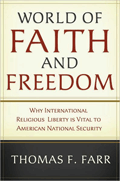
Religious-liberty wonk Thomas Farr is calling for some big changes. A longtime diplomat, Farr also served in the U.S. State Department under the last two ambassadors at large for religious freedom. In his new book, World of Faith and Freedom: Why International Religious Liberty is Vital to American National Security, and in a report he coauthored with Dennis Hoover, he looks at the execution of the 10-year-old International Religious Freedom Act (IRFA) and finds it lacking. U.S. policy has hardly improved religious freedom abroad, he says.
Kurt Donnelly, director of the State Department's Office of International Religious Freedom, calls Farr's report a "valuable contribution."
"In line with some of Farr and Hoover's recommendations, we have begun making better use of the tools of traditional diplomacy, and we are doing more with the tools of public diplomacy and with targeted assistance programs," Donnelly says.
What did Obama's remarks in Turkey tell you about his administration's approach to religious freedom? And what is the meaning of him pressing for Halki seminary to be reopened?
No speech by a President tells you everything you need to know about policy — or even most of what you need to know. Because speeches need to be followed by actions.
In 2002, Bush gave a fantastic speech in China. The content on religious freedom was excellent. At the time, I thought, this is money in the bank! What I hadn't accounted for was that there were very few tentacles between what the President had said in that speech and what the State Department and other officials were prepared to do on the issue of religious freedom in China.
On balance, I was impressed with [Obama's speech to the Turkish Parliament]. Halki seminary has been a staple of our human rights discussions with the Turks, going back to Ronald Reagan and probably Jimmy Carter. Usually it's in private, and to mention it before the Turkish Parliament in the way he did was pretty good. He indicated that this isn't the sole content of this problem of religious freedom in Turkey. If the Turks began to take action on this, it would be a very important sign.
I thought his Halki seminary comments were pretty good, along some of the other things [Obama] said about free expression and freedom of religion. If they are a sign of his administration and his State Department beginning to take very seriously this religion-state issue in Turkey, it's a good sign. But if it's a rhetorical flourish that disappears without further adieu, then that's standard practice, and not just for this administration.
You say in the report that U.S. religious freedom advocacy is ineffective.
The function of advancing religious freedom has never — and I say somewhat surprisingly [not] under the Bush administration — never been integrated into the broader foreign policy of the United States. This whole [IRFA] thing was a backwater, it was compartmentalized.
Both ambassadors, [Robert] Seiple and [John] Hanford, did some very good things. Because of their personal persistence, they both got people out of jail. I would guess that over ten years there are hundreds of people who are walking free because of their efforts.
But the rule is that we're not actually advancing religious freedom. We're cursing the darkness of persecution.
Does the law itself need to be changed?
I think the law is sufficiently flexible to incorporate everything I've been talking about. The problem is, it doesn't require what I've been talking about.
Most of what it requires has been done. That is the sort of negative annual list of Countries of Particular Concern (CPCs). Every year the State Department puts out the list of the bad guys and goes through this silly procedure of deciding whether it will take economic sanctions against a country.
I say it's silly because in 10 years, economic sanctions have only been taken against one country. That was Eritrea, three years ago. And things got worse.
China has been on the list every year since the first one. After Tiananmen Square, we put sanctions on crime control equipment — cattle prods and barbed wire. The IRFA says if you have existing sanctions on human rights violations, you can use those for IRFA purposes. So every year we rubberstamp an existing, empty, rhetorical sanction for China. The Chinese, who in the early years were intensely irritated by this public condemnation, are beginning to yawn about it.
That doesn't mean we're not doing anything else in China. There are some pretty good programs, but it's all ad hoc. The good things that are going on are happening because a person on the ground — an ambassador, or a Foreign Service Officer, or an NGO that's being funded from the United States, or a military unit — is just trying to solve the problem.
Those people are, in effect, advancing religious freedom, but we're failing across the board because we have no policy to do so. Ad-hoc [religious liberty diplomacy] just won't cut it both for justice reasons and because of the national security of the United States.
Article continues below
Does the current system have the manpower to take a more proactive approach?
I don't believe we have enough diplomats. I think every Secretary of State who ever lived would agree with that. We need more Foreign Service Officers. We need a larger diplomatic establishment.
I believe that this should not be the responsibility of one office in the State Department with one senior official. It needs to be integrated into everything that our foreign policy does.
If you ask people around the world what U.S. religious freedom stands for, it's cultural imperialism, or it's Zionism, or it's making the world safe for American missionaries — all negative. We have utterly failed to communicate anything sympathetically about our own religion-state victories which came out of great struggles.
We persecuted our own. Congregationalists tortured and hung Quakers on Boston commons in the 17th century. Then, a century later, we have this magnificent thing called the First Amendment. We still have discrimination after that. And yet, despite that struggle, we now have the most religiously pluralistic and vibrant culture in the world. All the people around the world hear the success story, but they don't hear us talking about the struggle.
There are obviously some tensions between the U.S. Commission on International Religious Freedom (USCIRF) and the State Department. Most recently, the State Department updated its list of CPCs for the first time in two years — but didn't tell USCIRF for months.
There was healthy tension when I was [in the State Department]. There has to be some disagreement between those agencies. But I think that's good when it's a good cop/bad cop thing. When the commission is harshly criticizing the State Department about its failure to take to task one country or another, the State Department, if it is wise, can use that to its advantage with country X.
To get to the point you were making, I think the commission should criticize the State Department strenuously for its failure to be on time with its CPCs.
However, they should also be pointing out that [the annual CPC announcement] is the only attention this policy gets. The content of our policy needs to have far more depth than this annual list and the discussion of what that means. The commission has by-and-large not done that.
Article continues below
Why should evangelicals pay attention to this discussion over religious freedom policy?
One, because they are interested in justice. Two, because they are interested in the fundamental interests of their country, especially national security. For me, the two come together in religious freedom.
In Afghanistan, the Taliban was a terrible religious persecutor. When we threw them out by force, of course religious freedom went down. But now it's creeping back up. We have all these problems because we never actually advanced religious freedom in Afghanistan.
What should we be watching for?
I'd invite your attention to whom the Secretary of State is going to name as her ambassador at large. I think this is terribly important. If it's someone who's brilliant and devoted to religious liberty but who doesn't know the first thing about foreign policy or the State Department, it would be very difficult to make a way in that building, let alone in the foreign policy establishment.
Secretary Clinton has named an ambassador at large for women's issues. I have no doubt she will work directly under Sen. Clinton. This ambassador at large for religious freedom has never been that elevated. From the very beginning, it was put under an assistant secretary [for human rights]. It's kind of like a general working for a colonel.
The premise of the [IRFA] bill back in 1998 is that this issue is not getting enough attention. Sticking [the ambassador at large] under that situation is a continuation of the problem that international religious freedom is bureaucratically and functionally buried.












 While we pray for peace, we need moral clarity about this war.
 A Christian reconciliation group in Israel and Palestine warned that war would come. Now the war threatens their relevance.العربيةFrançais
 Christian artists work at the intersection of music and climate change.





