Desiring the Kingdom: Worship, Worldview, and Cultural Formation (Cultural Liturgies)
Author
James K.A. Smith
Publisher
Baker Academic
Release Date
August 1, 2009
Pages
240
Price
14.29
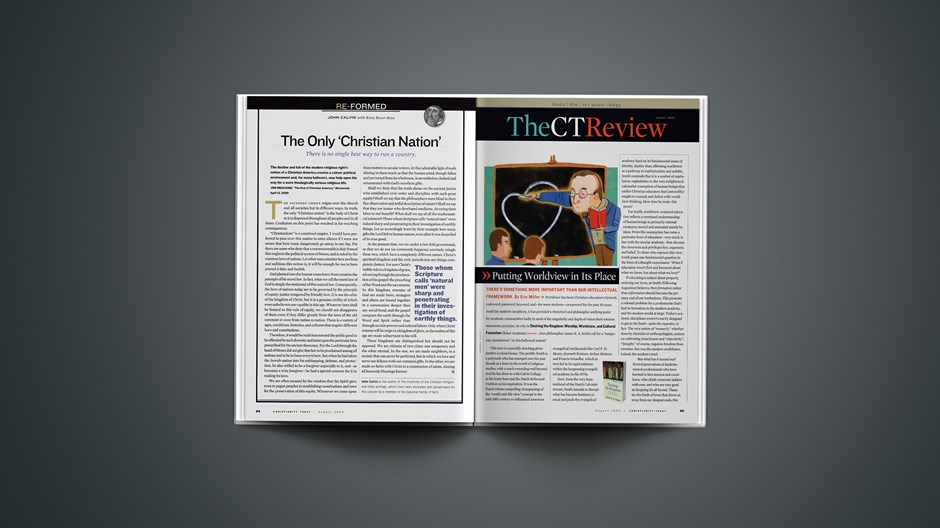
Worldview has been Christian education's byword, codeword, password, keyword, and—for some students—swearword for the past 30 years. Amid the modern cacophony, it has provided a rhetorical and philosophic unifying point for academic communities badly in need of the singularity and depth of vision their mission statements proclaim. So why in Desiring the Kingdom: Worship, Worldview, and Cultural Formation (Baker Academic) does philosopher James K. A. Smith call for a "temporary moratorium" on this hallowed notion?
This turn is especially shocking given Smith's ecclesial home. The prolific Smith is a polymath who has emerged over the past decade as a force in the world of religious studies, with a reach extending well beyond. And he has done so with Calvin College as his home base and the Dutch Reformed tradition as his inspiration. It was the Dutch whose compelling championing of the "world-and-life view" concept in the mid-20th century so influenced American evangelical intellectuals like Carl F. H. Henry, Kenneth Kantzer, Arthur Holmes, and Francis Schaeffer, which in turn led to its rapid embrace within the burgeoning evangelical academy in the 1970s.
Now, from the very fountainhead of the Dutch Calvinist stream, Smith intends to disrupt what has become business as usual and push the evangelical academy hard on its fundamental sense of identity. Rather than affirming worldview as a pathway to sophistication and solidity, Smith contends that it is a symbol of capitulation: capitulation to the very enlightened, rationalist conception of human beings that earlier Christian educators had (ostensibly) sought to unmask and defeat with worldview thinking. How does he make this move?
For Smith, worldview-centered education reflects a continued understanding of human beings as primarily rational creatures, moved and animated mainly by ideas. From this assumption has come a particular form of education—very much in line with the secular academy—that elevates the classroom and privileges fact, argument, and belief. To those who espouse this view, Smith poses one fundamental question in the form of a thought experiment: "What if education wasn't first and foremost about what we know, but about what we love?"
If educating is indeed about properly ordering our loves, as Smith (following Augustine) believes, then formation rather than information should become the primary end of our institutions. This presents a colossal problem for a professorate that's had its formation in the modern academy, and the modern world at large. Today's academic disciplines weren't exactly designed to get to the heart—quite the opposite, in fact. The very notion of "research," whether done by chemists or anthropologists, centers on cultivating detachment and "objectivity"; "thought," of course, requires freedom from emotion: this was the modern confidence, indeed, the modern creed.
But what has it turned out? Several generations of students-turned-professionals who have learned to love success and excellence, who climb corporate ladders with ease, and who are very good at shopping (in all forms). These are the kinds of loves that direct us away from our deepest ends; this is mis-education—missed education. And Christian institutions, Smith charges, have been complicit in this destructive, demonic project. "Could it be the case that learning a Christian perspective doesn't actually touch my desire, and that while I might be able to think about the world from a Christian perspective, at the end of the day I love not the kingdom of God but rather the kingdom of the market?"
Getting to the Heart
The kingdom of God requires a better shape and end. So what kind of schooling must we have? Smith urges an elemental shift in form from the "Christian university" to the "ecclesial college," the latter distinguished above all by an anthropology that understands that it's not the cognitive processing of information that fundamentally shapes our identities, but rather what and whom we worship. We are homo liturgicus: "desiring, imaginative animals," in Smith's formulation. "Humans are not primarily or for the most part thinkers, or even believers," he insists. "Instead, human persons—fundamentally and primordially—are lovers." And if churches are the places designed expressly to help us learn to love God, then it only follows that Christian colleges must be "intimately linked to the church and thus an extension of its practices."
Driving the book, in fact, is Smith's careful, charged case for intersecting practices, liturgies, and worship in the lives of all humans, whether they realize it or not. Christians, in his reading, do not introduce worship to the world so much as correct what is already everywhere going on, seeking to move our restless hearts from the mall or the state or the stadium back to the One for whom we were made. It follows that all of college life—from the curriculum to the classroom to the dorm—must strive to get to the heart.
Article continues below
What does this look like? Here, Smith's argument feels unfortunately incomplete, as he fails to take us deep enough into the terrain of the actual college campus. In what he considers the heart of the book (but actually feels something like a separate book), he leads the reader into a lengthy practice-by-practice description of the liturgy of Christian worship, from the call to worship through the Eucharist to the offering, describing its formative effects in a way intended to reveal the life-shaping, life-changing practices that must be woven into everyday educational life. It's meant to be a discussion that's descriptively thick, as in "rich," and in places it is. But often, it's thick like a milkshake: difficult to swallow and a little too sweet. Smith's hopefulness can come off as a touch pious and earnest; at times one is left wondering how reliable his sense is of our condition, circumstance, and prospect. We are, after all, a verifiably deplorable people, predictably resistant to the reformist impulses that govern Smith's lively, visionary imagination.
This quality of mind is, of course, also his great strength. To read Smith is to get a primer on contemporary theology and philosophy, though he's not a popularizer so much as an able, agile public scholar who collects and redirects. He sees his work as "an attempt to articulate the Reformed tradition as an Augustinian renewal movement within the church catholic," an admirable and altogether necessary way of conceiving of ecclesial differences in our atomizing age. His writing would become more affecting were he to foster a richer, more filial sense of our present connection to previous epochs, persons, and discourses, honoring the organic, earthy realities of our historical lineage and making more evident our debt to those we follow.
So, in the end, is Smith really out to take down worldview? Not really. "The goal," he writes, "is to push down through worldview to worship as the matrix from which a Christian worldview is born—and to consider what that means for the task of Christian education." If we are to be a peculiar people, we must be peculiarly formed. It adds up to a compelling case. Worldview-espousing administrators and faculty—and all who find themselves captive to the wrong loves—owe it to their progeny, not to say their Lord, to give Smith's sharp critique and holy vision a careful look.
Eric Miller, professor of history at Geneva College, Beaver Falls, Pennsylvania



















 While we pray for peace, we need moral clarity about this war.
 A Christian reconciliation group in Israel and Palestine warned that war would come. Now the war threatens their relevance.españolالعربيةFrançaisрусскийУкраїнська
 Beyoncé’s right. Whether listening to Cowboy Carter or reading theology, diversity is a good thing.






